Stop 8 of 8Must-see
Twenty years to take the retouching off
Where to stand
Outside, once the visit is over, with the painting still fresh in your eyes
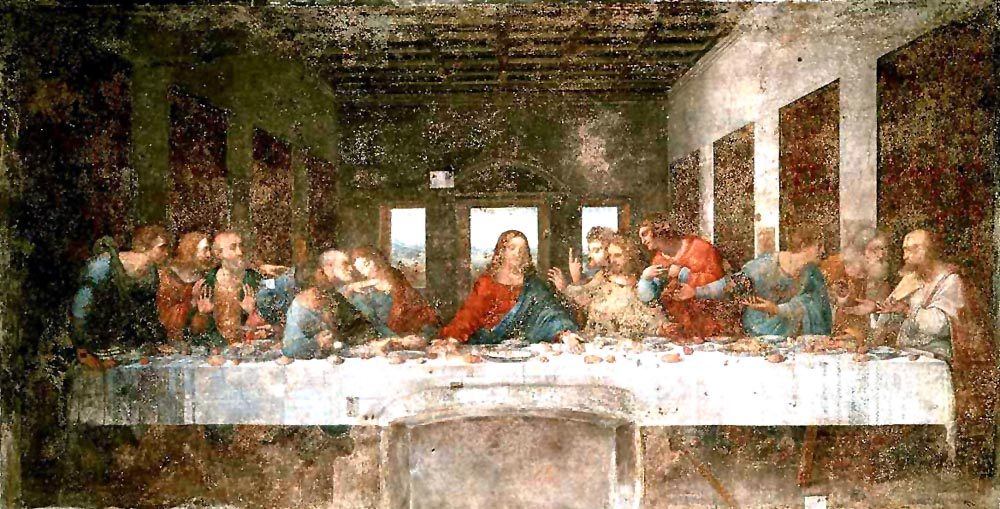
For centuries, restoring the Last Supper meant repainting it. Between the late 1970s and 1999 the restorer Pinin Brambilla Barcilon did the opposite: she took away, layer after layer, until she found Leonardo again.
Spot the detail
Think back to the colors: in some areas they were paler and flatter than elsewhere. Do you know why?
The full story
What you saw is not the painting your great-grandparents saw. Theirs was covered in retouching, and a good part of it was not by Leonardo.
Nine restorations are documented since the early 1700s, and for almost all that time restoring meant redoing. The first, in 1726, filled the gaps with oil paint and covered everything in varnish.
A few decades later another painter removed that work and started repainting the figures: he had redone nearly all the faces when protests stopped him. In the 1800s someone even tried to detach the painting from the wall, the way it is done with . He wrecked the central area and had to stick the pieces back on with glue.
Taking away instead of adding
In the late 1970s Pinin Brambilla Barcilon, a restorer, arrived. Her method was the opposite: don't add, take away. Piece by piece she removed the repainting, glues and varnishes built up over more than two centuries, to recover what was left of Leonardo underneath.
It took her more than twenty years. Leonardo had needed about four to paint it. The painting went back on view in 1999.
The result still divides opinion. Original parts that nobody had seen for centuries resurfaced, hidden under the old fills. But some scholars have criticized the work for the way it changed colors, tones and even the shape of certain faces. You decide which side you are on: you have just seen the painting.
The copy and the prevention
To get an idea of what the Supper looked like when it was new, there is a witness. It is the copy painted around 1520 by the painter Giampietrino, now in London, at the Royal Academy. It shows what the wall has lost, starting with Christ's feet. The restorers used it as a guide too.
Since 1999 the watchword has been prevention: filtered air, a climate monitored around the clock, a few people at a time. That is why you were only inside for fifteen minutes.
If you take away just one idea, make it this. You have looked at Leonardo with holes in him. The holes are part of the story: an intact painting would not have told you how hard it was to still have it.
About this stop
Record
Twenty years to restore, four to paint
Leonardo da Vinci took about four years to paint the Last Supper in the of the convent of Santa Maria delle Grazie. The latest restoration, completed in 1999, took more than twenty, five times as long, for a painted wall nearly nine meters wide, about 29 feet, and more than four meters high. The numbers say everything about how fragile the work is: nine documented restorations since the early 1700s, and traces of even older ones. Few paintings have been so cared for, retouched and argued over. And few ask their viewers to count the minutes: you stay in the room for fifteen, no more.
Less than we would like, but at last you can see it. Nine restorations are documented since the early 1700s, and for a long time restoring meant repainting. The latest campaign, which ended in 1999, removed those layers and recovered the original parts that had been hidden. Where the paint was lost, the gaps were filled in watercolor in muted tones, without pretending it was Leonardo.