Stop 6 of 7Must-see
The Rocchetta, the fortress within the fortress
Where to stand
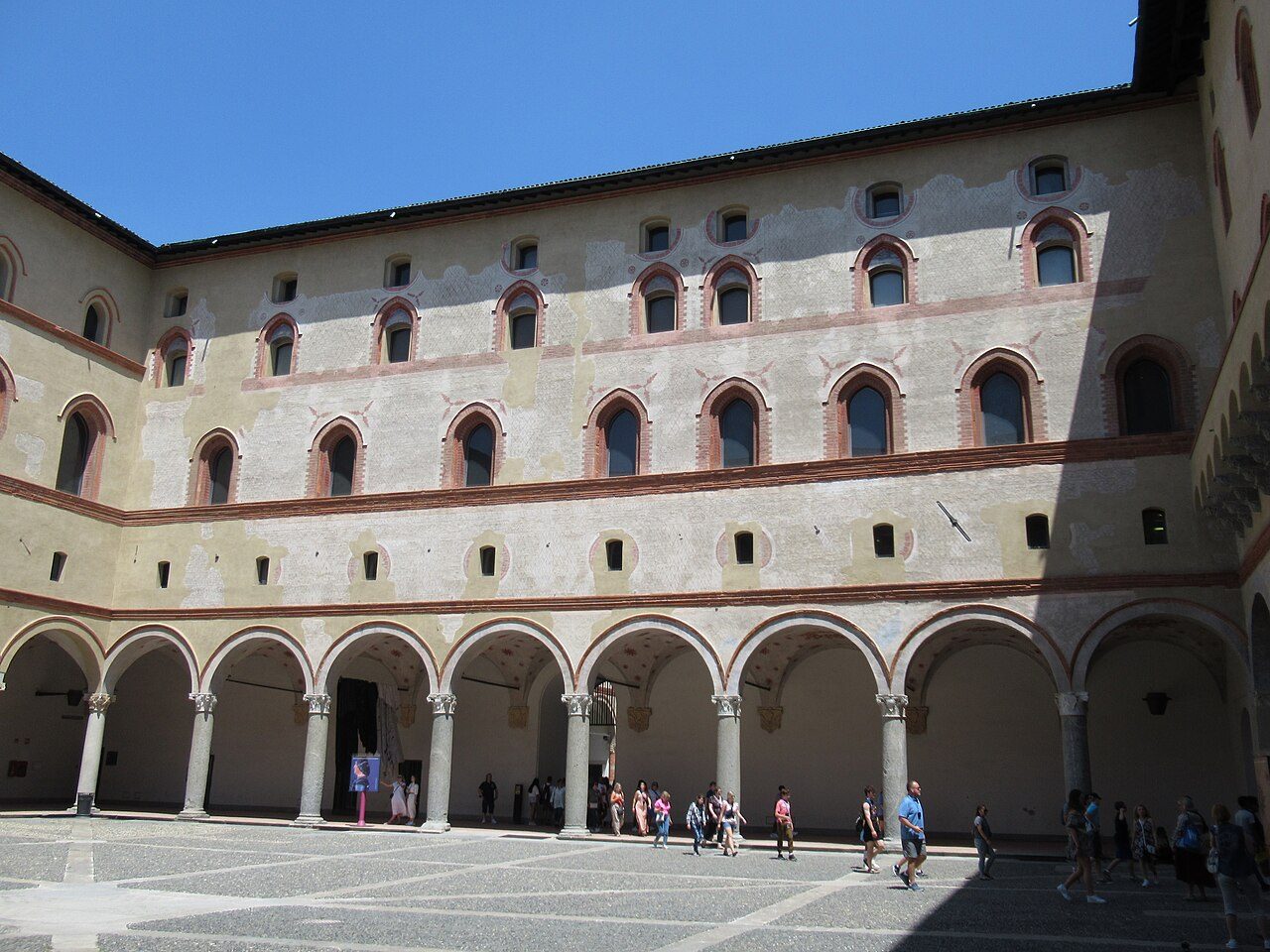
In the middle of the Rocchetta courtyard, between walls five stories high with porticoes on three sides
The last refuge of the Sforza: a closed courtyard, with the duchy's treasure watched over by a painted guardian. A place so secure that for a child duke it became a prison.
Spot the detail
The courtyard has four sides. Count the ones with a portico: which is missing, and why?
The full story
Walk in and look up. The walls rise five stories on every side and the sky becomes a square. After the elegance of the Corte Ducale, the dukes' courtyard, the air is different here. This is the Rocchetta, the inner stronghold of the Castello Sforzesco: the fortress within the fortress.
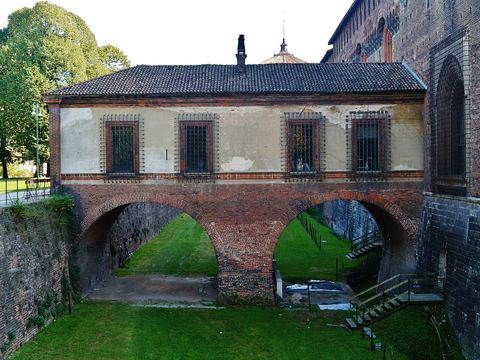
Every castle has a last refuge, the place you lock yourself into when everything else is lost. The Sforza had theirs a few steps from their rooms. Originally the only way in was a single over a moat.
And one detail says a lot. When Francesco Sforza, the first duke of the dynasty, began rebuilding the Castello, one of the first things finished was the Rocchetta's own tower, the Torre Castellana, in 1451. First the safe, then the house.
The Sala del Tesoro
A safe in the literal sense. On the ground floor of the tower is the Sala del Tesoro, the Treasure Room, where the dukes kept their riches. Getting in took three keys, used one after another, and they were held by three different people: the duke, the , and the chamberlain, a high court official.
Above the door, a fresco attributed to Bramante or Bramantino shows Argus, the guardian of myth who had a hundred eyes and closed only two at a time. A painted watchman who never sleeps. History had its irony, though: when the vault was rebuilt, Argus lost his head, eyes and all.
From refuge to prison
Then there is the other side of a place this secure. Where it is hard to get in, it is hard to get out.
After the assassination of Duke Galeazzo Maria Sforza, his widow, Bona di Savoia, ruled on behalf of their son Gian Galeazzo, still a child. It was she who wanted the tall tower that bears her name, right beside here. But in 1480 her brother-in-law, Ludovico il Moro, had the boy shut up in the Rocchetta itself, removed him from his mother's guardianship, and took over the government of the duchy. The family refuge became a gilded cage.
Now look at the porticoes. They run along three sides and were not built together: the last was added in Ludovico il Moro's time. Among the family emblems that recur around the Castello is one with a little dove and a motto in French, a bon droit, meaning by right. Tradition attributes it to the poet Petrarch.
By right. In a courtyard built by people who had taken power by force of arms, and who knew how quickly it can be lost.
About this stop
Anecdote
A Leonardo in exchange for a watch
The Rocchetta, the most closed-in courtyard of the Castello Sforzesco, is home to the Biblioteca Trivulziana, the Trivulzio family library. Among its treasures is a notebook by Leonardo da Vinci, the Codex Trivulzianus. Inside, between war machines and caricatures, run long columns of learned words: Leonardo copied them out to enrich his vocabulary. In the mid-1700s the notebook belonged to a man from Novara, Gaetano Caccia. The Milanese nobleman Carlo Trivulzio got it from him around 1750. In exchange he gave a silver watch, bought secondhand at that. He says so himself in a note attached to the codex. Perhaps the best deal ever struck in Milan.
This stop on the map
Next stop
Leave the Castello by the rear gate, toward the park, and follow the moat to the right, past the corner tower, to a small covered bridge