Stop 7 of 7
The Ponticella and Leonardo at il Moro's court
Where to stand
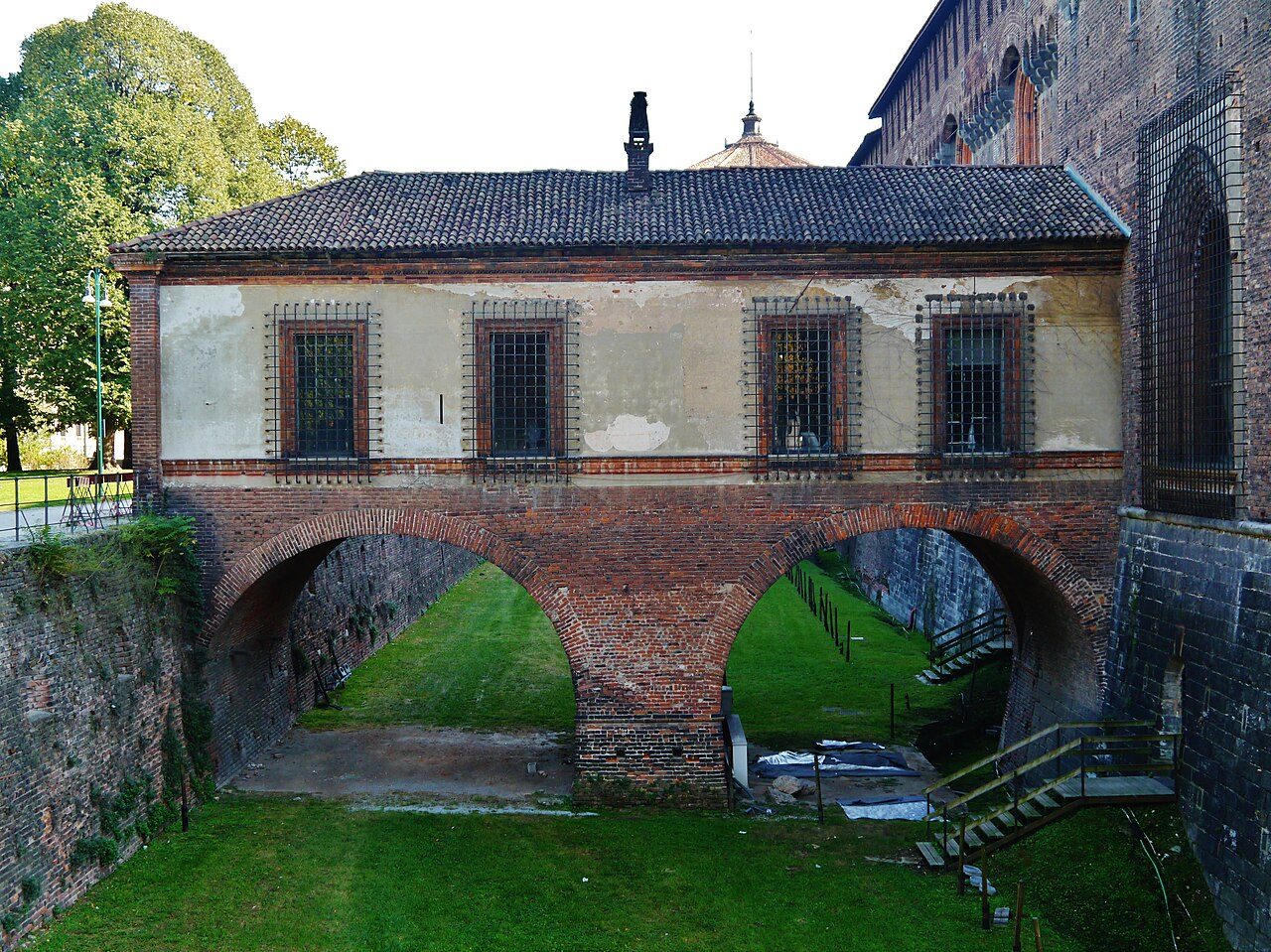
Outside the Castello, along the moat beside the Corte Ducale, facing the small bridge with the loggia
An elegant little bridge over the moat, attributed to Bramante, where Duke Ludovico il Moro shut himself away to mourn his wife. It is the right place to talk about Leonardo, the tunnels, and how the party ended.
Spot the detail
The bridge crosses the moat and finds nothing on the other side. What was it heading for?
The full story
In front of you, over the moat, is a small covered bridge with a long of slender columns. Amid so much wall it looks like a whim. This is the Ponticella, the little bridge of Ludovico il Moro, and this is where the dukes' Castello Sforzesco ends.
Ludovico Sforza, known as il Moro, duke of Milan at the end of the 1400s, had it built to link his rooms to the outer ring of walls. The design is attributed to Bramante, the architect working for him in those years, though there is no firm proof.
Inside are three tiny rooms. One is called the Saletta Negra, the little black room: according to the chronicles, il Moro shut himself in there to mourn his dearly loved wife, Beatrice d'Este. A line in Latin survives on a slab of black marble. Translated, it says roughly this: in the end, everything mortals had judged happy turns sad.
Leonardo at il Moro's court
Il Moro had reason to think so. His court was among the richest in Europe, and his most valuable man was Leonardo da Vinci.
In this Castello Leonardo painted several rooms of the ducal apartment and, in 1498, the Sala delle Asse, a pergola of mulberry trees covering walls and vault. He worked on a great equestrian monument to Francesco Sforza, the duke's father: he would never finish it, and it was French soldiers who destroyed it. And he drew. In one of his notebooks, the Codex Forster, there are sketches of tunnels under the Castello.
The tunnels under the Castello
For centuries those tunnels were half history, half legend. In 2024 the Politecnico di Milano, the city's technical university, went looking for them with ground-penetrating radar and laser scans. They really are there. They were mainly for the soldiers.
One, it is said, led all the way to Santa Maria delle Grazie, the church of the Last Supper, where the Sforza wanted their tombs. There is no proof, but it is hard not to believe it at least a little.
In 1499 the French arrived and il Moro fled. Leonardo noted, dryly: the duke lost his state, his possessions, and his freedom, and none of his works was finished for him.
Now turn toward the park. In il Moro's day it was the Barco, the dukes' hunting reserve. Napoleon made it a parade ground, the 1800s a garden. On this side the Castello still looks out of town, as it did the day it was built astride the walls.
About this stop
Legend
The secret passage to the Grazie
The story goes that a tunnel runs from the Castello Sforzesco all the way to Santa Maria delle Grazie, the church of the Last Supper, where the Sforza, dukes of Milan, wanted their family tombs. The duke could have reached it without being seen. What is certain are the drawings of tunnels Leonardo da Vinci left in the Codex Forster and the surveys of 2024, which used ground-penetrating radar and lasers to confirm a network of passages from the 1400s beneath the Castello. Whether one really reaches the church remains, for now, a hypothesis.