Stop 2 of 8Must-see
The Portal and Frescoes of Santa Margherita
Where to stand
At the start of the medieval section, on the ground floor: past the Romanesque portal, facing the frescoes with the three saints
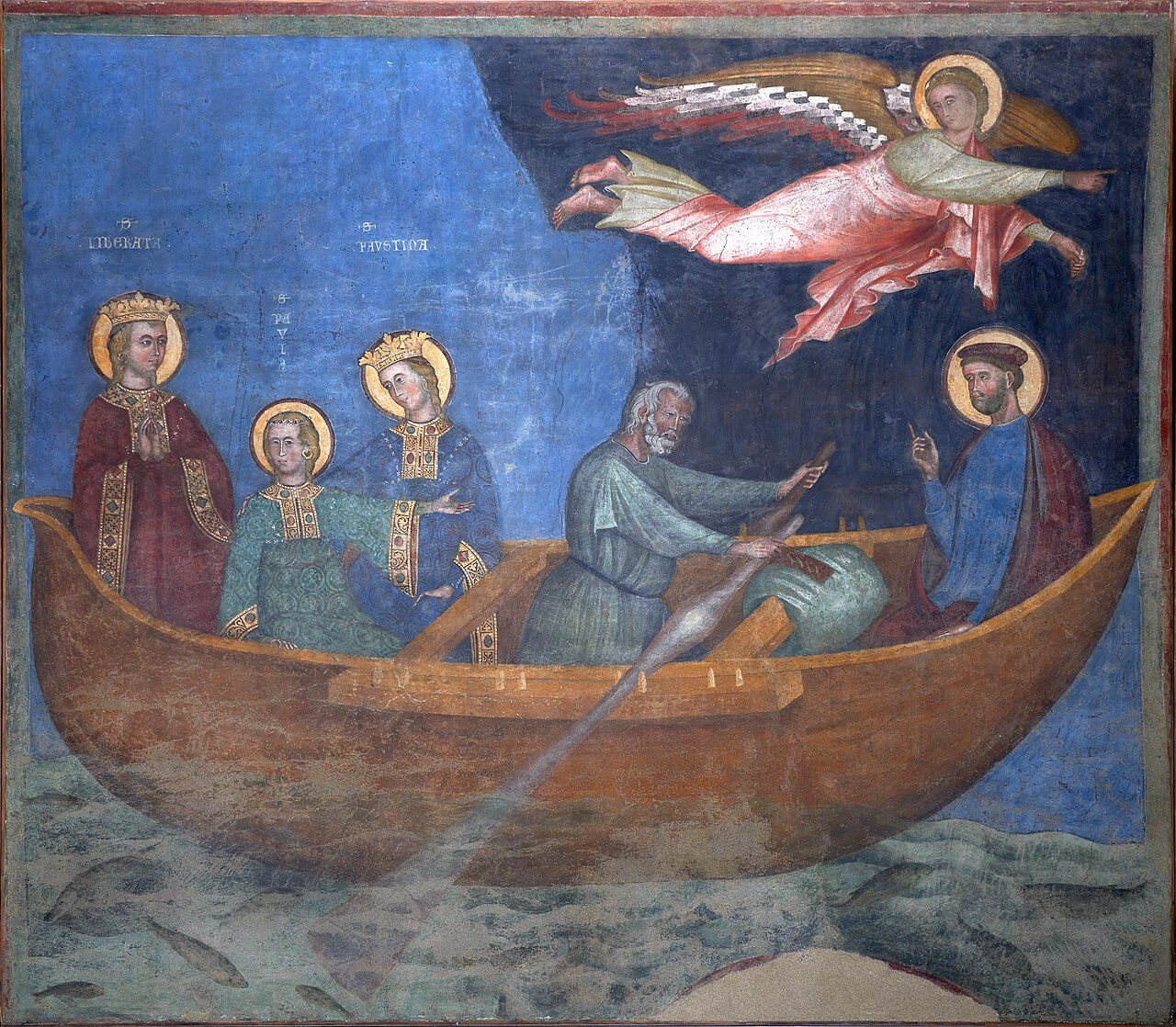
Five fourteenth-century scenes tell of the journey of Saints Liberata and Faustina to Como. They are a story in episodes, from the walls of a monastery that no longer exists. The museum grew up around them.
Spot the detail
The saints change clothes between one scene and the next: find the moment it happens
The full story
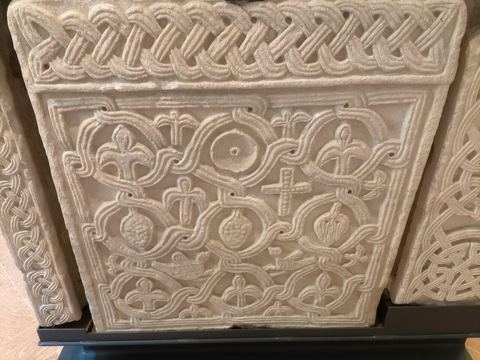
You enter the Middle Ages through a real door: the Romanesque portal of the church of Santa Margherita. The church is gone, and so is the Benedictine monastery it belonged to. What remains is this threshold and, right after it, the most precious thing of all: the frescoes.
A story in episodes
Stand in front of the scenes and read them like a story in episodes. The main characters are three women with halos, and beside them the painter wrote their names: Liberata, Paola, Faustina. In one scene they look down from the top of a ring of walls at a gentleman dying in his bed, mourned by two women.
Then they leave. They cross the Po River by boat, with a priest named Marcello, a boatman and an angel as their guide. They arrive beneath the walls of Como: a church and a tall tower rise behind.
Finally they present themselves at a monastery, where a group of nuns welcomes them. The last image is the monastery church itself, with three and its bell tower.
This is the legend of Saints Liberata and Faustina, painted for the nuns who lived in that monastery. The two saints were deeply venerated in Como: in 1317 their bodies were carried in a solemn ceremony to a place beneath the high altar of the Duomo, the cathedral. The frescoes came soon after, on the wave of that celebration.
A painter without a name
Nobody knows who painted them. Scholars call him the First Master of Santa Margherita, a name of convenience taken from these very scenes. He was a painter in step with his time: elegant Gothic figures with a trace of Byzantine stiffness, and buildings set at an angle to create depth.
Pietro Toesca, the art historian who studied them in 1912, years later saw in them an echo of the stories of Saint Francis in Assisi. He added, though, with a touch of malice, that the painter had little success in bringing his tale to life. Judge for yourself.
The scenes were from the walls in the nineteenth century. When Palazzo Volpi opened as a museum, the first section was built right around them. Everything you will see on the floors above came later.
About this stop
Legend
The Sisters Who Refused to Marry
In the fourteenth-century frescoes from Santa Margherita, on the Pinacoteca's ground floor, a gentleman dies in his bed, mourned by two women. Legend says it all starts there. Liberata and Faustina, a nobleman's daughters, see the widow's anguish and decide never to marry. Their father insists they take husbands. They cross the Po River and become nuns in Como. How much is history, nobody knows: the earliest record of the sisters dates from the 1200s, seven centuries after they are said to have lived. A curious fate for someone who refused marriage: in the folk tradition of northern Italy Liberata is invoked as the protector of women in childbirth.
Next stop
Carry on through the medieval rooms, among the carved marbles, as far as the reconstructed apses