Stop 2 of 8
The filandina
Where to stand
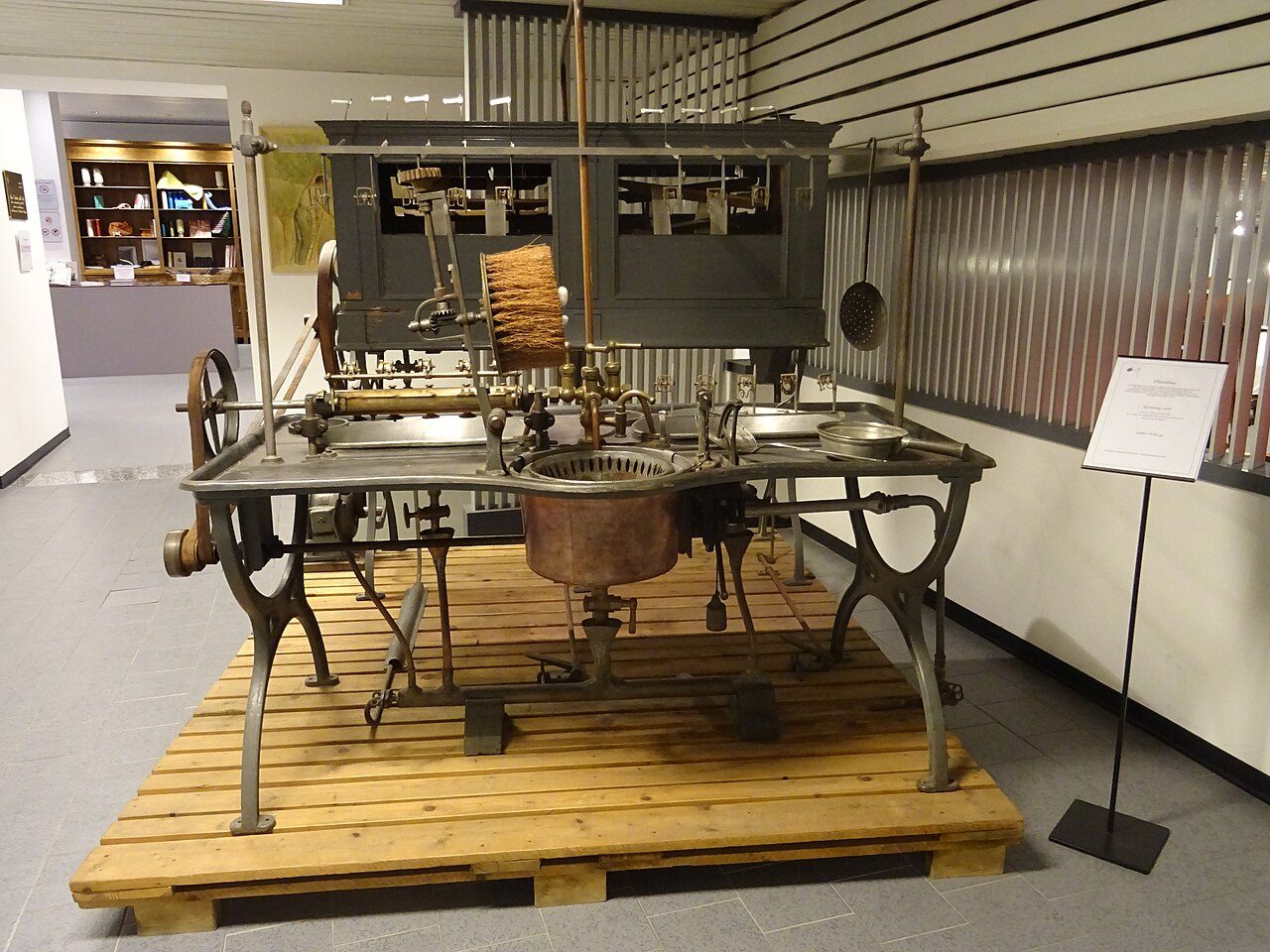
In front of the filandina, the machine with the basins and the big round brush
This is where the becomes thread. The operation is called and it was done in the filanda, the reeling mill, with hands in hot water. It was work for women and girls.
Spot the detail
The round brush above the basin: what was it for?
The full story
You have a and you know it is made of a single thread. The problem is finding where it begins. The machine in front of you does exactly that, and turns a caterpillar's thread into something that can be woven.
How the filandina works
The operation is called , and the machine is a filandina, a small reeling machine. Take it in order. There is one basin for brushing and two for the reeling itself. Behind them, a large box.
In the first basin the went into hot water, which softens the , the thread's natural glue. A brush made of plant fibers turned in the water and the end of the thread caught in its bristles. At that point the cocoon could be unwound.
A single thread, though, is too fine for any use. So seven of them, drawn from seven , were joined into one sturdier thread, which wound onto the reels in the box at the back and became a skein. The museum also gives a measure of the effort: about half a kilo of silk, roughly a pound, in eight hours of work.
Work in the reeling mill
Now picture the same machine repeated many times over, side by side. That was the filanda, the mill.
Almost all the workers were women and girls, for two reasons the museum states bluntly. They were paid less than men. And they had slim fingers and nimble hands, which is what you need when the thread snaps and has to be rejoined with a weaver's knot: a flat, nearly invisible knot, like the ones used on boats.
Ico Parisi's film
If you want to see those gestures in motion, the museum has a film that is worth the stop. It is called La seta di Ico, Ico's Silk, a documentary shot in the Como area between 1937 and 1939 by Ico Parisi, who later became a designer, with Pino Costamagna and Giovanni Galfetti.
It runs a little over half an hour and follows the whole production chain, from the fields to the sale, without hiding the child labor or the lives of the mill women. Some scenes show machines now on display in these rooms.
The silk that leaves here is not yet soft or shiny. That comes later, in the dye works. First it has to learn to be strong.
About this stop
In culture
Ico Parisi's lost film on silk
At the Museo della Seta, Como's silk museum, a dedicated room shows a film long believed lost. Between 1937 and 1939 Ico Parisi, barely past twenty and later a successful designer, shoots a documentary on silk in the Como area with Pino Costamagna and Giovanni Galfetti: thirty-three minutes that follow the production chain from the fields to the sale, without hiding the children's work or the women's toil. Then the film vanishes. In the mid-1990s the silk entrepreneur Michele Canepa gives the museum a copy on videotape. In 2021 the museum began restoring and digitizing it.
Anecdote
The cooked hands of the reeling women
Facing the filandina, the machine at the Museo della Seta, Como's silk museum, look at the basin and think of hands. The reeling women, who unwound the , kept theirs in hot water all day, close to boiling where they sought the thread's end. The newspaper Corriere del Ticino reported what Olga Ceppi, among the last reeling women of Switzerland's Canton Ticino, told a 1989 television documentary. She spoke in dialect: hands were cooked, like a chicken cooked too long, after fourteen or fifteen hours in water. A Lombard mill song is harsher: el mestè de la filanda l'è el mestè degli assassini, a trade for murderers.
A lot, and all in one piece. The museum speaks of an unbroken thread two kilometers long; other sources give anything from a few hundred meters to a kilometer and a half. But it is so fine that on its own it is useless: in the mill seven were joined to make a workable thread. And the yield was low. A filandina like the one on display produced about half a kilo of silk in eight hours of work. That helps explain why silk has always been a luxury fabric.
The museum gives two reasons, and the first is the less noble one: they were paid less than men. The second is technical. Rejoining a broken thread with a weaver's knot, flat and nearly invisible, took slim fingers and nimble hands. Raising silkworms, which was done at home, also fell to women and children. The documentary shot in the Como area in the late 1930s by Ico Parisi, which the museum screens, highlights exactly this: child labor and the role of women, inside and outside the home.
Next stop
Look for the big wooden machine full of bobbins: that is the torcitoio