Stop 3 of 8Must-see
The torcitoio
Where to stand
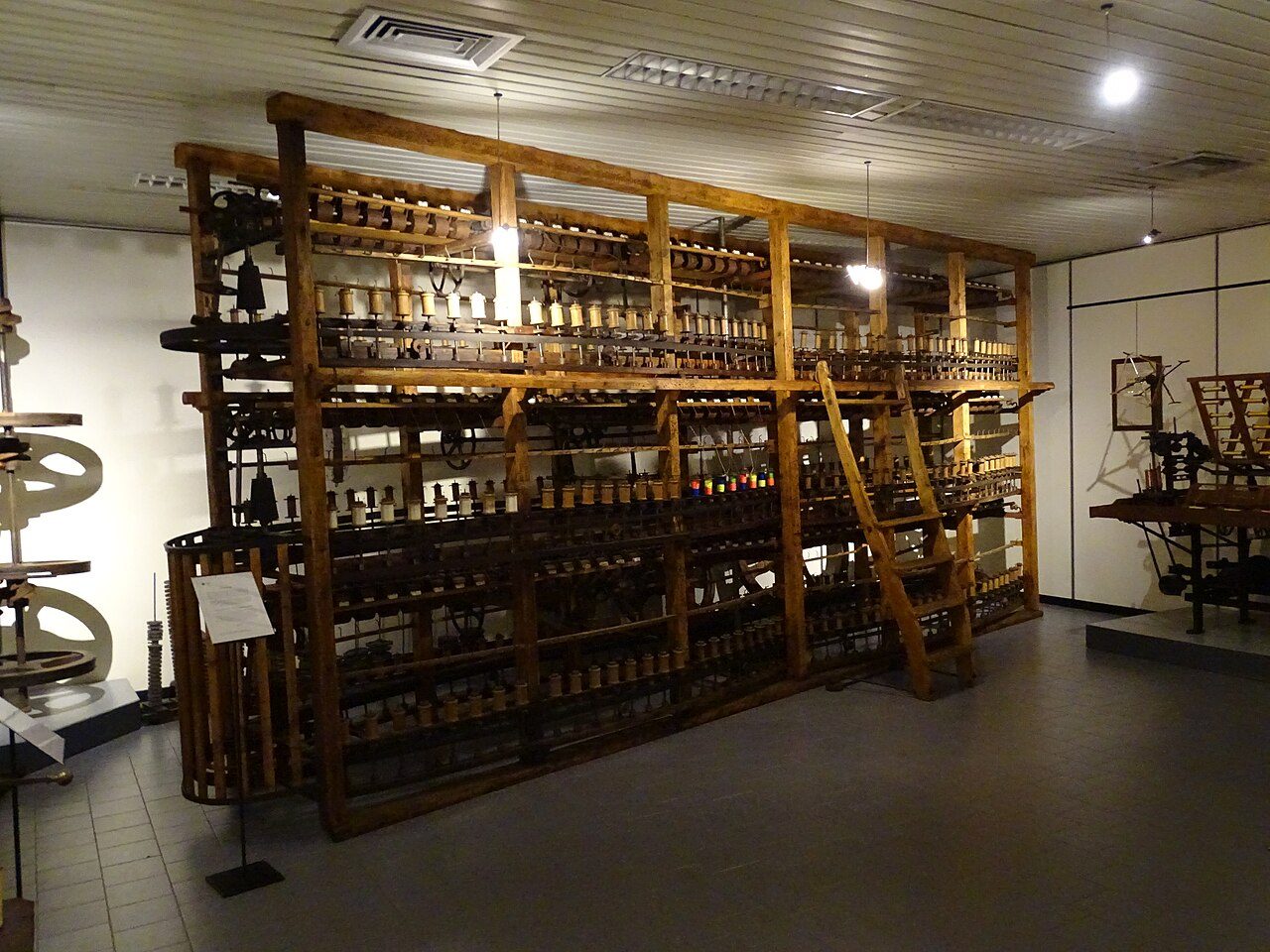
In front of the torcitoio, the big multi-level wooden structure full of bobbins
A wooden machine from 1870 that twists hundreds of threads at once. Without twist, silk thread frays apart; with the right twist it becomes a strong yarn, softer or shinier depending on how it is worked.
Spot the detail
Count the levels of bobbins, from the bottom up
The full story
This is the most theatrical piece in the museum, and if you like wooden machines you may be here a while. It is called a torcitoio, a machine, and what it does is easy to say: it twists the thread on itself.
What the twist is for
Why bother? The thread that comes out of the mill is a bundle of extremely fine filaments. , as the twisting of silk is called, binds them tightly to one another and stops them from separating: the thread gains cohesion and strength.
There is more. By changing the number of twists, or by twisting together threads that are already twisted, you get different yarns, softer or shinier. Much of a fabric's character is decided here, before it ever reaches the loom.
How the machine is built
Look at how it is built. The bobbins are arranged on three levels, called valichi, and there are 288 of them. They all turned together, driven by water.
The model has a name that sounds like a joke, piantello a pancia in fuori, roughly a frame with its belly sticking out, and you can recognize it by its double-bellied structure, unlike the circular shape of traditional machines. It dates from 1870.
A much older idea
The idea, though, is far older. Originally silk was twisted by hand. In the Middle Ages, in the Tuscan city of Lucca, a machine was developed that could work many threads at the same time, and it was later connected to a waterwheel.
That is why the torcitoio is also called a silk mill. According to tradition it was a merchant from Lucca, Bolognino di Borghesano, who brought the craft to Bologna in the 1300s.
Before it got here the thread went through the winding machine, which transferred it from skeins to bobbins. The winding machine ended up connected to a waterwheel too: the torcitoio went through bobbins in huge quantities and somebody had to keep up.
After came steam. Damp heat slightly softens the , the thread's natural glue, which then dries, sticks the coils together and sets the twist.
Keep the water in mind. The museum stands in a district where, from the mid-1800s to the early 1900s, textile firms clustered to harness the power of the Cosia stream. A machine like this explains why. No running water, no yarn.
About this stop
In culture
Renzo, the most famous silk spinner
In front of the machine at the Museo della Seta, Como's silk museum, think of Renzo Tramaglino, the hero of Alessandro Manzoni's novel I promessi sposi, The Betrothed: he is the best-known silk worker in Italian literature. Renzo is a silk spinner, a profession, Manzoni writes, hereditary, so to speak, in his family. The novel, set in the 1600s on the other branch of Lake Como, describes it as a once very profitable trade now in decline, so much so that many workers were emigrating to neighboring states. Renzo also has a small plot of land, which he farms when the mill is idle.
Anecdote
The English spy and the silk mill
The torcitoio, the machine at the Museo della Seta, Como's silk museum, is heir to an Italian machine, the silk mill, which in the early 1700s was at the center of an industrial espionage case. An earlier mill in Derby, England, had failed. John Lombe, who had worked there, went to Piedmont and returned with machine drawings and some Italian workers. A few years later a five-story mill rose in Derby, seen as an ancestor of the modern factory. Lombe died in 1722. By a tradition recorded almost seventy years later by William Hutton, a Derby historian, a woman sent from Italy poisoned him. There is no proof.
Next stop
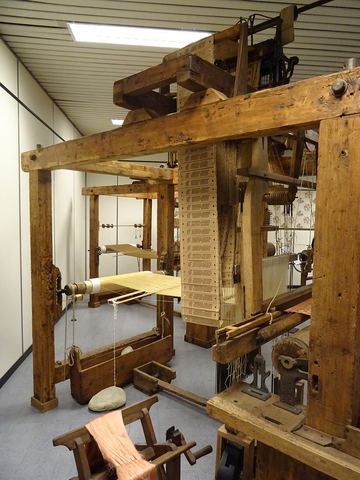
Head for the wooden looms, in the section on weaving