Stop 4 of 8Must-see
The chapel of the Magi
Where to stand
In the right arm of the transept, at the end of the right aisle, in front of the great stone sarcophagus
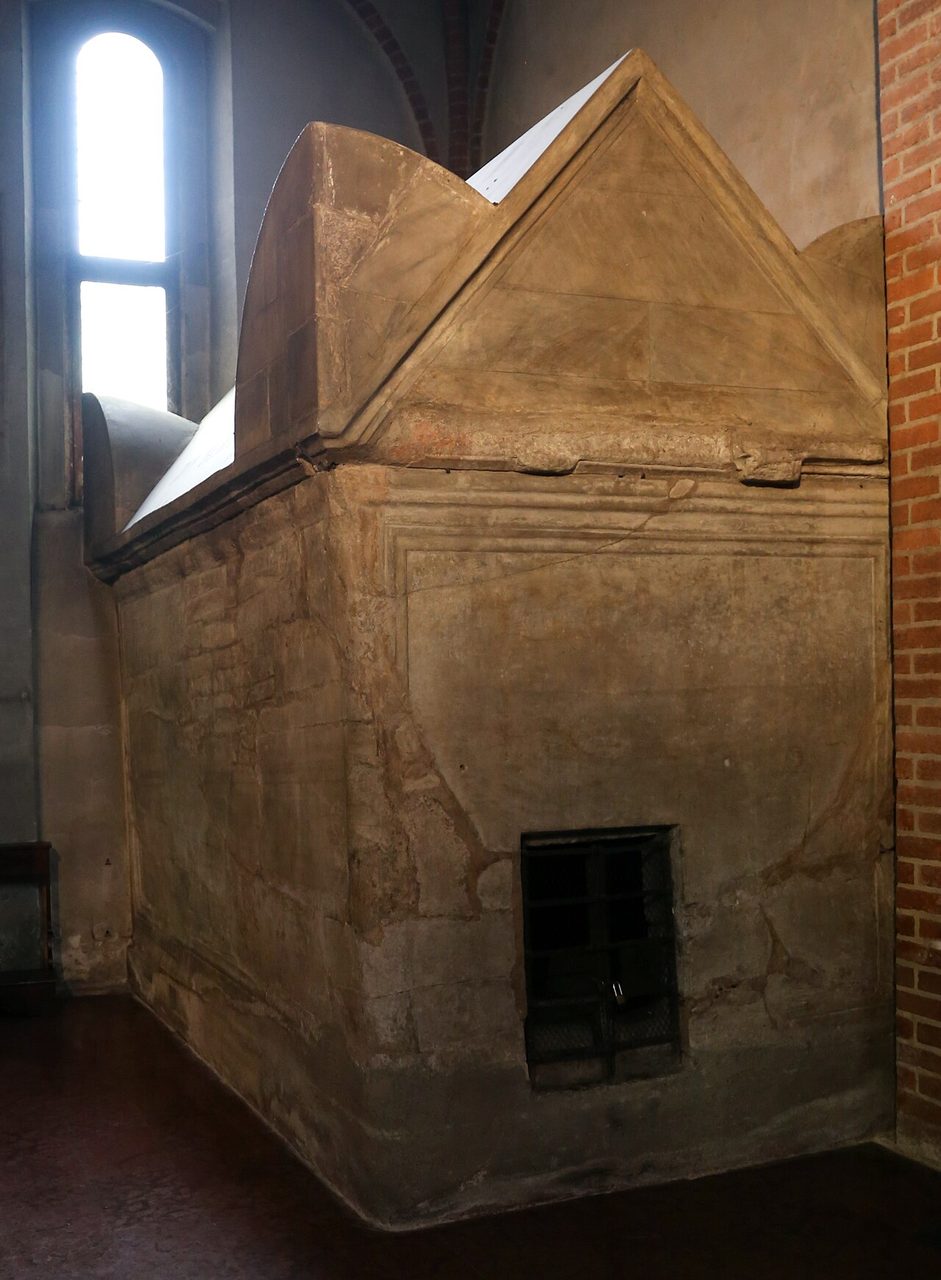
A huge Roman sarcophagus, empty, with a star on its lid. According to tradition it held the bodies of the Magi, the Three Kings, until they left for Cologne in 1164. A few fragments came back in 1904.
Spot the detail
The sarcophagus is almost completely plain. Find the only decoration on its lid
The full story
Here it is, the reason this church exists. It is a Roman sarcophagus of stone, big and bare, set in the , the arm that cuts across the church.
According to tradition, the bodies of the three Magi lay inside it, the wise men who came from the East to worship the infant Jesus. Helena, the mother of the emperor Constantine, is said to have found them and had them taken to Constantinople. From there, in the 4th century, they are said to have reached Milan with the bishop Eustorgio.
It has to be said that the story first appears in writing only in the 12th century, eight hundred years later. But in the Middle Ages nobody doubted it, and like these were worth more than a treasure.
The theft of 1164
Nobody knew that better than Frederick Barbarossa, the German emperor at war with Milan. When the threat drew near, the Milanese hid the Magi inside the walls, in the church of San Giorgio al Palazzo. It was not enough.
In 1162 the city fell and was destroyed. Two years later Rainald of Dassel, archbishop of Cologne and the emperor's right-hand man, carried the bodies off. They have been in Cologne Cathedral ever since, inside a golden reliquary shaped like a small church.
Milan was left with the sarcophagus, empty.
What came back
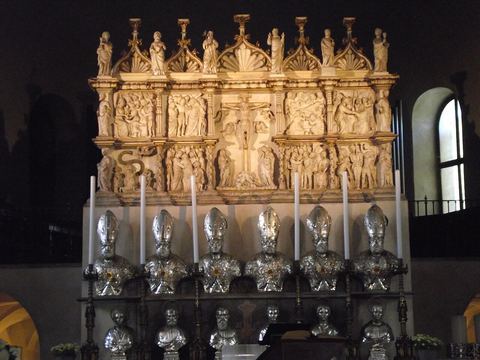
The Milanese asked for their Magi back for centuries, to no avail. Only at the start of the 20th century did Cardinal Andrea Ferrari, archbishop of Milan, obtain a few bone fragments from Cologne, which returned to the basilica in 1904. They are in the reliquary inside the niche above the chapel's altar.
On the same altar, look at the 14th-century marble triptych: three pointed scenes that tell the journey of the Magi. In the center is the adoration of the Child. At the sides, the angel warning the three kings and their meeting with Herod.
High up, above the entrance to the chapel, a Lombard painter of the late 15th century painted the Adoration of the Magi one more time.
An empty sarcophagus, when you think about it, is a strange thing to venerate. And yet every January 6 a procession in costume crosses Milan to come all the way here.
About this stop
In culture
In Cologne, a cathedral for the Magi
The basilica of Sant'Eustorgio keeps an empty Roman sarcophagus: tradition says it held the bodies of the three Magi. In 1164 Rainald of Dassel, archbishop of Cologne, carried them off, and those changed the face of another city. They arrived in Cologne on July 23. To hold them, the goldsmith Nicholas of Verdun built a reliquary of gold, silver and precious stones shaped like a small church, more than two meters long. It was in all likelihood the Magi that pushed Cologne, in 1248, to begin its great Gothic cathedral. The bones are still there, apart from a few fragments returned to Milan in the early 20th century.
Legend
The Magi's Epiphany procession
Every January 6 the three Magi return to the basilica of Sant'Eustorgio, which according to tradition held their bodies until 1164. A procession of costumed players sets out from Piazza del Duomo, crosses the center and stops at the basilica of San Lorenzo, where Herod waits with his escort. Then it reaches the forecourt of Sant'Eustorgio, to offer gold, frankincense and myrrh. The tradition is traced back to 1336. It was suspended at the time of the plague by Carlo Borromeo, archbishop of Milan, and revived in the 20th century by Archbishop Giovanni Battista Montini, the future Pope Paul VI.
In culture
The Magi in Umberto Eco's novel
The basilica of Sant'Eustorgio keeps the sarcophagus that tradition says held the bodies of the three Magi, taken to Cologne in 1164. The writer Umberto Eco made it an episode of Baudolino, his 2000 novel. The hero is a country boy adopted by the emperor Frederick Barbarossa, and a gifted liar. In the novel, in a Milan defeated by the emperor, the bodies of the Magi are “found” in Sant'Eustorgio, and it is Baudolino who sends them to Cologne. So begins his career as a maker of fake . It is fiction. But one fact is true: before the 12th century no known text speaks of Magi buried in Milan.
Nobody can prove it. That their bodies came to Milan with the bishop Eustorgio is a tradition put in writing only in the 12th century, and there are no older sources. What is history is the effect. The Milanese believed it, so did the Germans, and in 1164 those bones were carried off to Cologne as the most precious of spoils. There they stayed, and there they are venerated to this day.
A few fragments. For centuries Milan asked for its Magi back and got nothing. In 1903 Cardinal Andrea Ferrari, the city's archbishop, obtained a small share of the bones from the archbishop of Cologne, including a tibia and a vertebra. They returned to the basilica the following year. They are not in the great sarcophagus, which is empty, but in a 20th-century reliquary, in the niche above the altar of the chapel of the Magi.
Next stop
Head back toward the center of the church and stand in front of the high altar