Stop 5 of 8
The high altar and the ancona of the Passion
Where to stand
In the center of the church, in front of the presbytery, facing the great marble relief on the altar
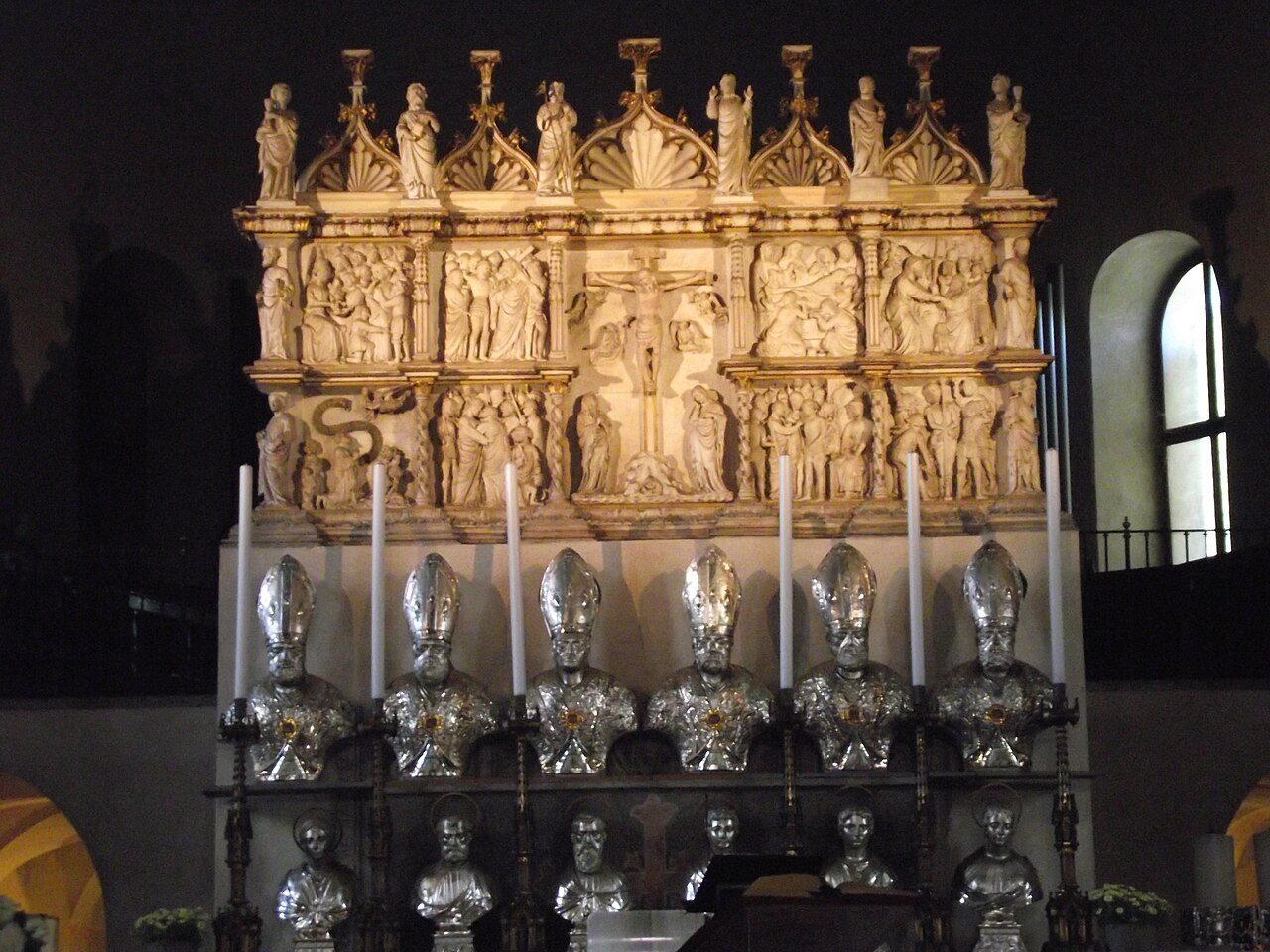
The altar is dominated by a great marble relief commissioned by Gian Galeazzo Visconti, duke of Milan. Under the altar table rests the bishop Eustorgio, and behind the altar the remains of the oldest church come to the surface.
Spot the detail
The ancona has nine panels, but one is twice as tall as the others. Which scene does it hold?
The full story
You are in front of the , the area around the altar. The great marble relief that dominates it is an , a large altarpiece, here carved instead of painted.
It was commissioned by Gian Galeazzo Visconti, duke of Milan, and carved between the last years of the 14th century and the first of the 15th. A few years earlier the same Gian Galeazzo had set the building of the Duomo in motion. To Sant'Eustorgio, the church where his family had its tombs, he left this.
Nine scenes in marble
The tells the Passion of Christ in nine panels, and it reads like a story in frames. It starts at the bottom left, with the prayer in the garden and the kiss of Judas. It goes on with the trials and the flagellation, and ends with the burial and the descent into Limbo.
In the center, larger than everything else, is the Crucifixion. Along the top runs a row of small statues of apostles.
It is not the work of a single hand: in all likelihood three different sculptors worked on it. The best is Jacopino da Tradate, to whom the two most successful scenes are attributed. Get as close as you can and try to pick them out by the quality of the faces.
Under and behind the altar
Now look down. Under the altar table is a 13th-century sarcophagus with the remains of Saint Eustorgio, the bishop of the legend, and of two other saints, Magno and Onorato.
Eustorgio, according to tradition, had founded this church for his Magi. He is still here. They, as you know, are not.
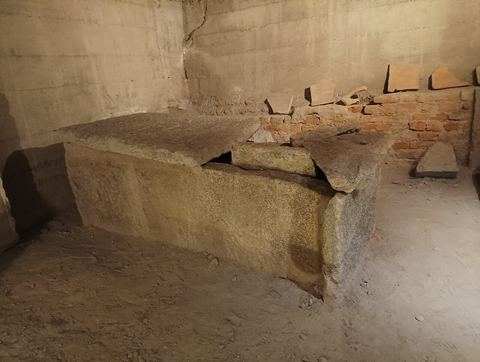
Then look beyond the altar. Behind it, below floor level, you can see the remains of an early Christian basilica, one from the first centuries of Christianity. It is the church that stood here before the one you are walking in.
Within a few meters you have three layers of history. Under your feet the church of the origins, under the altar table the bishop of the 4th century, above it all the marble of the Visconti.
Next stop
Leave the nave and make for the basilica's museum, in the rooms of the former convent: the route passes through the excavations under the church