Stop 6 of 8
The early Christian cemetery
Where to stand
On the route through the basilica's museum, in the excavations under the nave, in front of the tombs and gravestones
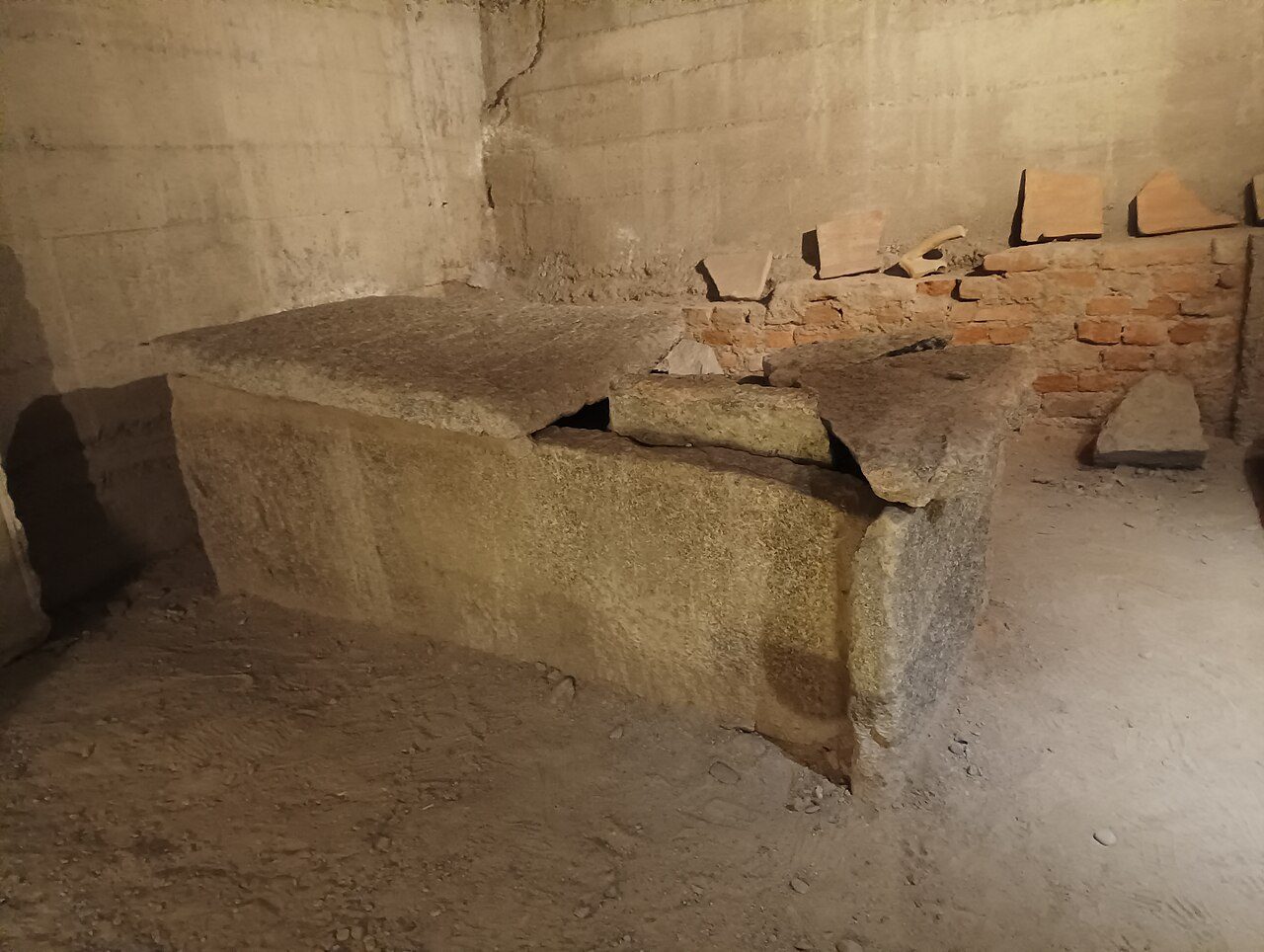
Under the church floor lies the cemetery where it all began: tombs from the 3rd century onward, excavated between 1959 and 1962. The gravestones show that Christians were being buried here as early as the 4th century.
Spot the detail
Find the slab engraved with a standing man, his arms raised. What shape is the clasp of his cloak?
The full story
Down here you go back sixteen centuries. What you have around you is a piece of the necropolis that filled this area in the last centuries of the Roman age, outside the walls of Milan.
One thing is clear at once: the basilica grew up among the tombs, and not the other way around. The legend speaks of a cart that stops. The excavations speak of a cemetery that was already there.
Three ways to be buried
The burials are not all alike, because the cemetery was used for a long time and in several phases.
- The oldest, from the 3rd and 4th centuries, are alla cappuccina tombs: the body is covered by roof tiles leaned against each other, like a small roof.
- Those from the 5th century are box tombs.
- The last traces reach the 7th and 8th centuries.
That makes about five hundred years of burials in the same ground.
The stones that speak
What tells us who these dead were is the engraved slabs. Those from the 4th and 5th centuries prove that by then the cemetery was Christian.
One commemorates a certain Victorinus, and can be dated precisely to 377. His trade, so to speak, was exorcist, which in the early Church was a recognized office. Another, the most famous, is the slab of the orant, with a man praying with his arms raised.
Found by chance, repeatedly
The cemetery has resurfaced in pieces over the centuries. A few tombs came to light as early as the Middle Ages, in chance digs. In 1764, when an old pier was removed, a burial turned up with coins of a son of the emperor Constantine.
Another son of Constantine was Constans, the emperor who, according to tradition, gave the Magi to Eustorgio. The coins do not prove the legend. But the period is the right one.
The real excavation was carried out between 1959 and 1962, under the nave. Scholars, it has to be said, have still not worked out how these tombs relate to the remains of the ancient church you saw behind the altar. The basilica still has something to tell.
Next stop
Continue along the museum route to the sacristy: from there you enter the Cappella Portinari