Stop 2 of 8Must-see
Two churches in one
Where to stand
Just inside, a few steps from the door, looking straight at the big painted wall at the end of the hall
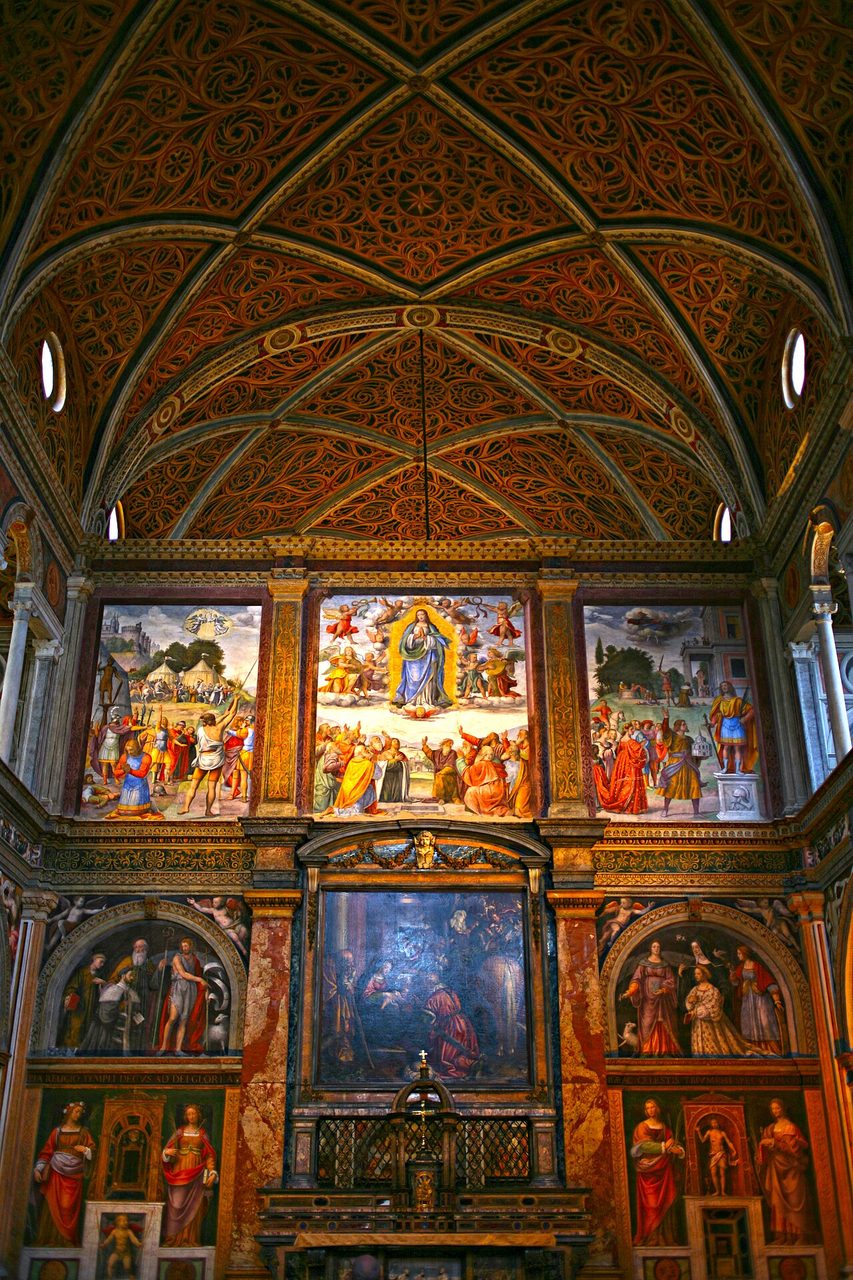
The wall in front of you is not the end of the church: it is a border. On this side the people of Milan prayed, on the other the nuns, who followed Mass without being seen. The space behind it is bigger than the one you are standing in.
Spot the detail
At the center of the wall, above the altar, is the only painting that is not a fresco. What is it doing there?
The full story
Forget the colors for a moment and look at the shape of the room. It is a single hall, with no side aisles, and it ends soon. Too soon, for a church this ambitious.
The reason is the wall in front of you: it is not an end wall, it is a , a partition. It cuts the building from one side to the other, and behind it the church goes on, for a stretch longer than the one you are in.
The public here, the nuns there
San Maurizio is a double church. This half, facing the street, was for the public. The other belonged to the Benedictine nuns, who from the mid-1400s lived in : they did not go out and did not show themselves to anyone. But they still had to attend Mass.
The solution was to build two halls, one behind the other, with Mass celebrated only on this side. The priest stood at this altar. The nuns listened from the other side, through a large opening closed by a grille, right above the altar. Their floor is about half a meter higher than yours, a foot and a half, to help them follow.
Carlo Borromeo reduces the grille
For a few decades the opening filled the whole central arch. Then came Carlo Borromeo, archbishop of Milan and a leading figure of the Counter-Reformation, who took seriously. In 1577 he had the grille reduced, and where there had been empty space the big canvas with the Magi appeared. What the nuns had left was mostly listening.
The passages that let you through to the other side today date from the nineteenth century, when the monastery no longer existed. For three centuries the congregation never saw the other half, and the nuns never set foot in this one.
The idea caught on: the same plan turns up in other convent churches built later.
Keep it in mind for the whole visit, because it explains everything. Nothing here was painted for just any audience. On this side they painted to be admired by the city. On the other, to accompany the prayers of women who would never go out again.
About this stop
In culture
Caravaggio's teacher by the door
Before you leave the public hall of San Maurizio, turn toward the entrance. On either side of the door are four scenes painted between 1572 and 1573 by Simone Peterzano, a painter from a Bergamo family who had recently arrived from Venice and presented himself as a pupil of Titian. On one side are stories of devoted sons, with the return of the prodigal son. On the other are stories of anger, with Christ driving the merchants from the temple. About ten years later a boy named Michelangelo Merisi entered Peterzano's workshop. The world knows him as Caravaggio.
Anecdote
The Last Supper, copied down the street
In the public hall of San Maurizio, in the chapel of the Deposition on the left side, look at the two groups of apostles painted on the side walls. The gestures will seem familiar: they are taken faithfully from Leonardo's Last Supper, which is not far from here, in Santa Maria delle Grazie. They were painted in the second half of the 1500s by Aurelio Luini and his brother Giovan Pietro, who got the apostles up on their feet. Aurelio was a devotee of Leonardo: according to the writer Lomazzo he owned a little book of his caricatures, heads of old men and deformed peasants laughing.
Anecdote
Thirteen apostles: count them
In the public hall of San Maurizio, look up at the center of the dividing wall, high up, above the large canvas with the Magi. The Virgin rises to heaven among angels playing music, and below her the apostles stretch out their arms. Count them: there are thirteen. One too many, and not by oversight. Scholars think a saint was added on purpose, perhaps Saint Paul, probably at the wish of whoever was paying. A second detail: the wall is almost all by the painter Bernardino Luini, but most scholars do not believe this central scene is his. The hand is less sure, and they suspect a workshop assistant.
At first yes, fairly well: a large grille filled the whole arch above the altar, and the floor of their hall was built about half a meter higher precisely to help them. In 1577 Carlo Borromeo, archbishop of Milan, had the opening reduced to make stricter, and soon afterward the arch was closed with a large canvas. From then on the nuns could mostly listen. For communion and for adoring the consecrated host there were still two small openings in the wall, which you can see from their side.
Next stop
Walk up to the dividing wall as far as the altar and look at the figures painted on either side of it