Stop 4 of 8Must-see
Oldrado, the Podestà on Horseback
Where to stand
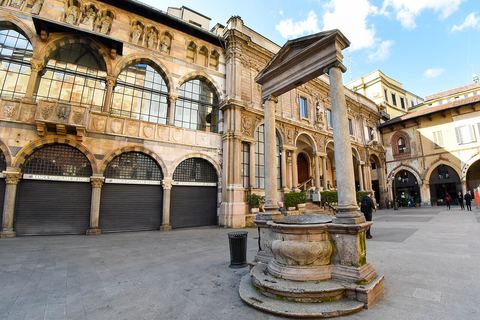
In the square, facing the long side of Palazzo della Ragione, looking up at the middle of the facade
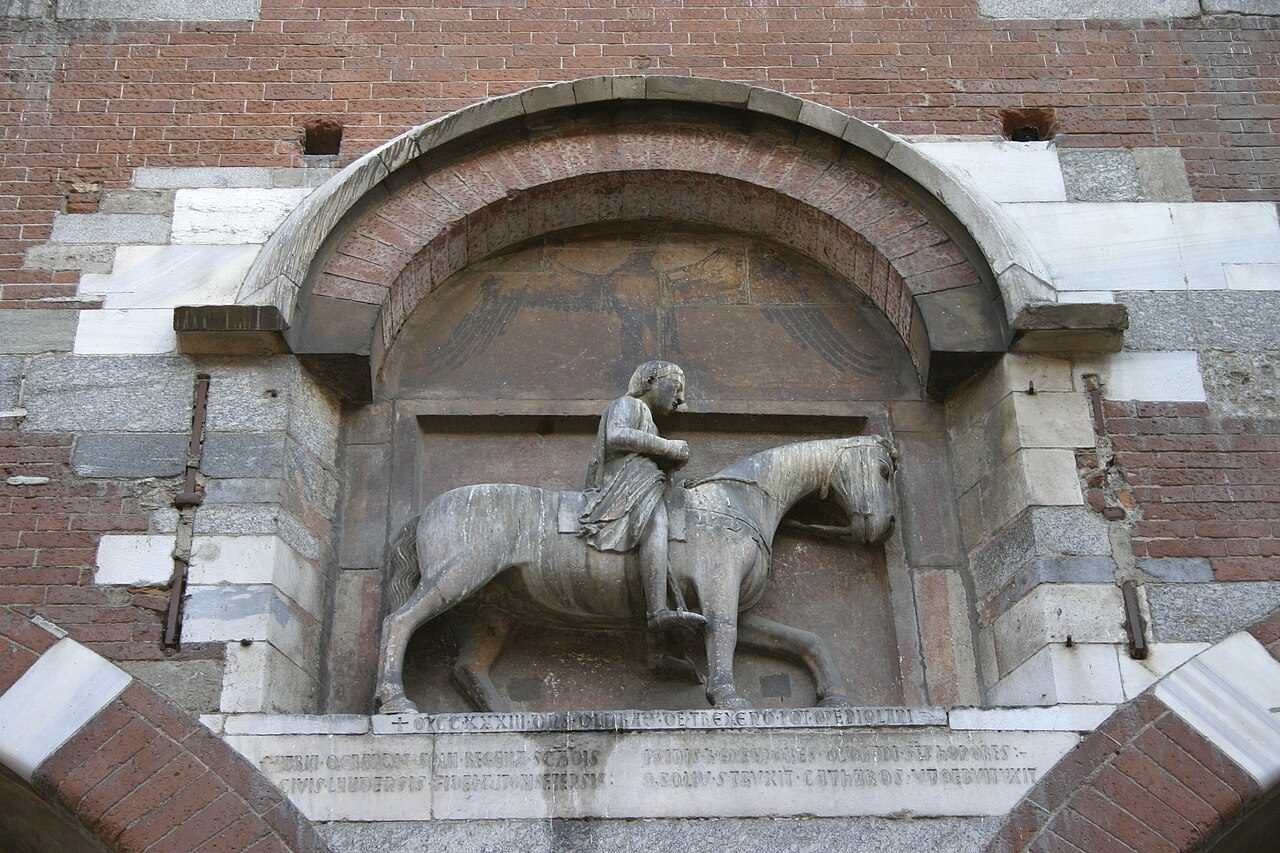
A marble horseman in a niche: Oldrado da Tresseno, the under whom the palace was finished in 1233. It is one of the first great equestrian monuments of the Middle Ages, and its inscription boasts of a burning.
Spot the detail
Look at the rider's right hand, closed in a fist on the saddle. What's missing?
The full story
Look up at the middle of the facade. In a niche of colored marble a man rides forward, slowly, his head slightly bowed. He is not a saint and he is not a king. He is an official: Oldrado da Tresseno, of Milan.
The was an outsider called in to govern the city for a year. Oldrado came from Lodi and held office from June 1233 to May of the following year. In those months the palace was finished, and someone decided to mark the fact this way.
A horse after centuries
Today an equestrian statue surprises no one. In 1233 it did: this is one of the first great horseback monuments of the Middle Ages, and it looks openly to those of the ancients. The sculptor has no certain name. He worked in the style of Benedetto Antelami, the master active in Parma.
Look at the details. Oldrado wears no armor, just rich civilian clothes, and his head is bare. The horse moves at a parade walk. Behind him, on the back of the niche, is a large painted eagle with its wings spread. Originally the background was red, with gold stars.
The inscription people argue about
Beneath the statue run a few lines of Latin verse. They ask the passerby to remember the merits of Oldrado, citizen of Lodi, defender and sword of the faith, who built the palace. Then comes the closing line:
catharos ut debuit uxit
It means: he burned the , as he was bound to. The Cathars were Christians whom the Church condemned as heretics. A law of Emperor Frederick II prescribed the stake for them, and in September 1233 Oldrado applied it. It is jarring to read that as a badge of honor on the front of a town hall.
Not everyone liked the statue either, for that matter. A century later the chronicler Galvano Fiamma dismissed it like this: a great vituperium, a disgrace. Today's scholars are more cautious. More than the man, they say, that horseman celebrated the office: the as guardian of justice.
About this stop
Anecdote
The statue of Oldrado that caused a scandal
On the facade of Palazzo della Ragione, in Piazza Mercanti, rides a statue of Oldrado da Tresseno, the who governed Milan when the palace was finished in 1233. The first written verdict on it is a hatchet job. About a hundred years later, the Dominican friar Galvano Fiamma notes in his chronicle that the podestà was carved in marble. And he adds: quod fuit magnum vituperium, which was a great disgrace. Whether that was his opinion alone or a widespread grumble, historians cannot say. But the phrase shaped the monument's reputation for centuries, as the whim of a man who chose to celebrate himself.
Anecdote
The marble horseman who was once in color
On the facade of Palazzo della Ragione, in Piazza Mercanti, a marble horseman sits in a niche: Oldrado da Tresseno, of Milan in 1233. Today he is the color of stone, but he was once painted. Recent restorations found many traces of paint: the back of the niche was bright red, scattered with gold stars, and the eagle behind him had a yellow-orange beak and feet. The horse was brown, the saddle the color of leather. Scholars also noticed a hole in the right hand: it held an object, in all likelihood a sword, the symbol of justice. Today that closed fist grips thin air.
Because the top floor is not medieval. In 1773 Empress Maria Theresa of Austria had the palace raised to house the notaries' archive. The architect Francesco Croce added a story with large oval windows, in the taste of his day. In the 1970s, when the archive was moved out, there was a debate about demolishing the addition to bring back the 13th-century look. The idea of keeping it prevailed, championed by the architect Marco Dezzi Bardeschi, who went on to oversee the refurbishment of the palace.
They were Christians belonging to a movement that the Church of the day condemned as heresy, and that was active in Lombardy too. In 1224 a law of Emperor Frederick II laid down burning at the stake as the penalty for heretics. In September 1233 the Oldrado applied it in Milan, in the presence of the Dominican friar Pietro da Verona, later venerated as Saint Peter Martyr. The inscription under the statue records it with the words "as he was bound to": for some scholars a boast, for others the formula of an official duty.
Next stop
Turn around and walk to the well with the two columns, in the middle of the square