Stop 5 of 8
The Well and the Square of Sentences
Where to stand
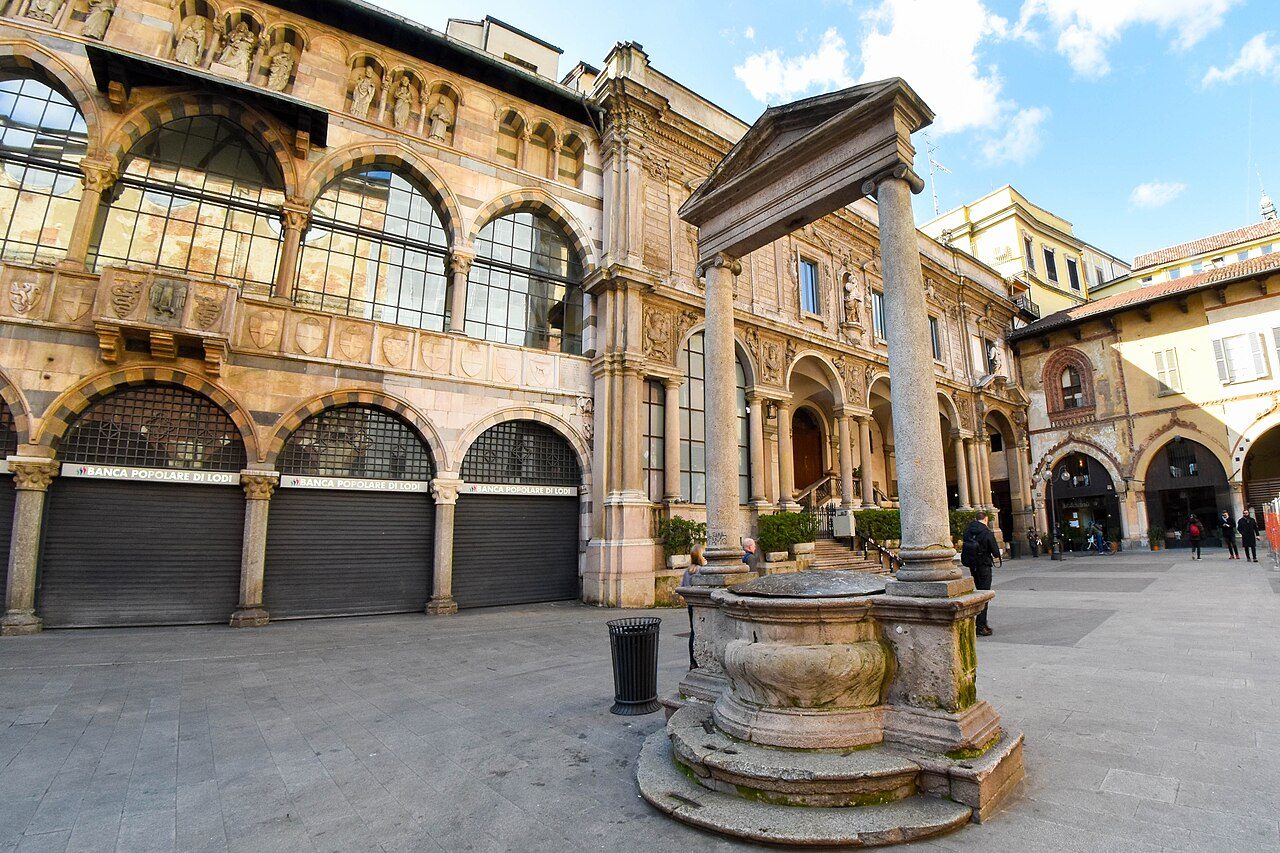
In the middle of the square, beside the well with the two columns
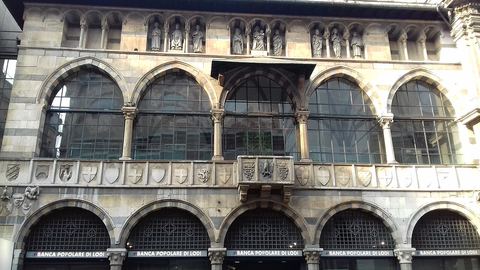
From the center you see the whole square: the palace, the loggia, the schools, the notaries' house. Here proclamations were read, convicts were put on display and, tradition says, bankrupts were humiliated.
Spot the detail
The well is made of two parts from different periods. Can you tell them apart?
The full story
Stand beside the well and turn all the way around. On one side the palace of the Comune, Milan's medieval city government, opposite it the loggia of the sentences, and then the schools and the notaries' house. Four buildings, four different centuries. This is the right spot to understand what the place was for.
The well dates from the 1500s. The two columns that rise above it, with their lintel, were added in the 1700s.
The square as a megaphone
In the Middle Ages, whatever mattered was said here. On the palace steps the grida, the public proclamations, were read out and sentences were posted. Here death sentences were carried out and the guilty were put in the pillory. Shaming portraits were even painted of people who had failed to show up for trial, until the practice was banned.
Debtors passed through here too. Anyone who could not pay was declared insolvent in public, in front of everyone. Milanese tradition is blunter: it tells of a "bankrupts' stone," on which the ruined had to show themselves bare-bottomed. Where the stone stood, the sources do not agree. Some put it right here, where the well is now.
In a city of merchants, going bust was not a private matter. It was a show.
After the judges, the fair
When the Comune moved out, the square was left to the Milanese. Until the end of the 1800s it hosted the Oh bej! Oh bej! fair, one of the best loved in the city.
And there is a chapter few people remember. In 1943 bombs destroyed La Rinascente, the department store on Piazza del Duomo. For a few years, while it waited to be rebuilt, its temporary home was here, in some of the rooms of Palazzo della Ragione.
Today this is one of the quietest corners of the center. Hard to believe that for centuries it was the loudest.
About this stop
Legend
The bankrupts' stone
According to tradition, in the middle of Piazza Mercanti, where the well stands today, there was once a large stone: the bankrupts' stone. Anyone who had been ruined and could not pay his creditors had to show himself to the crowd there, bare-bottomed. The details change from one telling to the next, and so does the exact spot where the stone stood. This much is certain: in this square insolvent debtors really were declared so in public, on the steps of Palazzo della Ragione, the town hall, where proclamations were also read and sentences posted.
Next stop
Walk up to the black-and-white striped loggia, opposite Palazzo della Ragione