Stop 2 of 6Must-see
The Darsena
Where to stand
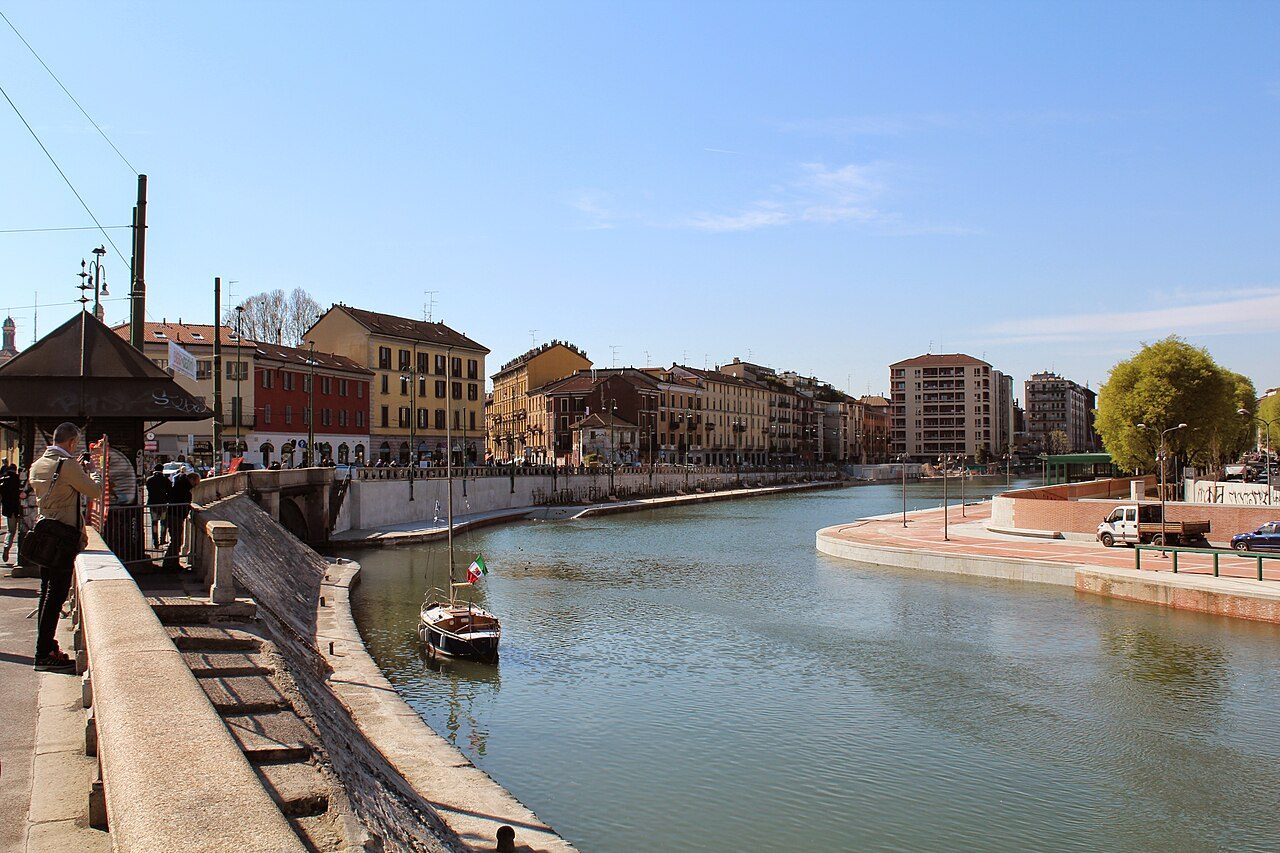
At the edge of the Darsena, at a spot where you can see the basin along its whole length
A port dug inside the city in 1603 by the Spanish governor. For nearly four centuries it took in barges, in the end loaded mostly with sand. The last one came in in 1979. Since 2015 the basin has been open water again.
Spot the detail
The shape of the basin: it isn't straight, it bends slightly. Ask yourself why
The full story
In front of you is a port without a sea. This is the , the dock of Milan, and the shape gives it away: a long, narrow basin, about 750 meters by 25, roughly 2,500 feet end to end, and barely a meter and a half deep. It's not a lake and it's not a river. It's a machine for getting boats into the city.
From pond to port
First there was a pond, the pond of Sant'Eustorgio, where the Grande, the great canal from the Ticino river, was already emptying its water in the Middle Ages. In 1603 the Count of Fuentes, the Spanish governor of Milan, turned it into a real port and set it against the city walls. That's why the basin is long and slightly curved: it traces a fortification that no longer exists.
It worked as a junction. Water comes in from the Grande and leaves by the Naviglio Pavese, the canal to Pavia. In between, the boats moored, unloaded and set off again. The loads were shifted by porters, who by tradition came from the Blenio Valley, in the Swiss canton of Ticino.
The port of sand
The numbers are startling. In the 1930s about seventy barges a day came in here: traffic that, according to the most often quoted figures, beat that of seaports like Bari, Brindisi or Messina.
After the war the still ranked among Italy's leading ports by weight of goods. The credit went to a single cargo: sand to rebuild the city. Cranes piled it on the bank in dunes that everyone called the sabbioni, the big sands.
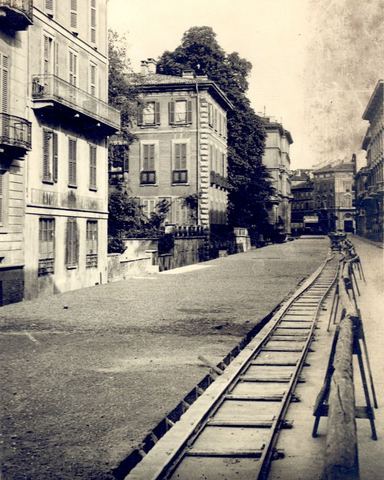
Then the traffic died away. At the end of March 1979 the last barge came in, loaded with sand, and with it ended the centuries-long story of freight on Milan's . The basin stayed where it was, with little water and a lot of wild vegetation.
The garage never built
At one point it nearly vanished altogether. In the 2000s the city handed the area to a company to dig a garage underneath.
The digging brought up the foundations of the Spanish walls and a wooden deck, perhaps the floor of an old , the chamber that raises and lowers boats. Work was halted and the project scrapped. The port was saved by its own past.
The water came back in 2015, after a year and a half of construction.
If you have time for only one thing on this walk, this is it. It's the place where the system of the can still be read at a glance, with water coming in on one side and going out on the other.
About this stop
Record
The Darsena, a Port Busier Than Bari
The , the old port dug inside Milan, once had more traffic than some seaports. It sounds like a joke, but it's statistics. In 1936 about seventy barges a day came in: enough, according to the most often quoted figures, to beat the ports of Bari, Brindisi and Messina. In 1953 the Darsena still ranked thirteenth among Italian ports for goods received and third for tonnage. The figure was inflated by a single cargo, sand, needed to rebuild the city after the war. Cranes unloaded it in great heaps on the bank, and the sabbioni, the big sands, became one of Milan's typical landscapes.
Anecdote
The Seaport That Stayed on Paper
By the early 1900s the , Milan's old port, was no longer enough: too many barges. In 1907 a new port was proposed southeast of the city, linked to the Po river by a canal running as far as Cremona. The plan was approved ten years later, and in 1919 the digging began. Then groundwater filled the excavation, the work stopped and fishermen moved in on the pond. The port was never born. The name stayed: that part of Milan, far from any sea, is still called Porto di Mare, the seaport.
Anecdote
The Last Barge into Milan's Port
The story of freight on the , Milan's canals, has a precise ending. At the end of March 1979, in the early afternoon, the last barge came into the , the city's old port. It was nearly forty meters long, it came from Castelletto di Cuggiono, a village along the Naviglio Grande, and it carried a hundred and twenty tons of sand. With that load, the carrying of goods on Milan's canals came to a close. After nearly four centuries the port of Milan had stopped working.
No. On the Pavese the last cargo barges passed in the 1960s, and on the Naviglio Grande the last one reached the in 1979. Since then the water in the canals has mostly gone to irrigating fields. The boats you may see today carry people, not goods. With the works of 2015 the Darsena became open water again: the old port looks like a port once more.
This stop on the map
Next stop
Stay on the bank and walk a few steps: the next stop is told looking at the same water