Stop 5 of 6Must-see
The Naviglio Grande and the Duomo's Marble
Where to stand
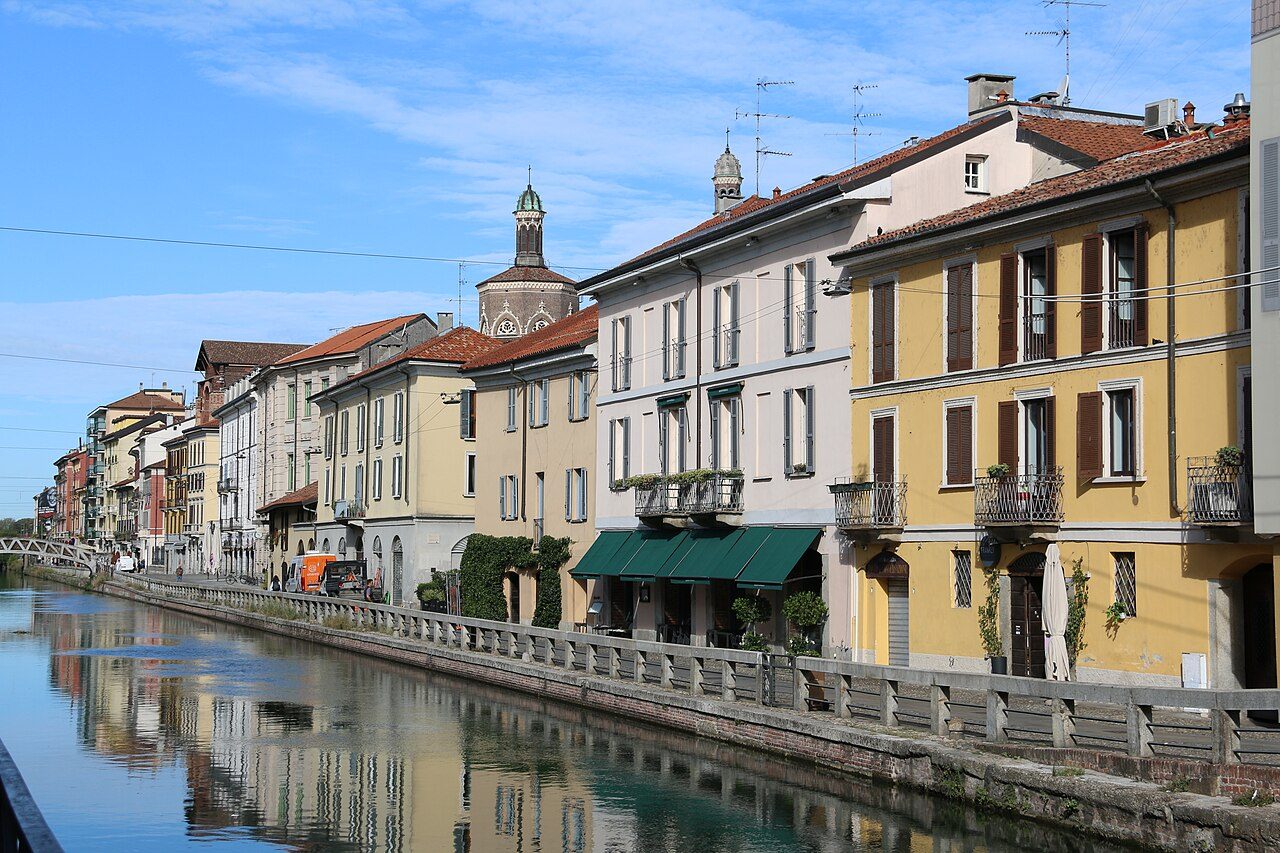
On the alzaia of the Naviglio Grande, the towpath along the canal, at a spot where you can see the water and both banks
The oldest of the has been bringing the water of the Ticino river to Milan for eight hundred years. Down this canal came, block after block, the marble for the Duomo, on boats that paid no .
Spot the detail
See which way the water flows. Then picture a barge that has to go back, against the current
The full story
Walk a few steps along the canal and watch it flow. Of all the , Milan's canals, this is the oldest: some fifty kilometers dug to bring the water of the Ticino river to Milan.
It reached the edge of the city in the early 1200s, when out here there was the basilica of Sant'Eustorgio and its pond. A few decades later it was widened and made navigable. From then on, for seven centuries, whatever Milan didn't have arrived this way.
The marble of the Duomo
The most famous cargo is the marble of the Duomo, Milan's cathedral. It comes from Candoglia, a quarry at the mouth of the Ossola Valley, near Lake Maggiore. Gian Galeazzo Visconti, lord of Milan, granted it to the Fabbrica del Duomo, the body that built the cathedral, and exempted it from . The blocks went down toward the Ticino and then turned into the Grande: about a hundred kilometers, all of it by water.
The mark on the boats
To be recognized, the Fabbrica's boats carried a mark: AUF, from the Latin ad usum fabricae, for the use of the Fabbrica. Whoever showed it went through without paying. And here comes the story everyone in Milan tells: from that mark, supposedly, comes the Italian expression a ufo, which means freeloading, without paying.
It's a much-loved tradition, but the dictionaries stay cool. For the Treccani dictionary the origin of the word is unknown. Go ahead and tell it, but as a legend.
The boats of the Naviglio
Now look at the boats that aren't there. The typical ones, the cagnone, were more than twenty meters long and carried about forty tons. They came down with the current and went back up towed by horses. There was a passenger boat too, the barchett de Boffalora, the little boat from Boffalora, made famous in the 1800s by a comedy by the writer Cletto Arrighi.
Today people stroll along the banks. Farther on, a bridge bears the name of Alda Merini, the poet who lived a short walk from this canal and made it her landscape.
When you stand in front of the Duomo, remember this bank. That mountain of marble came through here, one barge at a time.
About this stop
Anecdote
The Podestà Killed over Canal Taxes
The Grande, the canal that brings the water of the Ticino river to Milan, cost a podestà his life. A podestà was the outside magistrate called in to govern the city, and in 1257 the post belonged to Beno de' Gozzadini, from Bologna. Under him the digging of the canal moved forward toward Milan. Paying for it took taxes, and Gozzadini insisted that churches and monasteries pay them too. The clergy stirred up the people against him. At the end of his term Gozzadini was tried and convicted, then brutally killed, and his body ended up in the city moat. The boats arrived more than ten years later.
Anecdote
Leonardo's Water
On the Grande, the canal that carries Ticino river water to the , Milan's old port, Leonardo da Vinci, artist and engineer, owned something unusual: water. Louis XII, the king of France who ruled Milan in the early 1500s, had given him a water right at San Cristoforo, along the canal. It meant he could draw water from the Naviglio, precious in a countryside that lived on irrigation. Leonardo did not forget it. In his will, dictated in France a few days before he died, he left that right to his servant, Battista de Vilanis. To the very end, a little of the Naviglio's water was his.
In culture
Alda Merini's Bridge on the Naviglio
Alda Merini, one of the best-loved voices of twentieth-century Italian poetry, lived in Milan, a short walk from the Grande, the oldest of the city's canals. In November 2019, ten years after her death, Milan named a bridge over the canal after her, at the corner of the Ripa di Porta Ticinese and Via Corsico. The choice was no accident: it was close to her home, and it was singled out as a place that stood for her life and her poetry.
Next stop
Carry on along the alzaia to number 14, where a narrow alley with a little channel opens between the houses