Stop 6 of 8
The Padiglione Ferroviario
Where to stand
Inside the pavilion, at the start of one of the platforms, with the locomotives lined up in front of you
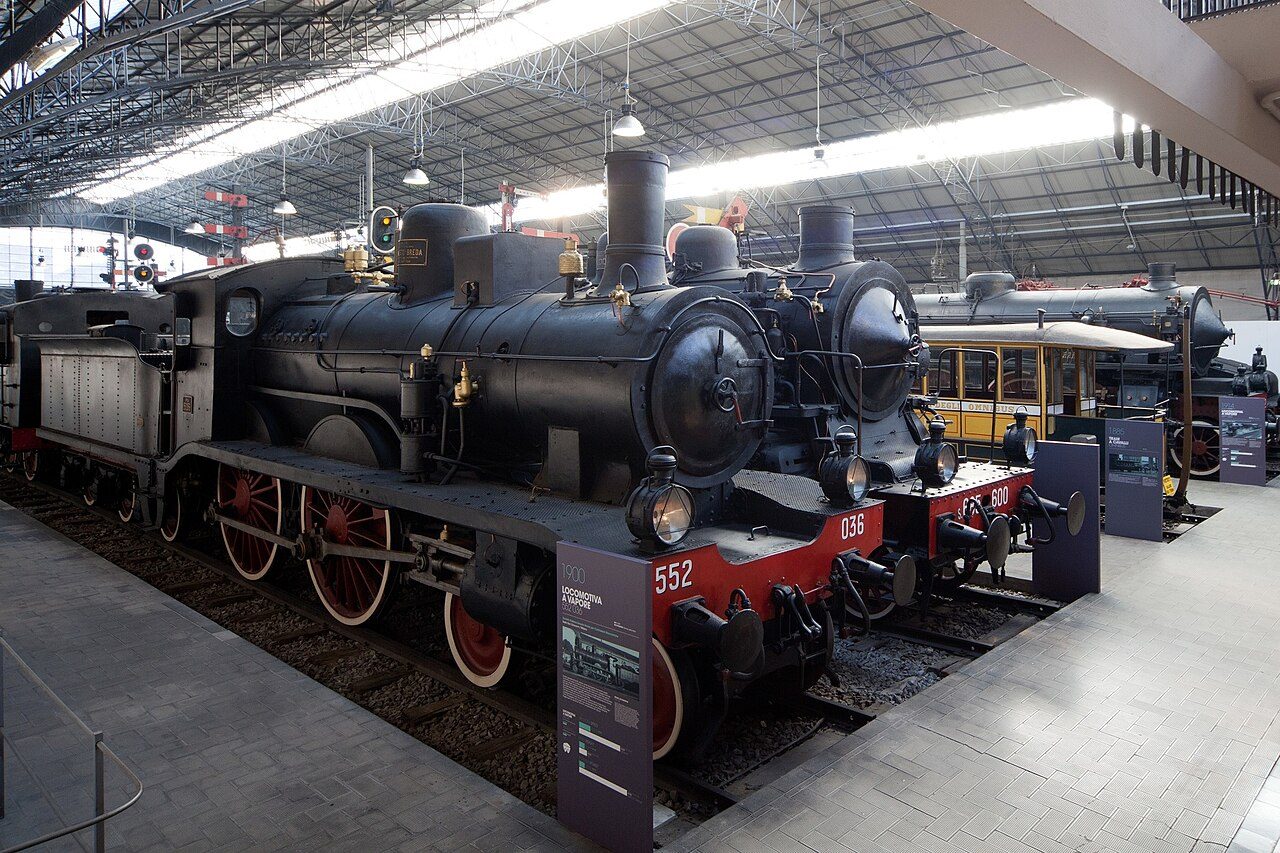
The railroad pavilion is laid out like a late-1800s station, with tracks, platforms and signals. Here you'll find the big steam locomotives, one of the first electric ones, and the streetcars that carried workers to Milan's factories.
Spot the detail
Among the steam locomotives, look for the Gr 552
The full story
For a moment it doesn't feel like a museum. There are tracks, ballast, signals, platforms. The pavilion is laid out like a late-1800s station, and the locomotives stand along the platforms as if waiting to leave.
The idea is the right one. A train by itself says little. The railroad is a system: rails, ties, signals, electric wires, stations. And it is this system that, from the 1800s on, changed distances, for goods and for people.
Steam versus electricity
The most imposing are the big steam locomotives, like the Gr 691 and the Gr 685. These are the engines of the long hauls up and down the peninsula.
Then look for the E 430, from the early 1900s. It is one of the first electric locomotives to enter service in Italy, on the lines of the Valtellina, an Alpine valley. Next to the steam giants it looks like a modest thing. It won.
The mail for India
The best story belongs to the Gr 552. This type of locomotive was presented at the 1900 Paris World's Fair. It was fast and reliable, and so it was trusted with the most important trains. One of them was the Valigia delle Indie, the Indian Mail.
It was a weekly British train linking London to Bombay. From 1870 it began running through Italy, and soon afterward through the new Fréjus tunnel. You went by train from London to Brindisi, then by steamship through the Suez Canal.
On the Italian leg it was hauled by locomotives like this one, all the way down to Puglia. London to Brindisi took less than two days: for the time, a flash.
City transport
Don't stop at the trains. Also on display are the vehicles that carried workers to the factories of the new industrial Milan.
There is the horse-drawn omnibus. There is the Gamba de Legn, as the Milanese called it: wooden leg. And there is the Carrelli streetcar, which over the years has become a symbol of Milan around the world.
About this stop
Legend
Why it is called Gamba de Legn
In the museum's Padiglione Ferroviario, the railroad pavilion, is a small locomotive the Milanese called Gamba de Legn, wooden leg. It was the nickname of the steam trams that from the late 1800s linked Milan to the towns around it. Why that name? According to a popular tale, a man with a wooden leg worked along the line. There is no proof. The most believable explanation is the gait: slow and wobbly, like someone limping. In the city the train could not exceed ten kilometers an hour. The last one to serve Milan ran along Corso Vercelli on August 31, 1957, waved off by people along the street.
This stop on the map
Next stop
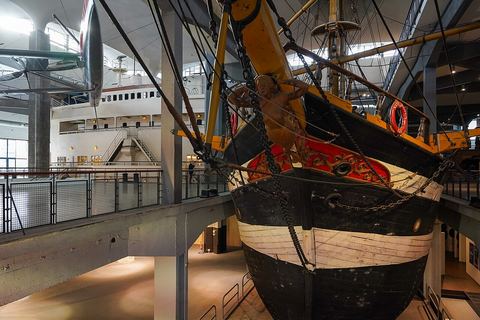
Follow the signs to the Padiglione Aeronavale, the air and sea pavilion, and stop in front of the sailing ship's bow