Stop 6 of 8Must-see
The stained glass
Where to stand
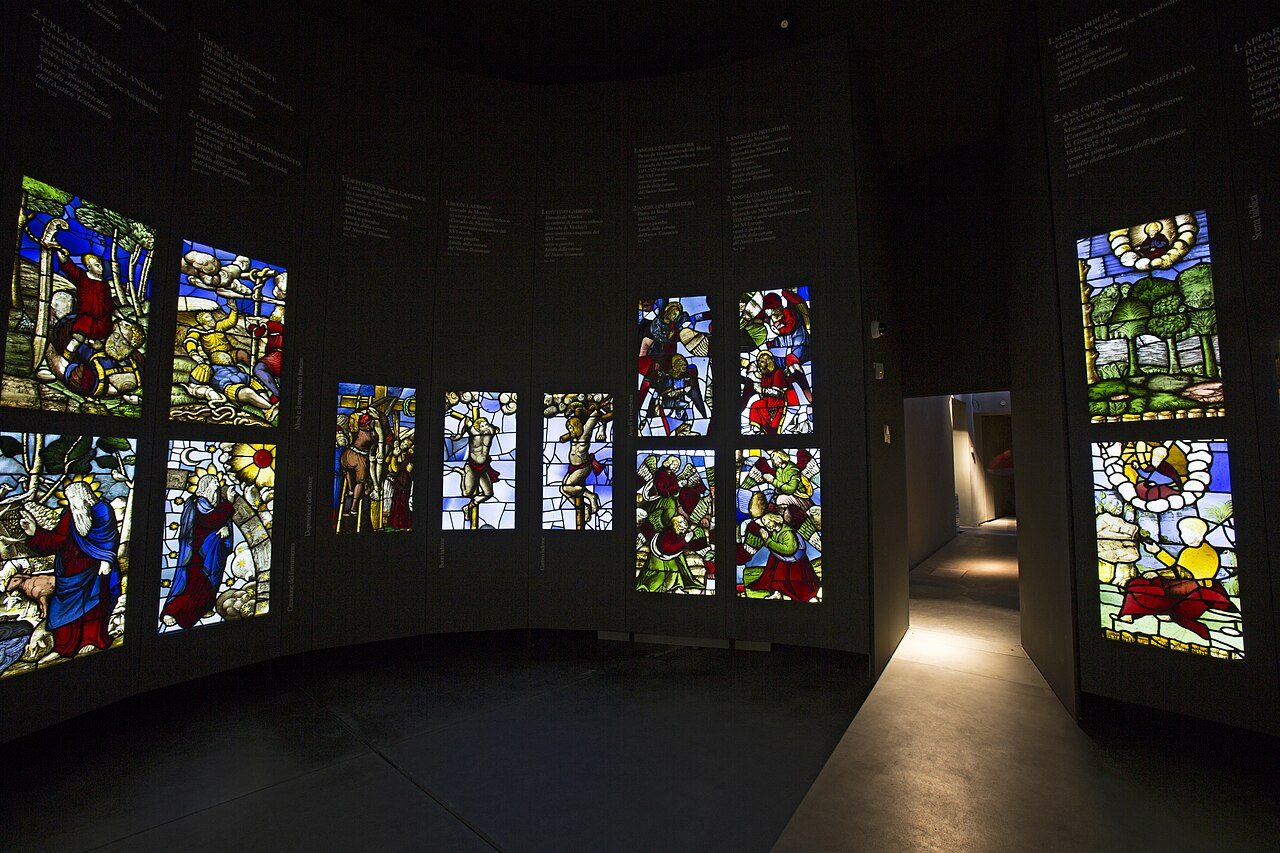
In the round room of the stained glass, at the center, with the lit panels all around you in two rows
The painted glass panels that sit very high up in the Duomo, here at eye level. Many come from the great Old Testament window in the apse. One was designed, according to the latest studies, by the young Arcimboldo.
Spot the detail
Low down, among the Genesis scenes, find God in a red tunic and blue cloak, between the moon and the sun. What is in the arch in front of him?
The full story
You arrive by a dark corridor. Then the room opens up, round, and the colors come at you. The panels are lit from behind, as if the sun were always shining outside.
In the Duomo there are 55 large windows of painted glass, home to more than three thousand figures. From the floor you see patches of red and blue. Here you see the brushstrokes, the faces, the folds of the clothes.
Each panel is called an . A window is made of many antelli mounted one above the other, and it is read from the bottom up, like a comic strip stood on end.
Two makers for every panel
A window starts from a : the full-size drawing, prepared by a painter. Then it is the master glazier's turn. He cuts the colored glass, paints faces and folds onto it with grisaille, the dark paint used for outlines and shadows, and binds it all together with lead.
That is why every panel has two fathers, the one who thought it up and the one who made it. And they came to the Duomo from far away: Lombard workshops, but French, German and Flemish ones too.
The Old Testament and Arcimboldo
Many panels come from the Old Testament window, one of the great windows of the apse. It was begun in 1417 and finished only in the second half of the sixteenth century. More than a century for one window: that is the pace of the Duomo.
Among the scenes of the Creation there is a special one. The glazier is Corrado de Mochis, who came from Cologne. The is attributed to Giuseppe Arcimboldo, a Milanese, who in those years was working for the Duomo together with his father Biagio.
The name rings a bell. In 1562 Arcimboldo left for the imperial court, and there he became famous for his heads made of fruit, vegetables and animals. Here he is still a young cathedral painter, drawing God as he sets the sun, the moon and the zodiac in the sky.
Why they came down
Panels like these were taken out of the windows to preserve them. Arcimboldo's entered the museum in the 1950s. It was not intact: it had already been restored in the nineteenth century.
In the Creation of the Firmament the pieces remade back then are known: part of God's cloak, a few blue pieces of glass. Those are part of the story too. The museum also tells of the work of the Bertini, the family that restored and renewed the Duomo's windows in that century.
Stay a minute at the center of the room and turn all the way around. In the Duomo this light falls on you without your understanding it. Here you can read it, one at a time.
About this stop
In culture
Arcimboldo before the fruit heads
Giuseppe Arcimboldo is the painter of heads made of fruit, vegetables and animals, painted for the Habsburg emperors. Before that, though, he was an artist of the Duomo. Between 1549 and 1558 he worked for the cathedral, at first alongside his father Biagio, and prepared the , the full-size drawings, for some of the stained glass windows. One, with the stories of Saint Catherine of Alexandria, is still in the church. In the museum's stained glass room, scholars attribute to him the design of one panel, the Creation of the Firmament. In 1562 he left for the imperial court, and the rest is art history.
From the bottom up. Every window in the Duomo is made of many panels, the , and each one tells a scene. The story starts at the bottom and climbs. In the church it is almost impossible to follow, because the highest antelli are a very long way off. In the stained glass room, though, you have them right in front of you, arranged by the window they come from. Start with Genesis: the creation of the world takes up several panels.
Next stop
Leave by the far side of the room: the corridor leads to a courtyard with a copy of the Madonnina, then back in toward the Borromeo rooms