Stop 7 of 8
Tintoretto and the Gonzaga tapestries
Where to stand
In the rooms of the Borromeo era: first in front of the large Tintoretto canvas, then in the tapestry rooms
The sixteenth century of Carlo Borromeo in two masterpieces. A large early canvas by Tintoretto, forgotten for centuries and rediscovered in 1954. And the the duke of Mantua gave the archbishop: there were seven, four remain.
Spot the detail
In the Tintoretto canvas, find the young man on the left who is not looking at Jesus: he is looking at you
The full story
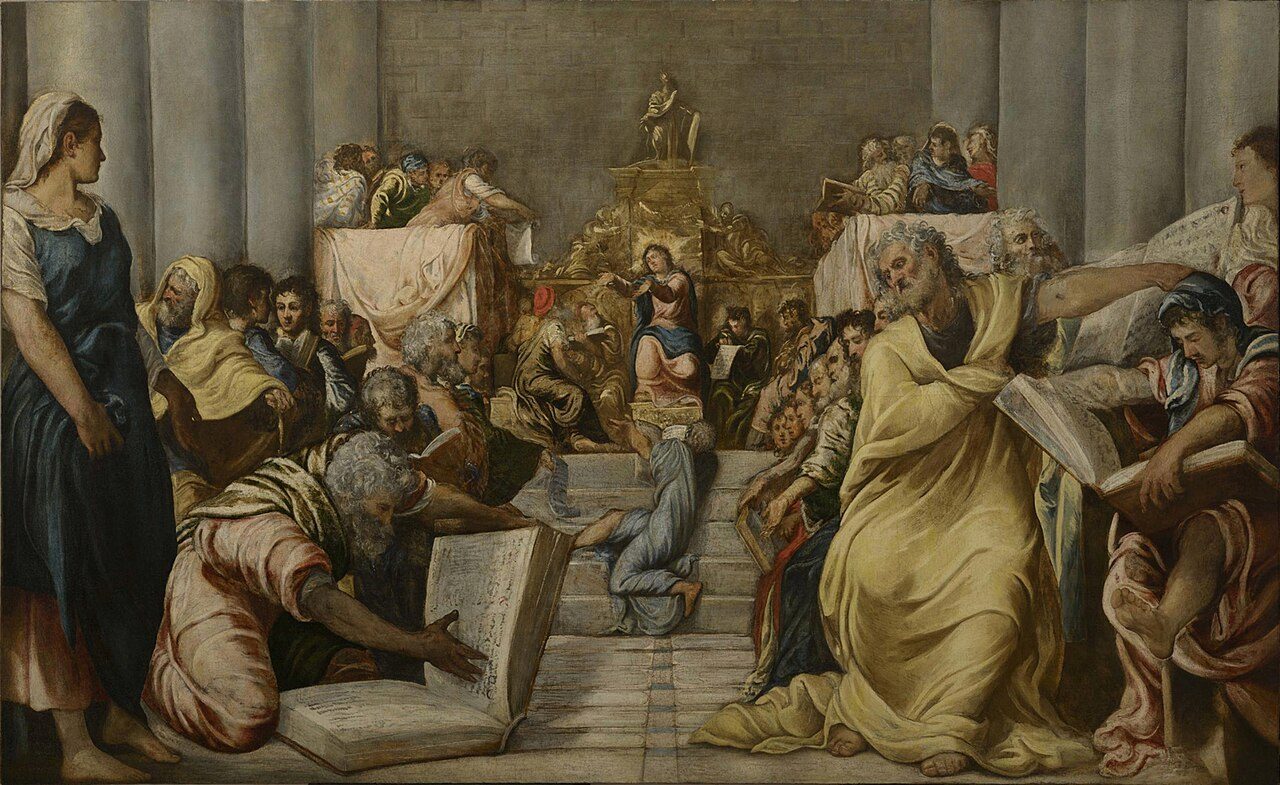
After so much marble, a painting. And a painting you do not expect in Milan: a canvas by Tintoretto, the Venetian painter, more than three meters wide.
It tells an episode from the Gospel. Jesus is twelve, his parents have lost sight of him, and they find him in the temple in Jerusalem debating with the doctors of the Law. Tintoretto puts him at the center but far off, on a golden chair at the top of a flight of steps. All around, the wise men fret, leaf through enormous books, and do not know what to answer.
The painter made it around 1540, when he was just past twenty. It shows: this is a painting out to astonish, with its receding columns and gigantic figures.
A masterpiece found again
The canvas appears in the seventeenth century in the inventories of the gallery of the archbishop of Milan. Then the sources forget about it, for centuries.
During World War II it ends up sheltered from the bombs. In 1954 it resurfaces in a workshop of the Fabbrica, the body that looks after the Duomo, and only then does anyone realize what it is. The museum had been open for a year.
The Duomo of San Carlo
The rooms around you tell the story of Carlo Borromeo, archbishop of Milan in the later sixteenth century and later a saint, San Carlo, and of his cousin Federico, who carried on his work. There is a fragment of one of the Quadroni, the huge canvases of the miracles of San Carlo, painted by Giovan Battista Crespi, known as il Cerano.
Look also for the painting of San Carlo in procession with the Santo Chiodo, the Holy Nail. It is the plague scene, when the archbishop carried the relic through the streets of the city.
The Moses tapestries
Then come the : three stories of Moses and a scene of cherubs at play. They came out in the mid-sixteenth century from the workshop that Nicola Karcher, a tapestry weaver from Brussels, ran in Mantua. They are made of wool, silk, silver and gold. The , that is, the full-size drawings, were by Giovanni Battista Bertani, a pupil of Giulio Romano and architect to the Gonzaga.
The most spectacular is the Crossing of the Red Sea, more than six meters wide. The Egyptian soldiers ride down on horseback and in chariots into the sea split in two. On the far shore Moses is about to stretch out his hand, and the waters will close again.
Guglielmo Gonzaga, duke of Mantua, gave the series to Carlo Borromeo, his relative. A few years later the archbishop passed it on to the Duomo.
There were seven. In 1906 three of them were on show at the Milan International Exposition. On August 3 the decorative arts pavilion caught fire, and the three were lost. The ones in front of you are the survivors.
About this stop
Anecdote
Three tapestries gone up in smoke
The series of with the Stories of Moses, on display in the museum, once numbered seven pieces: six stories and a scene of cherubs at play. The Gonzaga, dukes of Mantua, had ordered them in the mid-sixteenth century, Duke Guglielmo had given them to Carlo Borromeo, archbishop of Milan, and he had passed them on to the Duomo. In 1906 Milan hosted the International Exposition, and three tapestries were shown in the decorative arts pavilion. On August 3 the pavilion burned down. Moses before Pharaoh, the Passover and the Gathering of the Manna were gone. The four that were saved are the ones you see today.
Next stop
After the tapestries, carry on along the gallery of terracotta and plaster models to the room of the Madonnina