Stop 8 of 8Must-see
The skeleton of the Madonnina
Where to stand
In the room devoted to the Madonnina, in front of the large iron frame as tall as the statue
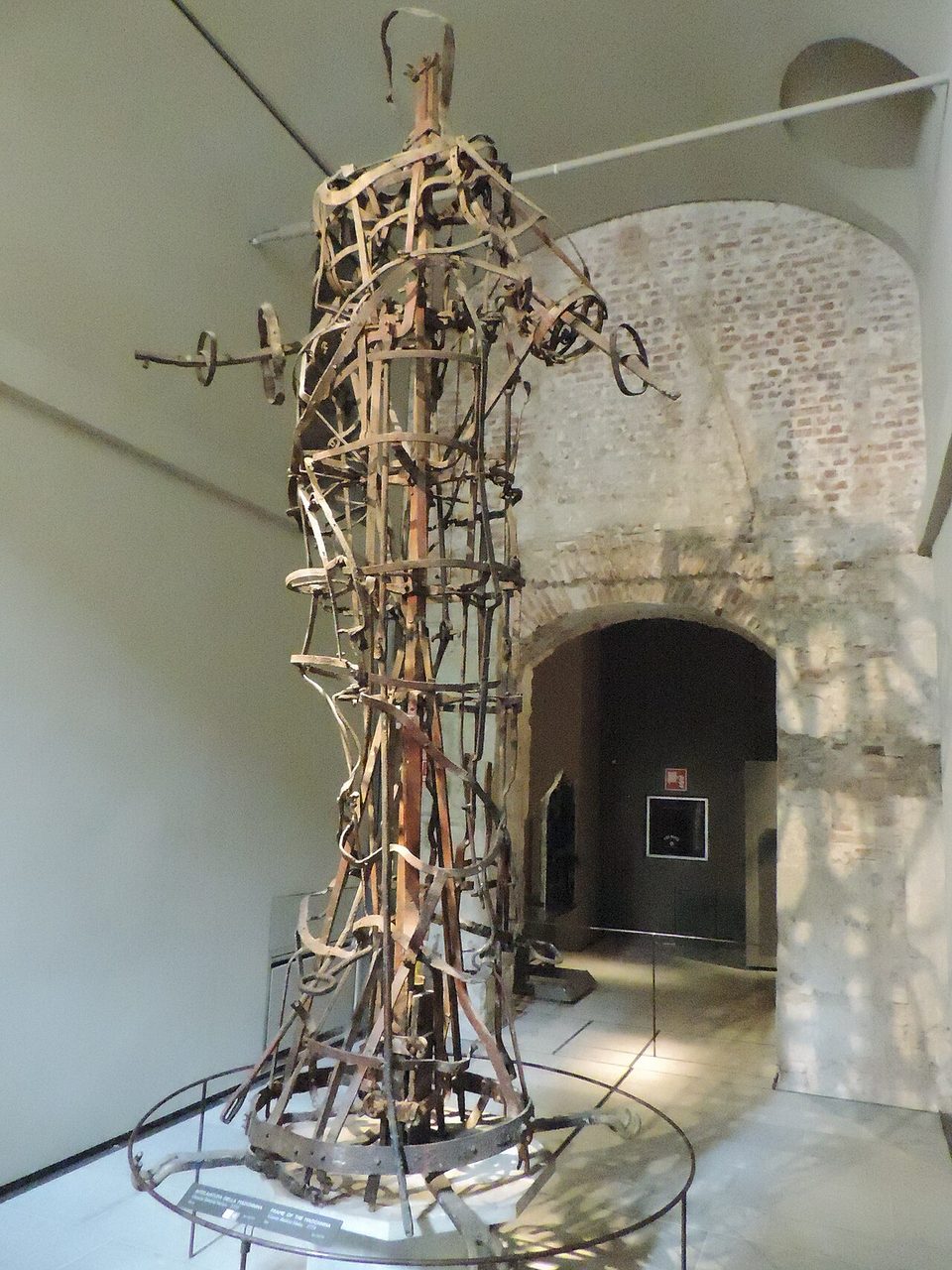
The Madonnina, the gilded Virgin on top of the Duomo, is not solid: it is a shell of gilded copper sheets. This is the iron frame that held it up on the tallest from 1774 to 1967, 108 meters above the ground.
Spot the detail
Look at the base of the iron frame: there is a ring. What was it for?
The full story
From the piazza the Madonnina, the gilded Virgin on the Duomo's tallest , is a dot of gold against the sky. Here you see the part of it nobody ever sees: the skeleton.
It is an iron frame more than four meters tall, about 13 feet. It was forged in 1773 by Giovanni Battista Varino, a blacksmith in the service of the Fabbrica, the body that builds and maintains the Duomo. For almost two centuries it held the statue up on top of the main , with the gilded sheets fixed all around it.
Three trades for one statue
The Madonnina is a three-man job. The sculptor Giuseppe Perego made the terracotta model: it is in this same room, and it is worth looking at before anything else. The blacksmith Varino built the frame. The goldsmith Giuseppe Bini beat out the copper sheets, 33 in all, and gilded them.
The finished statue is a little over four meters tall. It went up on the in December 1774. The spire was new too: it had been raised a few years earlier, and it is the feat that marks the Duomo's eighteenth century.
Also in the room are the full-size wooden model of the head and the old halberd, the staff that accompanies the statue.
Perego's entrance exam
To get here you walked through the Camposanto gallery, its walls covered with models in terracotta and plaster. They are not decorations. They are the models for the Duomo's sculptures, from the seventeenth century on. The Fabbrica asked the sculptors for them, approved them, and only then had them translated into marble.
Joining the sculptors of the Duomo took a test as well. Perego's has survived, signed: a Hercules Slaying the Nemean Lion, from 1754. Twenty years later, the same man would give Milan its symbol.
The swap of 1967
Iron out in the open does not last forever. By 1967 Varino's frame was so far gone that it threatened the stability of the statue. The Fabbrica replaced it with one in stainless steel, and brought the old one here, together with the halberd.
So the Madonnina you see from the piazza is the eighteenth-century one on the outside, and inside it has a twentieth-century skeleton. That is the Duomo's method: you change the worn-out part, the rest carries on.
Before leaving you pass the Modellone, the big wooden model of the Duomo, once more and cross one last room, with the sketch models for the fifth bronze door of the facade. Then you are back in the piazza. Look up at the tallest : now you know what is inside.
About this stop
Anecdote
The Madonnina sculptor's entrance exam
To join the sculptors of the Fabbrica del Duomo, the body that builds and maintains Milan's cathedral, you had to pass a test of skill, alone or in competition with other candidates. One of these tests has come down to us, signed: a Hercules Slaying the Nemean Lion, from 1754. Its author is Giuseppe Perego. He passed the exam, and some fifteen years later the Fabbrica entrusted him with the model for the statue to be set on the tallest . It was the Madonnina, the symbol of Milan. In the museum the exam piece and the model are a few rooms apart.
No. The real Madonnina is still in its place, on top of the tallest , where it has been since December 1774. Here you find what lies behind it. There is the original iron frame, replaced in 1967 with a steel one. There are the terracotta models by the sculptor Giuseppe Perego and a full-size wooden model of the head. In a courtyard along the route there is also a copy of the statue, which you can look at up close.