Stop 1 of 7
Piazza del Duomo
Where to stand
In Piazza del Duomo, near the equestrian monument at the center, with the cathedral in front of you and the Galleria's arch on your left
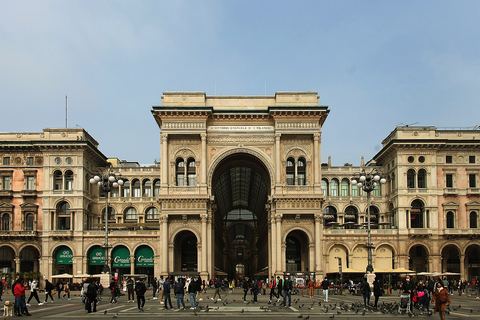
The Galleria wasn't born alone: it is the showpiece of a plan that redrew the whole square in the mid-1800s. From here you see Mengoni's project in full, porticoes included, and the king it is dedicated to.
Spot the detail
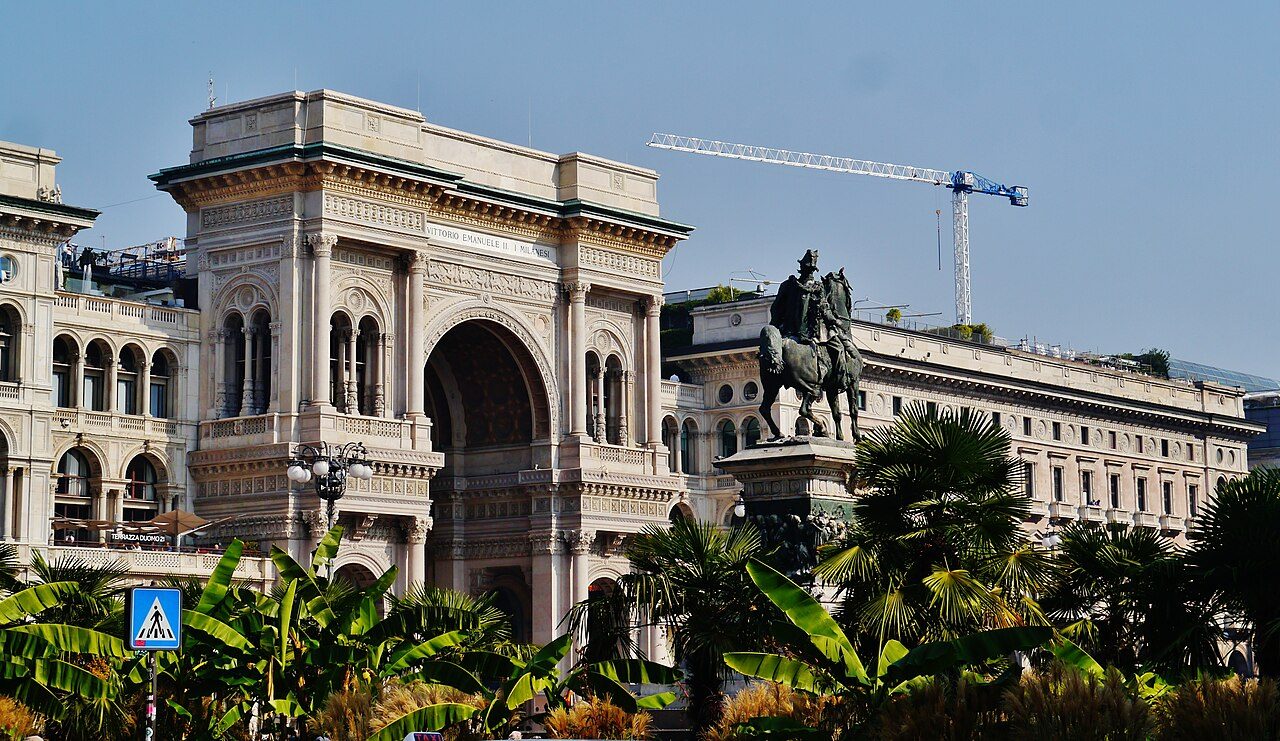
The bronze king at the center of the square: why is he pulling on the reins?
The full story
Stand near the king on horseback, with the Duomo, Milan's cathedral, in front of you. Now look to your left: between the porticoes an arch opens up, as tall as a building. That is the entrance to the Galleria. Before you head over, take in everything else, because the arch, the porticoes, and the very shape of the square are one single design.
What the square was before
Until the middle of the nineteenth century this space was much narrower. Small houses, workshops, and a long old arcade, the Coperto dei Figini, crowded in front of the cathedral. In 1859 Milan joins the kingdom of the House of Savoy and decides those little houses are not up to the job. It wants a square fit for a capital.
After three rounds of competition the commission goes to Giuseppe Mengoni, an architect who came up from Bologna, and his plan is radical: demolish, widen, and enclose the square in a frame of porticoed buildings, all in a row. On the north side, the one to your left, the porticoes break off to make room for a glass-covered street leading straight to Piazza della Scala. That is how the Galleria comes about, as the most ambitious piece of a general cleanup.
Not everyone applauds. The Milanese writer Delio Tessa, in one of his short stories, will go so far as to say that everything has been wrong since the day they knocked down the Coperto dei Figini.
A design left unfinished
Mengoni doesn't get to see his design complete either. The porticoed buildings are finished in the 1870s, but the monumental building meant to close off the square opposite the Duomo will never be built. And on the side across from the Galleria, the twin towers of the Arengario are an addition from the 1930s.
As for the king, the statue arrives almost twenty years after the architect's death. But it closes the circle. The square, the porticoes, and the Galleria are Milan's way of telling everyone it had become Italian. Now go and see how it wrote that on the arch.
About this stop
Anecdote
The mayor who never opened the Galleria
The new Piazza del Duomo and the Galleria Vittorio Emanuele II, Milan's glass-roofed arcade, had a political godfather: Antonio Beretta, mayor of Milan from 1860. But city finances sank, and some newspapers accused him of misusing public funds. There was talk of a house due for demolition, overpaid to a city official, his brother-in-law. And of a secret deal with the English construction company to build one story higher: some accounts call it a bribe. His administration refused an inquiry and sued a newspaper, but the case came to nothing. No court ever established the charges. Beretta resigned in July 1867. Two months later the Galleria was inaugurated without him.
This stop on the map
Next stop
Walk toward the great arch that opens between the porticoes on the left side of the square, and stop a few steps short of it