Stop 2 of 7Must-see
The Entrance Arch
Where to stand
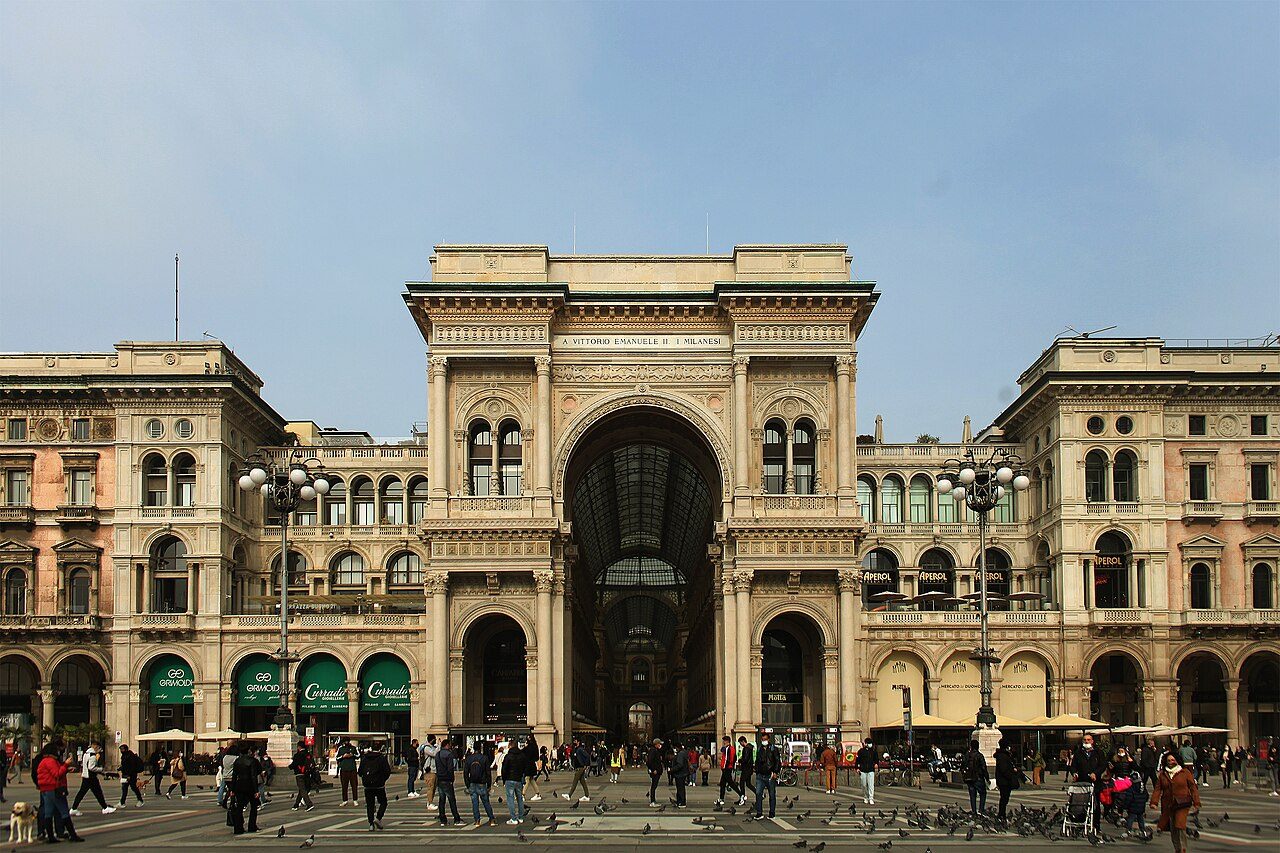
In the square, facing the Galleria's arch, a few steps back so you can see all of it up to the inscription at the top
A more than thirty meters tall, finished ten years after the rest of the Galleria. It is the last thing Mengoni built: he fell from its scaffolding just as the work was done.
Spot the detail
The inscription at the top of the arch: who signs the dedication?
The full story
The ancient Romans built a for generals coming home victorious. Milan made one into the doorway of a street of cafés and shops, and saw nothing odd about it.
Look at it from the bottom up. At the center is a single gigantic opening that swallows people by the dozen. On either side rise columns with leafy capitals and paired windows, in a style that revives the Renaissance.
At the top, more than thirty meters above the ground, about a hundred feet, is the dedication to the king. It is a facade designed to stand next to the Duomo, Milan's cathedral, without looking shabby, and to announce that something important lies behind it.
The arch missing at the opening
And yet when the Galleria opened in 1867, the arch did not exist. The English company that had built everything else soon ran into trouble and went bankrupt. The city had to take over the Galleria, and the monumental entrance stayed on paper for years.
Mengoni's last building site
In the end Mengoni decided to do it himself. He took on the contract personally, like any ordinary builder, and committed to delivering the arch by the end of 1877.
He made it, with a day to spare. On December 30, 1877, he climbed the scaffolding for a final inspection. He was forty-eight. He fell, and he died.
Officially it was an accident. But Milan started whispering right away. The architect had been attacked for years by newspapers and colleagues, some had called the Galleria useless, and to many people bad luck seemed too simple an explanation.
There was talk of suicide. No proof has ever turned up, one way or the other.
Four thousand people came to the funeral. The arch was inaugurated two months later, without him.
As you walk under it, remember that for the man who designed it this was not the doorway to a street of shops. It was the last piece of a work he had given almost fifteen years to, and the only one he never saw without scaffolding.
About this stop
Anecdote
Mengoni, the architect who fell from his arch
Giuseppe Mengoni, the architect who designed the Galleria Vittorio Emanuele II, Milan's glass-roofed arcade, worked on it for almost fifteen years, through controversy, delays, and the bankruptcy of the company building it. For the great entrance arch facing the Duomo, Milan's cathedral, he acted as contractor himself. On December 30, 1877, with the work done a day ahead of the deadline, he climbed the scaffolding for a final check and fell. He was forty-eight. The official version called it an accident, but a rumor of suicide went around at once, never proven. He is buried in Milan's Cimitero Monumentale, and a plaque at the Galleria's entrance remembers him.
Because it was born along with united Italy. In 1859 Milan passes from the Austrians to the kingdom of the House of Savoy, and soon afterward Vittorio Emanuele II becomes the first king of Italy. The city decides to rebuild its center and to name its most important project after the sovereign. He was the one who laid the first stone in 1865 and inaugurated the Galleria in 1867. The dedication at the top of the arch is signed by the Milanese.
Yes. Giuseppe Mengoni died on December 30, 1877, plunging from the scaffolding of the great arch facing the Duomo, Milan's cathedral, during his final inspection. The work had just been finished, a day ahead of the deadline. Officially it was an accident. In the city there was immediate talk of suicide as well, because the architect had been heavily criticized, but no one has ever proved it. The arch was inaugurated two months later.
Next stop
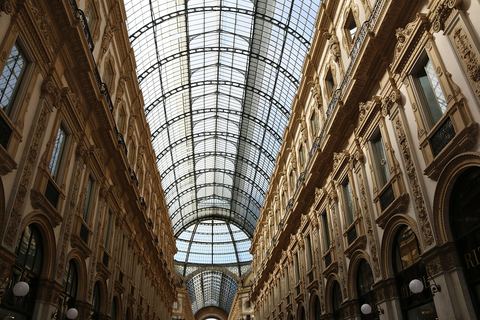
Pass under the arch, take about twenty steps into the Galleria, and look up