Stop 3 of 7Must-see
The Iron and Glass Vault
Where to stand
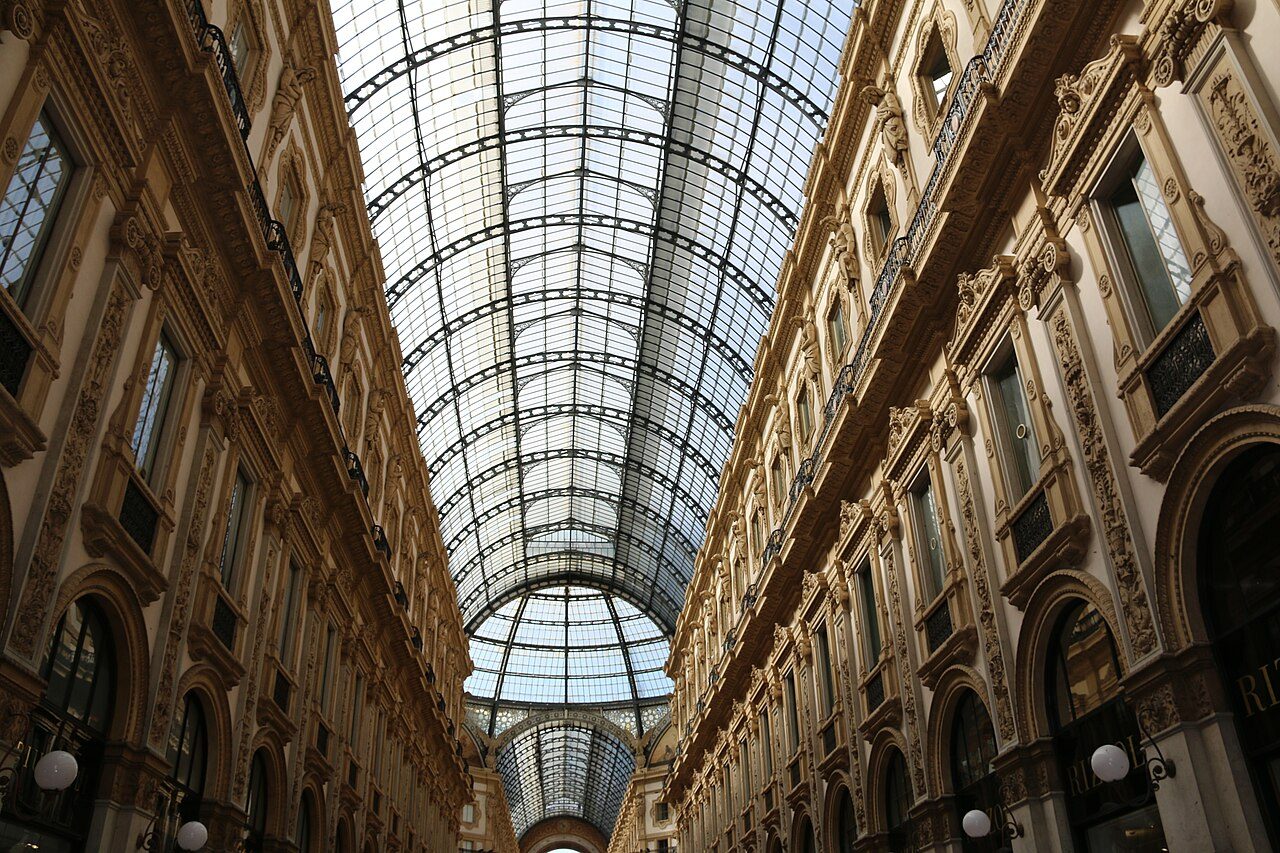
Inside the Galleria, just past the arch, in the middle of the walkway, looking up along the arm
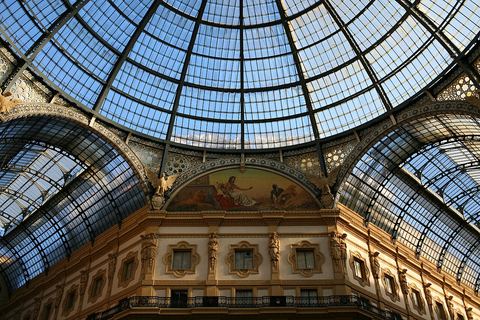
A sky of glass held up by iron arches, almost thirty meters above the ground. In 1867 this was the most advanced technology around, and the iron came from France.
Spot the detail
The glass above your head: does it look nineteenth-century to you?
The full story
Pretend you are a Milanese in 1867, walking in here for the first time. All you know are narrow streets open to the sky. And now you are walking on marble, out of the rain, under a ceiling that lets the daylight through. It must have felt like another age.
Look at how it is made. A series of iron arches spans the street from one building to the other, and between one arch and the next there is nothing but glass. The shape is a , meaning a half cylinder as long as the street.
Below, the facades act as if nothing were going on: windows, balconies, stucco, all in Renaissance style. That is Mengoni's trick: tradition at eye level, the future overhead.
Bigger than any other
Covered streets already existed. London and Brussels had theirs, and Milan had a smaller one too. But none was on this scale.
The arm you are standing in is almost two hundred meters long, and the vault passes almost thirty meters above the ground, about a hundred feet. The whole roof took around three hundred and fifty tons of iron.
French iron, English money
That iron was not Italian. The country's industry still lagged behind France and England. The money came from an English company, the parts were made by a French workshop, and the glass came out of the French factory of Saint-Gobain. The assembly was done in Milan, and in two and a half years the street was covered.
The hail and the bombs
Glass, though, is fragile. In 1874 a hailstorm smashed through some of the panes. And in August 1943 the bombing did far worse: the glass shattered and part of the iron gave way. It took twelve years for the Galleria to be itself again.
One tip: see it at different times of day, if you can. In full daylight the vault almost disappears and you feel as if you were outdoors. When the light fades, the iron stands out dark against the sky, and you realize how thin the thing holding it all up really is.
About this stop
No. The bombing of August 1943 destroyed the entire glass roof and part of the iron structure. Reconstruction began after the war and the Galleria was inaugurated a second time in December 1955, rebuilt as it had been. A major restoration, which brought the plaster back to its original colors, was then carried out between 2014 and 2015. The shape you see is the one Mengoni wanted; the materials, for the most part, are not.
Next stop
Keep going straight along the arm to the point where the space widens, under the dome