Stop 5 of 8Must-see
Twelve reactions to one sentence
Where to stand
In the refectory, facing the painting: run your eyes over the figures from left to right
Twelve apostles, four groups of three, a single sentence: “one of you will betray me.” Leonardo paints what he called : each man reacts with his body, in his own way. Judas is in among the others.
Spot the detail
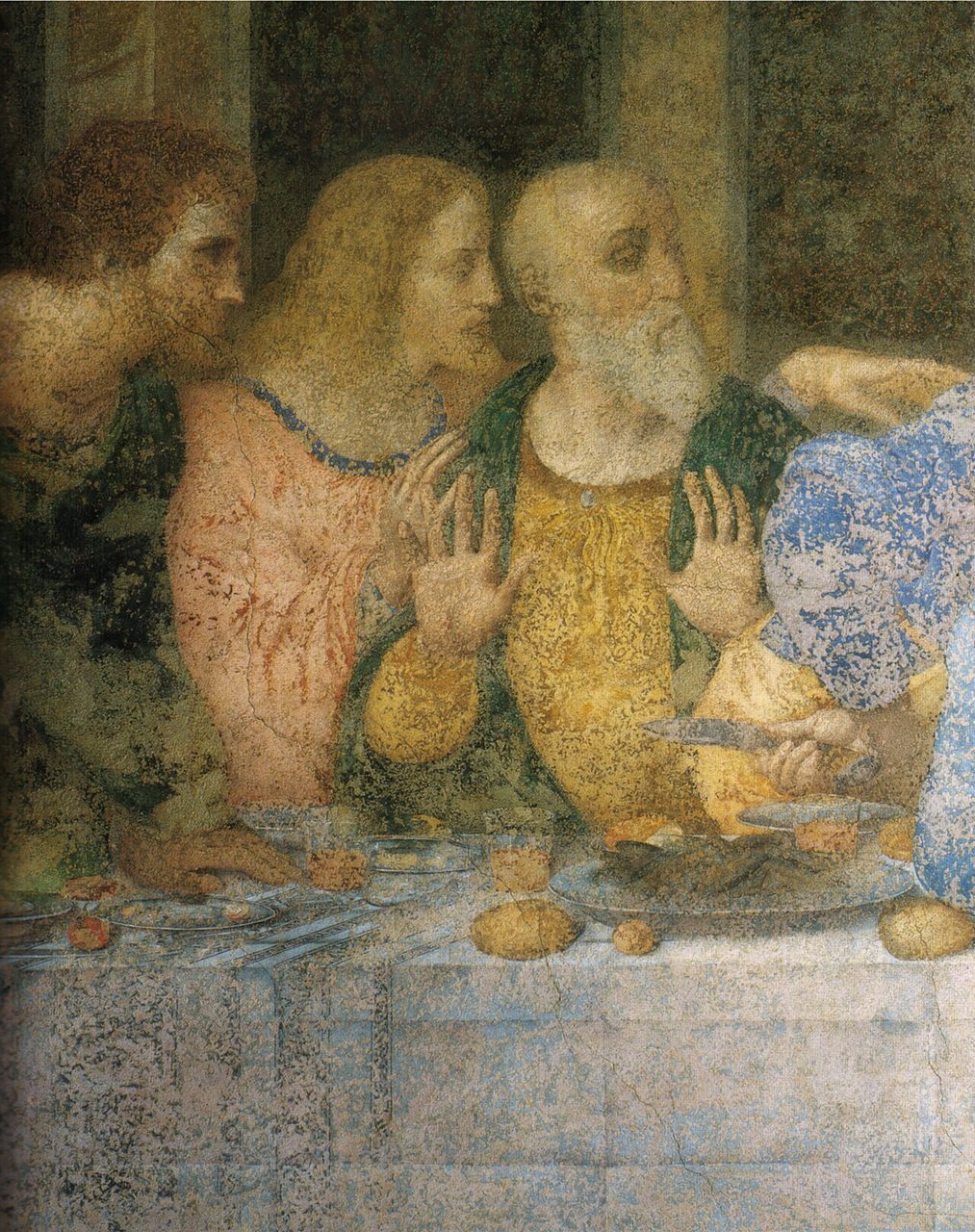
Find Judas. He isn't off to one side: look for the man who pulls back and clutches something in his hand
The full story
Leonardo used the phrase for the emotions you can read in gestures and faces. Here he stages twelve of them, all set off by the same sentence. Move from left to right: each group of three is a small scene.
At the far left Bartholomew, James the Less and Andrew are pure surprise. Then comes the tensest group. Peter lunges forward with a knife in his hand and touches the shoulder of John, the youngest, who leans toward him. Between them, his head lower than anyone else's, is Judas.
In the center is Christ, motionless. He has just said that one of them will betray him, and he adds nothing more. One hand is palm down, the other palm up. Some read his two natures into this, the human and the divine: it is an interpretation, not a certainty.
Just to the right Thomas raises a finger, the same one he will later want to touch with before he believes. James the Greater flings his arms wide. Philip seems to be asking for an explanation. At the far right Matthew and Jude Thaddeus turn toward Simon, as if to ask him whether they heard correctly.
The names and the hands
A detail that changes how you look: Leonardo did not write the names. We know almost all of them thanks to a sixteenth-century copy that records them. Before that, the only certain ones were Christ, Judas, Peter and John.
Notice one thing: in this scene it is mostly the hands that do the talking. Look at them one by one, if you have time left. The painting is one sentence and twelve answers, and no two answers are alike.
About this stop
In culture
John or Mary Magdalene beside Christ?
In Leonardo da Vinci's Last Supper, in the of the convent of Santa Maria delle Grazie, a delicate-featured figure sits next to Christ. In 2003 Dan Brown's novel The Da Vinci Code made one idea famous: that it is not the apostle John but Mary Magdalene. It is a novelist's invention. For art historians the figure is John, the youngest of the twelve, with the androgynous look Leonardo often gave his young men. Besides, if it were Mary Magdalene, there would be an apostle missing from the table. The theory does not hold up, but it has one merit: it makes people look at the painting figure by figure.
Legend
The face of Christ Leonardo never finished
At the center of Leonardo da Vinci's Last Supper, in the of the convent of Santa Maria delle Grazie, is the face of Christ. According to Giorgio Vasari, biographer of the artists, Leonardo left the head of Christ “imperfect,” meaning unfinished: he felt he could not give it the divinity the subject called for. Another sixteenth-century writer, Giovanni Paolo Lomazzo, claims the advice came from a colleague, the painter Bernardo Zenale. These accounts were written decades later, and are best taken as tradition rather than record. But they show how high Leonardo set the bar, and why the prior of the convent so often saw him standing still, thinking.
In culture
A melody hidden in the Last Supper?
In 2007 a musician and computer technician, Giovanni Maria Pala, announced he had found music inside Leonardo da Vinci's Last Supper. He had drawn a five-line musical staff across the painting and read the loaves and the hands around the table as notes. Read from right to left, the direction in which Leonardo wrote, they gave a slow melody of forty seconds, which to him sounds like a requiem. Alessandro Vezzosi, a Leonardo scholar, had not seen the research but judged the idea plausible, and warned: there is always a risk of seeing something that is not there. Leonardo certainly played the lyre. The rest, for now, is conjecture.
Next stop
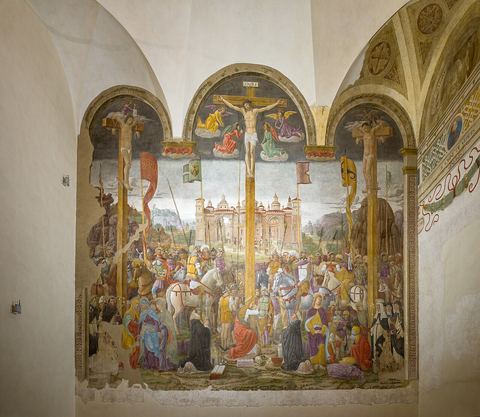
In your last few minutes turn around: on the opposite wall there is a large Crucifixion