Stop 4 of 7Must-see
Michelangelo's Pietà Rondanini
Where to stand
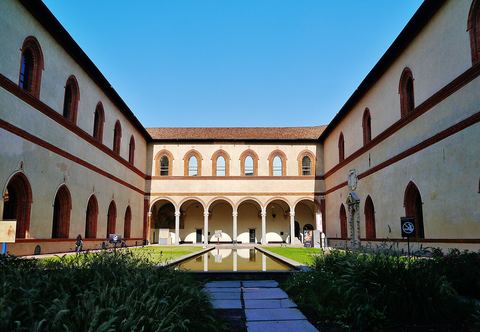
In the former Ospedale Spagnolo, on one side of the Piazza d'Armi. You come in facing the statue's back: then walk around it
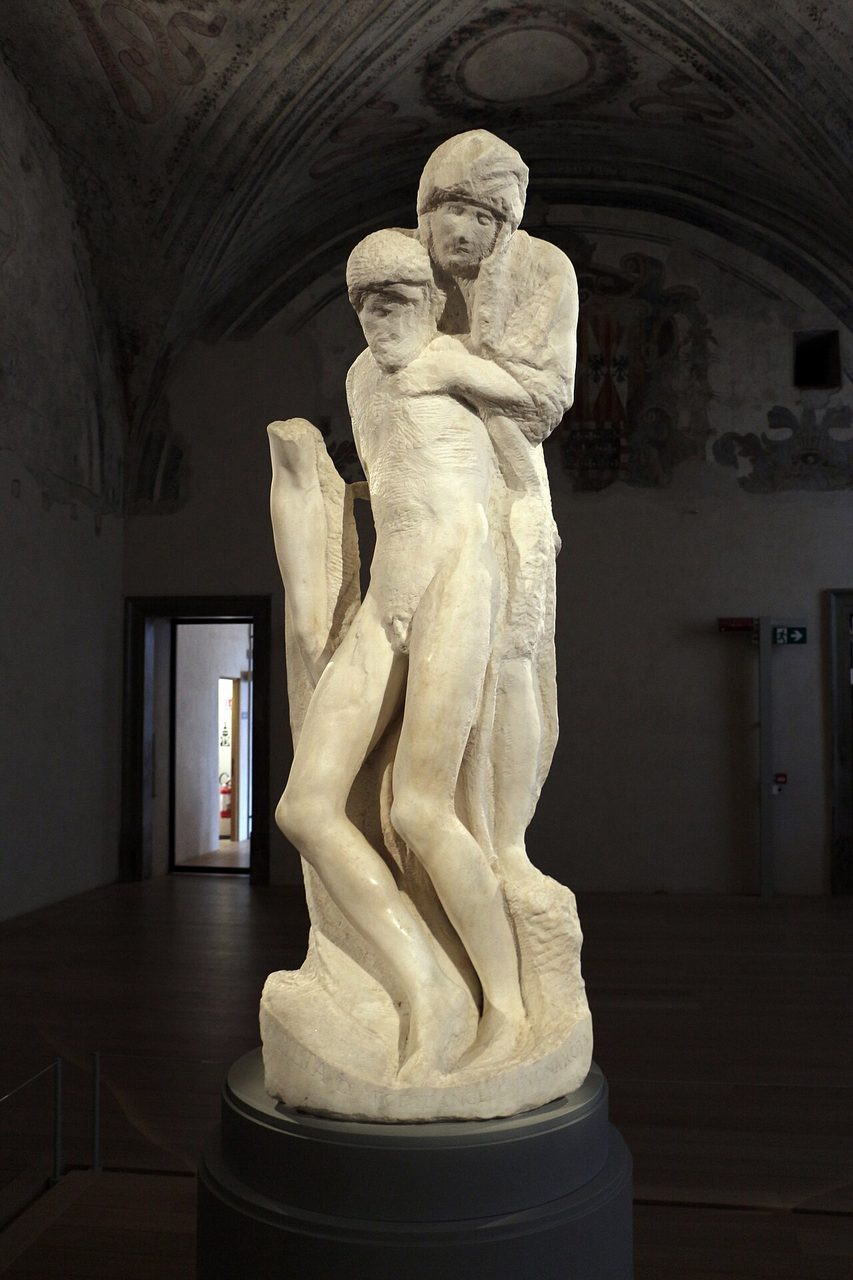
Michelangelo's last sculpture, which he worked on until a few days before his death. A mother and son almost fused into a single body, in marble left half done. If you have time for only one thing, this is it.
Spot the detail
Next to Christ's body there is an extra arm, detached from everything else. Find it
The full story
You walk in and see it from behind. A curved back, barely roughed out, in an almost empty room. That is deliberate: the architect Michele De Lucchi, who designed this museum, brings you in from the rear, so you walk around it before you meet it.
Do it, slowly. In front you find two standing figures, pressed so close they seem to be one. Mary is behind, holding up the body of her dead son as it slides downward.
There is nothing of the scene you expect, with the mother seated and her son in her lap. Here everything is vertical, gaunt, worn away. In places the marble is finished, in others it still carries the marks of the chisel.
Michelangelo's last sculpture
This is the last sculpture by Michelangelo Buonarroti, and it is unfinished. He worked on it in Rome, as an old man, and he was making it for himself: according to his biographers he wanted a Pietà for his own tomb. He had already tried one. The marble turned out to be flawed and, in a fury, he took a hammer to it.
This one he had already begun: he took it up again, then changed his mind and started over inside the same block, carving the new figures out of the bodies of the old ones. That is why Christ's legs, which come from the first version, are finished, while the torso above is painfully thin and barely roughed out. And if you look closely at Mary's face, the trace of another surfaces beside it, turned a different way: the earlier one.
He never stopped. The painter Daniele da Volterra, who was close to him, wrote that he was still working on it a few days before he died, in 1564. In the inventory of his house the statue is listed like this: two figures joined together, roughed out and unfinished.
From Rome to Milan
Then, for almost two centuries, little is known. In the 1700s it was bought by the Rondanini marquises, who gave it its name and set it in a niche in the library of their palace in Rome.
In 1952 the City of Milan managed to buy it, urged on by the scholar Fernanda Wittgens. For decades it stood among the sculptures in the museum of the Castello Sforzesco. Since 2015 it has had this room all to itself.
The room was a hospital, built in the 1500s for the Castello's soldiers sick with plague. The statue stands where the altar was. A place where the sick had nothing left but prayer, for a sculpture that resembles a prayer.
The English sculptor Henry Moore considered it among the most moving works ever made by an artist. Sit down on a bench and decide for yourself.
About this stop
Anecdote
The Pietà and the architect who said no
The Pietà Rondanini, Michelangelo's last sculpture, stands in the Castello Sforzesco, in the old Ospedale Spagnolo, the Spanish Hospital. When he was asked to design its new home, the architect Michele De Lucchi said no. They asked him at least to come and see the place. He walked into the room where soldiers sick with plague had nothing left but prayer, and changed his mind: a sacred place for a sacred statue. He set the sculpture where the altar had been, three oak benches in front of it, and almost nothing else.
Because Milan bought it. The Pietà stayed in Rome for almost four centuries: in Michelangelo's house, then in a workshop, and from 1744 in the palace of the Rondanini marquises on Via del Corso. In the early 1900s, when the palace changed hands, the Italian state gave up in writing its right to buy it first. So in 1952 the City of Milan, urged on by the scholar Fernanda Wittgens, was able to acquire it for the collections of the Castello.
Because it is, and for two reasons at once. Michelangelo worked on it until a few days before his death, in 1564, and ran out of time. But above all, at a certain point, he started over inside the same block, carving new, thinner figures out of the marble of the ones already made. Of the first version, Christ's legs and an isolated arm remain. The rest is the second, barely roughed out. What you see is not just an interrupted work: it is a change of mind left open.
Next stop
Go back to the courtyard, take the arched passage in the far wall, and look for the Corte Ducale on your right