Stop 6 of 8
The Palazzo dell'Arte and the Bagni misteriosi
Where to stand
On the side of the Palazzo dell'Arte facing the park, in front of the portico; then at the railings of its garden
The red-brick palace built in 1933 for the Triennale, Milan's great exhibition of architecture and design. In its garden is a fountain by Giorgio de Chirico: two swimmers, a swan and a beach cabin in the middle of Milan.
Spot the detail
In the basin of the fountain, find the two swimmers. How do they differ?
The full story
The long red-brick building is the Palazzo dell'Arte, the Palace of Art. Everyone, though, calls it the Triennale, after the exhibition it was built for.
An exhibition on the move
The story begins in Monza, in the 1920s, with an exhibition of decorative arts in the Villa Reale, the royal villa. It is a success, takes the name Triennale, and at some point the villa is no longer enough. In 1933 it moves to Milan, into a purpose-built palace.
The money comes from a bequest by Senator Antonio Bernocchi: five million lire. The design is by the architect Giovanni Muzio. It is built in a year and a half.
Look at the walls. That dark red is , an extremely hard brick that was almost a novelty in Italy at the time. The plan recalls that of a basilica, complete with a curved apse at one end. The portico toward the park, by contrast, is in pink Baveno granite, the same granite that holds up the Arco della Pace, the triumphal arch across the park.
Ever since, this has been a place for arguing about homes, objects and cities. Not always peacefully: in 1968 the palace was occupied by protesters. Today it also houses a design museum.
De Chirico's beach
Now look for the fountain in the garden. It dates from 1973, the year the Triennale asked a group of artists for works to place in the park, there for everyone. Twelve were made, and many were later taken back by the artists. This one was made to stay.
Its author is Giorgio de Chirico, one of the fathers of Metaphysical painting. It is one of his last works, and it is titled Bagni misteriosi, the Mysterious Baths.
In a basin with a sinuous outline stand two swimmers in one-piece bathing suits. Around them are the trappings of a beach resort: a cabin, a diving board, a ball. And two animals, a swan and a fish.
As a child De Chirico went sea bathing in Greece, and that memory comes back here, turned into a daydream. Nothing is frightening and nothing is normal. It is his way of working: taking ordinary things and putting them where you don't expect them.
If the fountain stays with you, it doesn't end here. The two swimmers and the fish you see in the basin are copies: the originals are sheltered from the weather, in the Museo del Novecento, Milan's museum of twentieth-century art.
About this stop
Anecdote
The Triennale, occupied on opening day
The Palazzo dell'Arte, home of the Triennale design exhibition in Milan's Parco Sempione, saw a show halted on its opening day. On May 30, 1968, the fourteenth edition was opening, devoted to the Grande Numero, meaning mass society. Instead the building was occupied by students, workers and artists, including the sculptor Giò Pomodoro. The architect Giancarlo De Carlo, one of the show's organizers, was photographed in the street arguing with them. With others he had designed a section of that edition titled La protesta dei giovani, the protest of the young. The occupation lasted more than a week and several installations were damaged. The Triennale reopened only in late June.
They are the Bagni misteriosi, the Mysterious Baths, by Giorgio de Chirico, a fountain from 1973. Two swimmers, one blond and one dark-haired, stand immersed in a basin with a sinuous outline. Around them are a cabin, a diving board, a ball, a swan and a fish. De Chirico takes the sea bathing of his childhood in Greece and turns it into a dreamlike scene. It is one of his last works, meant from the start to stay in the park.
This stop on the map
Next stop
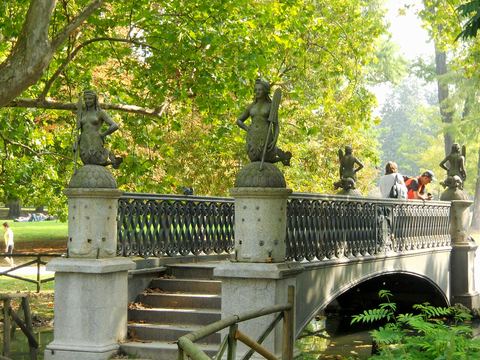
Go back into the park and look for the small lake: nearby a little iron bridge, with four mermaids, crosses the water