Stop 3 of 8
Porta Sempione, the road to Paris
Where to stand
Beyond the arch, on the side away from the park: the arch behind you and the straight line of Corso Sempione ahead
The arch was also a city gate, with two for collecting duty. From here set out the road Napoleon wanted, toward the Simplon Pass and Paris. And through here, in 1859, the liberators of Milan rode in.
Spot the detail
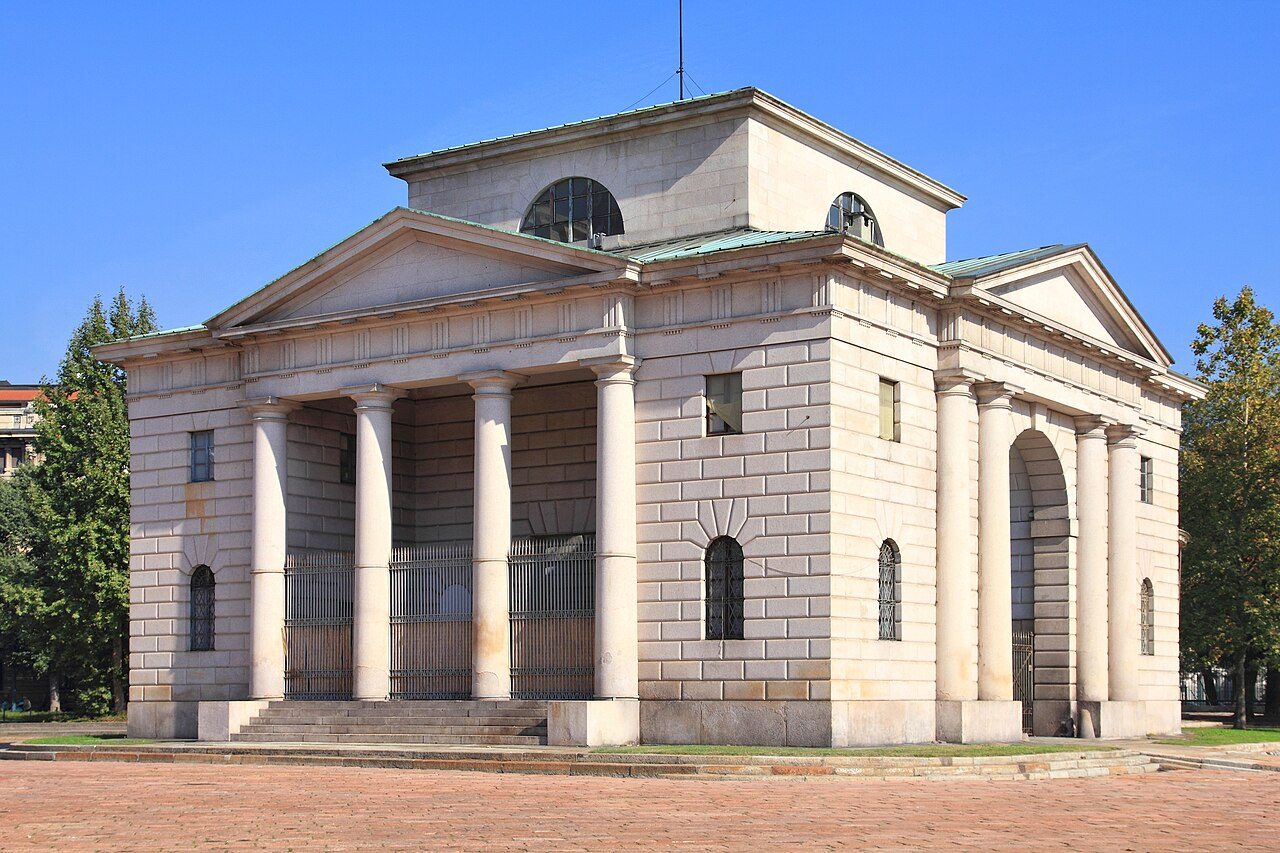
Flanking the arch are two low, identical buildings. What were they for?
The full story
Now turn your back on the arch. Ahead of you is an avenue as straight as a ruler, Corso Sempione, heading northwest. It is no ordinary avenue: it is the first stretch of a road that ends in Paris.
A road fit for an emperor
Napoleon wanted it, to link Milan to France over the Simplon Pass, the Sempione, in the Alps. Where the new road entered the city, an entrance to match was called for. That is why the arch stands here, on the edge of town, and not in a square in the center.
And that is why it is more than a monument. It is a gate, Porta Sempione, and in the 1800s a gate was also a customs post. The two low buildings at the sides are the : anyone bringing goods into the city stopped here and paid the duty.
The park owes its name to this road too. And when, a century later, a railway tunnel was dug beneath the same pass, Milan celebrated in the park, with a great exhibition.
Who came through here
The most famous entry is that of June 8, 1859. Four days earlier, at Magenta, the French and the Piedmontese had beaten the Austrians. Napoleon III, emperor of the French, and Vittorio Emanuele II, king of Sardinia, entered Milan through this gate, amid the crowds.
Picture the scene. The arch had been begun for the first Napoleon, the uncle. Half a century later it welcomed the nephew. Milan has not forgotten: in the park there is an equestrian monument to Napoleon III, by the sculptor Francesco Barzaghi.
Three arches in a row
This idea of a road between two capitals has made it into books as well. The American writer Ernest Hemingway, in his Paris memoir, describes an evening in front of the Arc du Carrousel. He looks toward the Arc de Triomphe and asks his wife whether it is true that the three arches are in line: those two and the one in Milan.
Whether they really are or not matters little. What matters is that someone, in Paris, thought of this arch as the other end of the same line.
Look down the avenue again. At the far end, the very far end, is Paris.
About this stop
Anecdote
Napoleon III, forty years in a courtyard
On a small rise in Milan's Parco Sempione stands an equestrian statue of Napoleon III, the emperor of the French who entered the city as a liberator in 1859. The sculptor Francesco Barzaghi modeled it around 1880, but Milan never managed to put it in a square: the political opposition was too strong. The emperor was not only the ally of 1859. In 1867 his soldiers had stopped General Giuseppe Garibaldi's volunteers at Mentana, near Rome. So the bronze ended up in the courtyard of the Palazzo del Senato, a palace downtown, half forgotten, and stayed there more than forty years. It reached the park only in 1927.
In culture
Hemingway and the three arches, Paris to Milan
Milan's Arco della Pace turns up in a memoir of Paris. The American writer Ernest Hemingway, in A Moveable Feast, describes an evening in the Tuileries gardens with his wife. They look through the Arc du Carrousel, and he asks her whether the three arches are really in a row: the two in Paris and the one in Milan, which in the book he calls "Sermione." Whether they truly line up or not, the question tells you what these arches had become in the imagination of those who looked at them: the two ends of the same road, the one Napoleon, emperor of the French, wanted between Paris and Milan.
Because of an Alpine pass. The Sempione, the Simplon in English, links Italy to Switzerland, and Napoleon wanted a road from Milan that would cross it and run all the way to Paris. The road entered the city right where the arch stands. From it the avenue, the gate, the square and finally the park took their names. In 1906, when the railway tunnel was opened beneath the same pass, Milan celebrated with an International Exhibition inside the park.
Next stop
Go back under the arch, enter the park and walk straight toward the Castello, to a concrete platform with six large panels