Stop 1 of 5Must-see
The Facade and the Portal
Where to stand
In the square, facing the church, far enough back to see the whole facade up to the three pinnacles
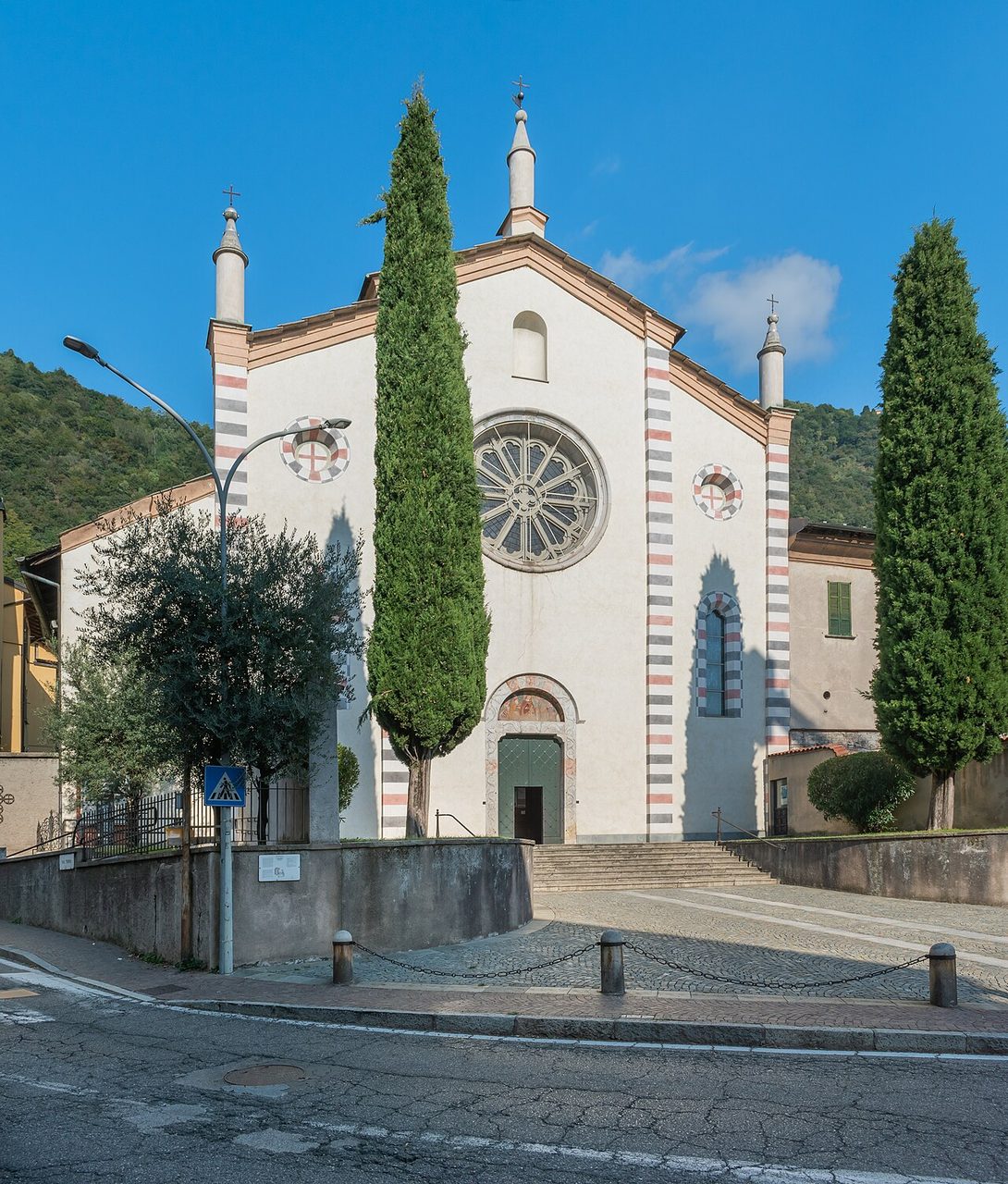
A simple facade that already sketches the interior: three parts outside, three aisles inside. The colors are the old ones, recovered by a restoration in 1995. Above the stone portal, a late 15th-century fresco survives with the saints of the house.
Spot the detail
Take a good look at the rose window in the middle of the facade: what is it made of?
The full story
Stand in the square and look at the outline. The center is taller, and the two sides slope down like shoulders. This is a , and it tells you in advance how the church is built inside: three parts outside, three aisles inside. Underlining the point are the , the shallow vertical bands that divide the wall, and three pinnacles on top.
Now look at the colors. Until a few decades ago this facade was painted to look like yellow stone blocks. In 1995 a restoration took it back to what must have been its old appearance: plaster in a single color, traced to the 16th century, and in bands of color. What you see is not a modern whim: it is an attempt to give the church back the clothes it once wore.
The portal and the fresco
The best part is in the middle, low down. The stone portal is from the 15th century, carved with flower motifs. Above it, in the , are the fragments of a fresco from the end of that century. It is damaged, but the subject is known: a Madonna and Child among four figures.
Scholars attribute it to Andrea De Passeri, a painter from Torno, on the lake, active in the late 1400s and early 1500s. Como's Duomo, the cathedral, has a Madonna delle Grazie by him.
The four figures in the fresco
The four figures were not picked at random. They are the family portrait of the people who ran the place.
There is Augustine, the saint whose rule the friars follow. There is Monica, his mother. There is Nicholas of Tolentino, one of the saints of the Augustinian order. And there is a woman from Como: Maddalena Albrici, abbess of the Augustinian convent at Brunate, on the hill above the city.
Here is a detail that makes the stop worthwhile. Maddalena had died in 1465, just a few decades before the fresco was painted. The friars put her straight in with the great saints of the order.
Rome took its time: her veneration was officially confirmed only in 1907. On this wall, the devotion of a neighborhood beat the paperwork by more than four centuries.
The square as it was
Before you go in, picture a different square. A wall once ran in front of the church, with two gates leading to the cemetery and the cloisters of the friary. One of the two still exists, bricked up. What now looks like a neighborhood church on a small square was the entrance to a little city of friars.
About this stop
Anecdote
Blessed, four centuries ahead of schedule
Above the portal of the church of Sant'Agostino, in Como, a late 15th-century fresco shows the Madonna among four figures dear to the Augustinians, the friars who built the church. Three are saints of the order: Augustine, his mother Monica, Nicholas of Tolentino. The fourth is a woman from Como: Maddalena Albrici, abbess of the Augustinian convent at Brunate, who died in 1465. The friars painted her among the saints a few decades after her death. Rome was slower. Her veneration as a blessed was confirmed by Pope Pius X only in 1907. After many moves, her relics have been together since 1998 in the church of Sant'Andrea in Brunate.
Legend
On January 17, the cars get blessed
Every January 17 the square in front of the church of Sant'Agostino, in Como, fills with cars waiting in line. They are waiting to be blessed. It is the feast of Saint Anthony the Abbot, the patron saint of animals, who has a statue inside the church, in the first chapel on the left: it comes from a nearby church dedicated to him, deconsecrated in the 18th century. Once, this was the day for blessing animals. Then engines came along, and the tradition adapted. Some people still bring their animals, pets or farm animals. The saint of the stables has learned to protect garages too.
Anecdote
A marble vine around the door
The portal of the church of Sant'Agostino, in Como, is from the 15th century, in white and red marble. Look at it up close: around the door run vine shoots, carved in relief among the flowers. This is no ordinary ornament. The vine gives wine, and the wine is the wine of the Mass: those who study the art of Como's churches call it the Eucharistic vine. Anyone going in passed under that sign before even seeing the altar. A city itinerary designed also for people who cannot see lists the relief among the things to touch. It is a sculpture you can read with your fingers too.
Anecdote
The painter who signed from Torno
The fresco above the portal of the church of Sant'Agostino, in Como, is unsigned: it is attributed to Andrea De Passeri, a painter from Torno, on the lake, documented between 1487 and 1517. A signature of his does exist, though, and it is the basis of what we know about him. It is on his first certain work, an Assumption painted for the church of Santa Tecla in Torno: next to the date, March 27, 1488, he wrote in Latin that Andrea De Passeri of Torno had painted it. The panel is now in the Pinacoteca di Brera, the picture gallery in Milan.
No. It is a fake rose window made of wood, fitted into the round window in the 19th century. What does belong to the old facade is the 15th-century stone portal, with its flower motifs, and the remains of the fresco in the . The colors have a story too: in 1995 a restoration removed the paint imitating yellow stone and took the facade back to what must have been its old appearance, with in bands of color.
This stop on the map
Next stop
Go in through the portal and stop at the start of the central nave