Stop 2 of 5Must-see
The Aisles and the Rediscovered Frescoes
Where to stand
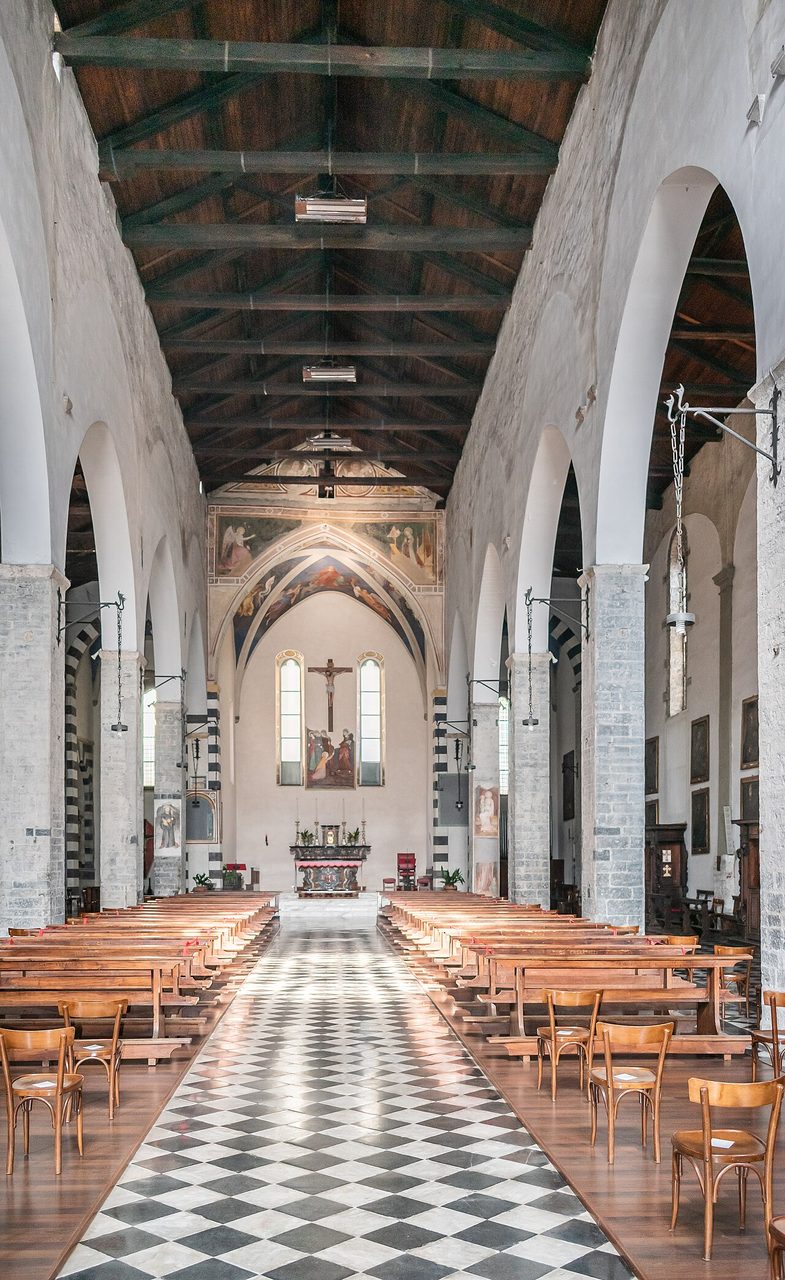
Inside, at the start of the central nave: look first at the ceiling, then down toward the altar
, an open timber roof, plain walls: this is the friars' Gothic, brought back to light in the 1960s after almost two centuries under a Neoclassical dress. At the far end, in the , the 14th-century frescoes remain.
Spot the detail
On the arch leading into the chancel, find an Annunciation: who keeps it company?
The full story
As soon as you are inside, look up. Above the nave there is no masonry vault but a wooden roof on , great triangles of beams left in plain sight.
Then look at the arches that separate the nave from the two side aisles: they end in a point. These are , the calling card of Gothic. And at the far end the three do not close with the usual curve, but with flat apses.
All very plain, and not by accident. The Augustinians were a : friars who lived on alms and preached among ordinary people. Their churches started out simple. This one, built in the 14th century, is the third the mendicants raised in Como, and today it is the city's only example of this stripped-down Gothic, usually associated with Cistercian monks.
Two centuries in Neoclassical dress
For almost two centuries, though, nobody saw it like this. In 1773, just after the friary was suppressed, the church became the parish church of the borgo, the suburb outside the walls, and was redone in the Neoclassical taste then in fashion. Between added vaults and new decoration, the wooden roof and the old frescoes disappeared from view. Only in the 1960s did a restoration demolish the added vaults, reopen the Gothic windows at the back of the and give the church back its roof.
So what you see is a Middle Ages won back. It is a choice, and you can argue with it: to recover the 14th century, a piece of the 18th was erased. I think it was worth it.
The frescoes in the chancel
Now walk toward the altar. The , the area around the altar reserved for the clergy, holds the oldest frescoes. They date from the end of the 14th century, the years when the church was consecrated: its first set of clothes.
They are fragments, so a little patience helps. There are a few prophets, the remains of a Crucifixion, an Annunciation on the arch in front of the altar. Other figures of saints, more fragmentary still, surface on the pillars along the nave.
One last thing. Within these walls, in 1393, Pietro Pioppi was buried, the man whose family had given the friars the land to build on. Whoever donated the ground earned a place in the church. It was the medieval way of staying on.
About this stop
It is described as the only church in the city in the Cistercian Gothic style, meaning that restrained Gothic of , flat apses, a wooden roof and very little decoration. It owes that partly to the restoration of the 1960s. Without that work you would still be looking at the Neoclassical dress of 1773, and you would never suspect the 14th-century forms underneath.
Next stop
Move to the left aisle and stop in front of the second chapel