Stop 4 of 6
The Torre di San Vitale
Where to stand
On the avenue, at the eastern end of the south side of the walls, at the foot of the corner tower
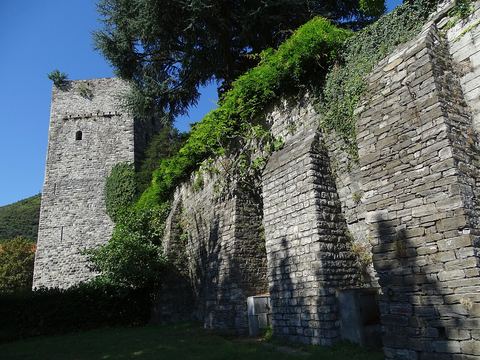
The tower that closes the walls to the east, about 36 meters tall. In all likelihood it is later than Porta Torre, and it is heavier and barer. Next to it is the Museo archeologico Paolo Giovio, the archaeological museum.
Spot the detail
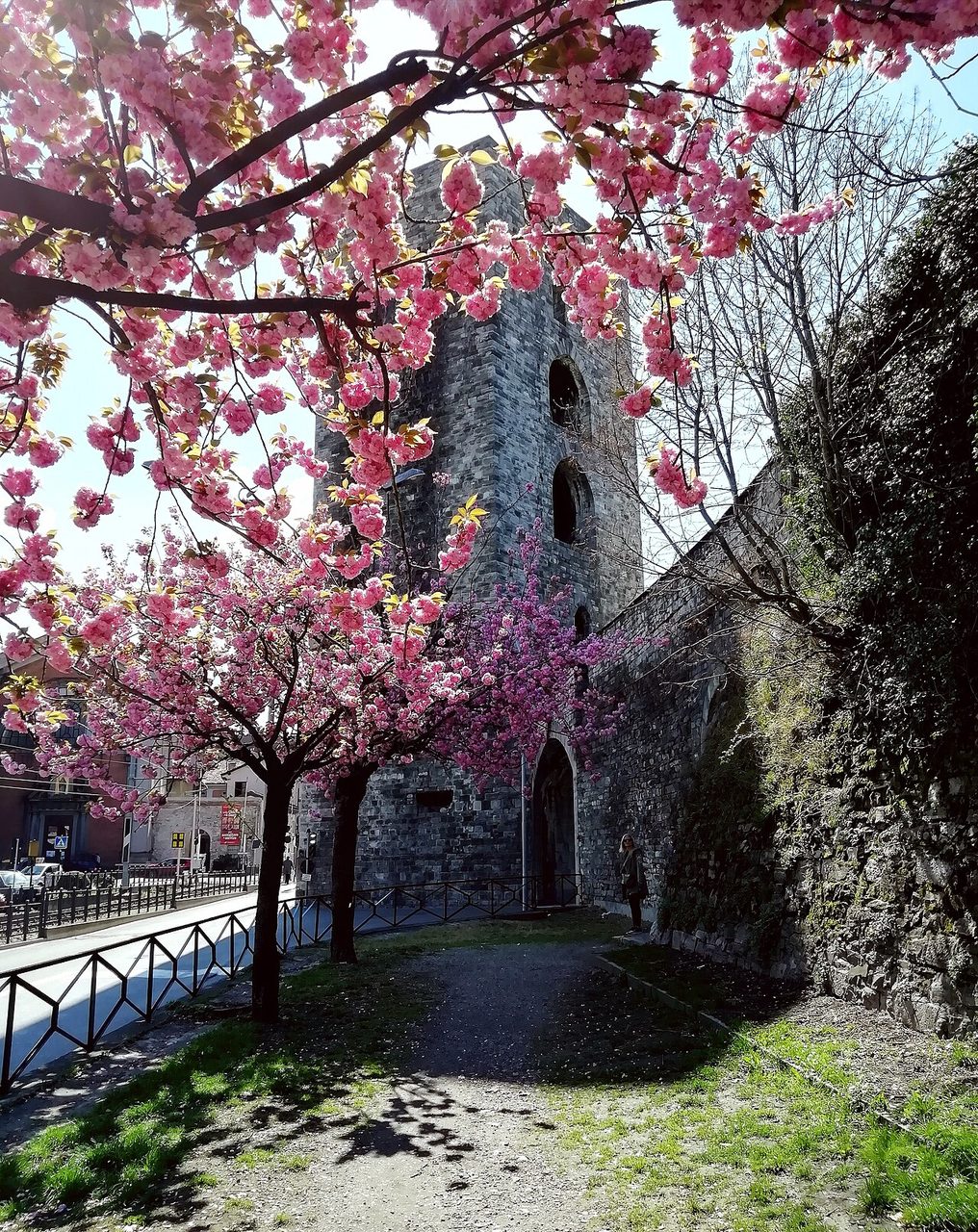
Look at the arched passages at the base of the tower: do they seem as old as the rest?
The full story
Here the walls turn a corner, and holding the corner is this: the Torre di San Vitale, the San Vitale tower, about 36 meters tall, around 120 feet, on a pentagonal plan. It makes a pair with the tower you will meet at the end of the route, at the opposite corner.
In all likelihood the two towers were built after Porta Torre, and it shows. They are more massive and less finished, with a few round-arched windows near the top. Nobody was meant to admire them. They just had to hold.
The passages you see at the base are not medieval: they were opened in the twentieth century to let the streetcar through, when it was decided to keep it out of the historic center.
The castle on the east side
From this corner the eastern side of the walls sets off, not nearly as well preserved, and with it begins a less heroic story. In the thirteenth century Como was split between factions, Guelphs against Ghibellines, and the fortifications began to serve against enemies within as well. It was then that the Rusca family built the Castello della Torre Rotonda, the castle of the round tower, on the east side.
In 1335 Azzone Visconti, lord of Milan, took Como, and that castle became a citadel with walls of its own, separating the rulers from the rest of the city. A fortress inside the fortress, pointed inward. Almost nothing is left: the citadel was destroyed by the people of Como themselves in the mid-fifteenth century, and the castle was demolished in the nineteenth to make room for the Teatro Sociale, the city theater.
The museum and the Roman walls
Next to the tower is the archaeological museum named after Paolo Giovio, a humanist from Como, and ancient sarcophagi and columns are gathered along this stretch of wall. It is the right place to remember that the medieval circuit traces the Roman one: same line, just slightly wider.
Eight centuries take their toll. Around 2022 a large stone came loose from the top of the tower, and the city had every tower in the circuit inspected.
Porta Torre is the face of the walls, the part made to be looked at. This is the shoulder: less handsome, but it is the one that holds.
This stop on the map
Next stop
Go back along the avenue, pass Porta Torre, and keep going with an eye on the top of the walls