Stop 6 of 8
The Salone d'Onore and the Angel Lunettes
Where to stand
One floor up, in the Salone d'Onore, the hall of honor: stand in the middle and look up at the two great half-moon canvases
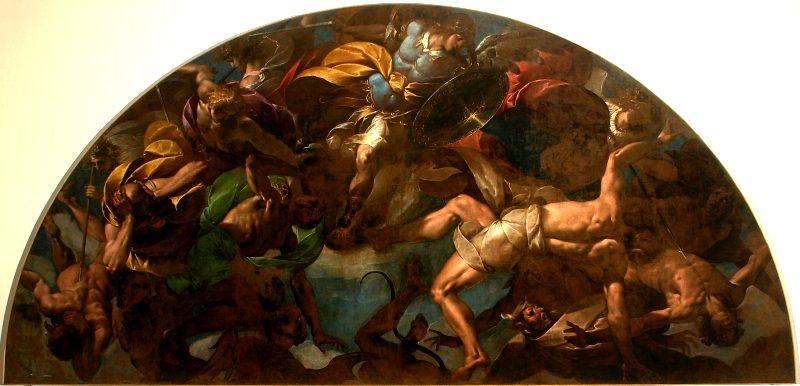
Two canvases seven meters wide, painted for a powerful family's chapel in a church that no longer exists. They tell of the same battle in heaven: the archangel Michael against the rebel angels. Around them, the of the suppressed churches.
Spot the detail
In each of the two lunettes look for the losers: how far along is the battle?
The full story
This is the palazzo's reception hall, and the museum has given it over to its bulkiest canvases. They are two , meaning half-moon-shaped paintings, each seven meters wide, about 23 feet. They were not made for a hall: they hung in the same chapel, in a church.
The Gallio family chapel
The church was San Giovanni in Pedemonte, of the Dominican friars. The chapel belonged to the Gallio family, the family of Cardinal Tolomeo Gallio. The subject suited the place. The convent housed the tribunal of the Inquisition, and nothing spoke against heresy better than an archangel hurling disobedient angels down from heaven.
Two lunettes compared
The first is by Morazzone, the nickname of Pier Francesco Mazzucchelli, one of the great Lombard painters of the early seventeenth century. He painted it around 1610. It is a tangle of plunging bodies: Michael with weapons in hand, the rebels driven toward hell. It is considered one of his most dramatic and spectacular compositions.
The second came a generation later and is attributed to Carlo Francesco Nuvolone. Same archangel, different moment: no longer the brawl but the victory, with a whirlwind of angels celebrating around the winner. Compare them and you see taste change in thirty years: more drama and more muscle in the first, more air and more light in the second.
Between them the museum has placed a third Fall of the Rebel Angels, by Paolo Pagani, a painter of the late seventeenth century. Three versions of the same downfall in a single room.
And the church? Gone, along with the whole convent. The name survives, though: in its place today stands the Como San Giovanni railway station.
The rooms around the hall
The rooms around continue the same story. They hold altarpieces and large sacred canvases orphaned when, between the end of the eighteenth century and the age of Napoleon, convents and churches were suppressed. Between one saint and the next, look for a bareheaded young man in armor. He is Vespasiano Gonzaga, the duke of Sabbioneta, portrayed by Bernardino Campi: for a long time the picture was believed to be by the Flemish painter Antonis Mor.
Next stop
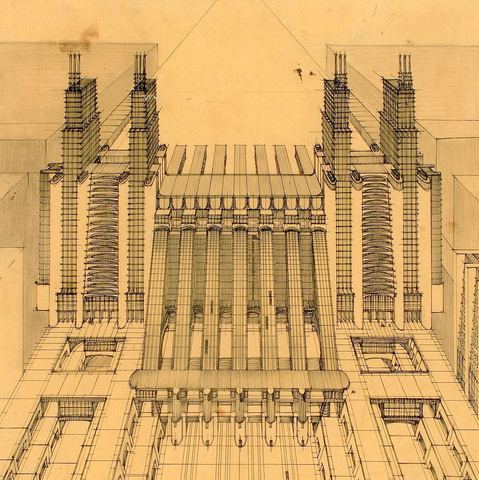
Go up to the top floor, devoted to the twentieth century, and look for the drawings of Antonio Sant'Elia