Stop 4 of 8Must-see
The looms and the Jacquard system
Where to stand
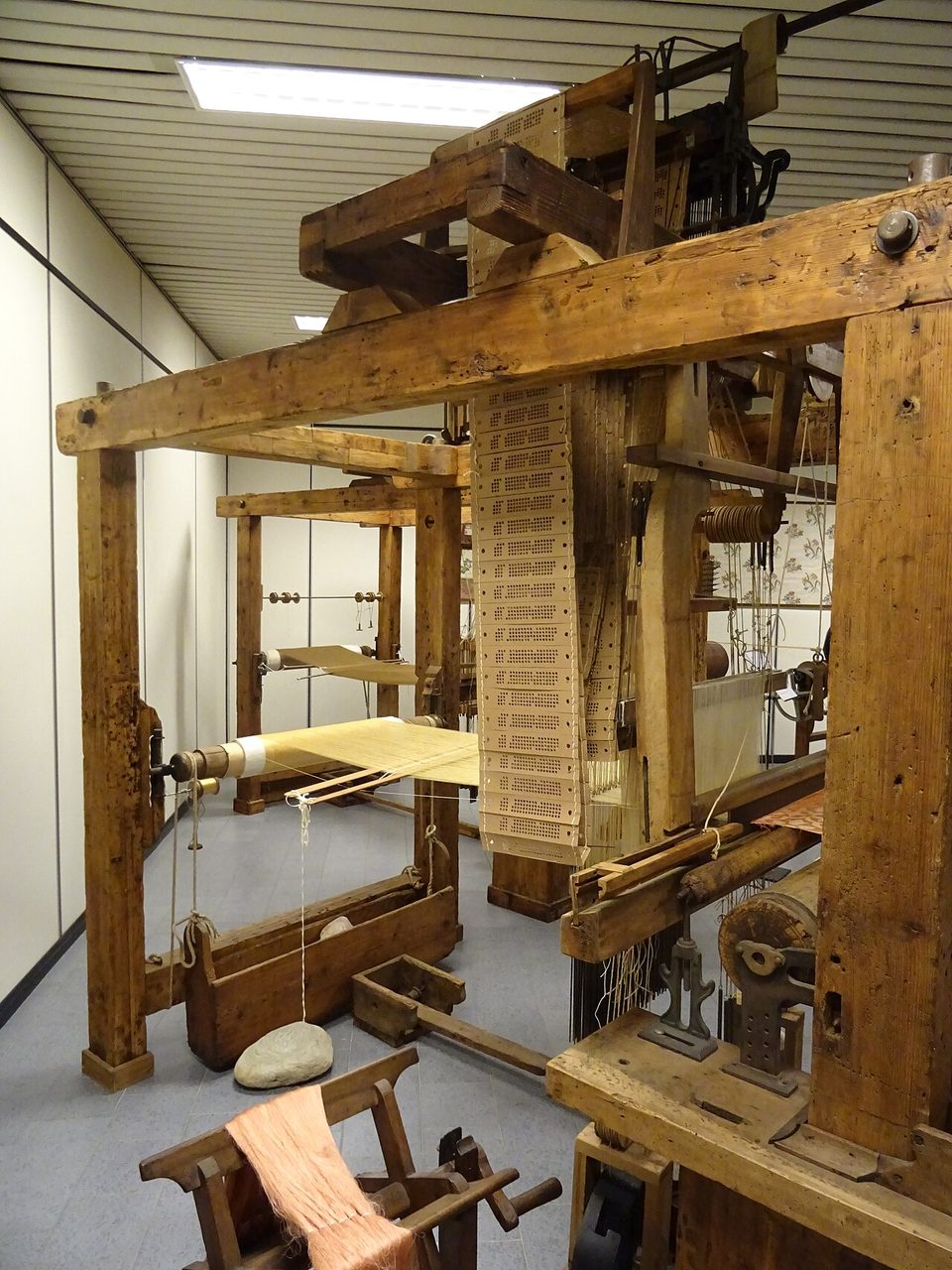
In the weaving section, in front of the handloom with the chain of punched cards
This is where thread becomes cloth. The handlooms show how and weft interlace; the Jacquard loom, with its punched cards, shows how a pattern is woven. And it looks a lot like a computer.
Spot the detail
The cards tied in a row on the Jacquard loom: look closely at the holes
The full story
Weaving means crossing two sets of threads. The vertical ones, stretched on the loom, are the . The horizontal one, running across them, is the weft. Everything else is ingenuity for doing it fast and well.
How the handloom works
Start with the wooden handlooms. The threads come off a roller, the warp beam, and pass through the eyes of the heddles, which lift some of them and leave the others where they are.
Between the raised threads and the still ones a gap opens, which weavers call the shed. The weft thread passes through it. Then the reed beats, pressing the new thread against the ones before it, and the cycle starts again.
Jacquard's punched cards
Heddles give you fabrics with a simple weave. For a complicated pattern you have to control the threads almost one by one. That is what the system developed in the early 1800s by the Frenchman Joseph-Marie Jacquard does, and here you see it mounted on a handloom from the end of that century.
A chain of punched cards runs over the loom. Where there is a hole, a hooked needle lifts a single thread. Where there is none, the thread stays down.
The pattern, in other words, is written in the holes. The weaver no longer has to keep it in mind: the machine reads it. Fabrics made this way are called figured fabrics.
From loom to computer
Does that remind you of something? It should. Hole or no hole is binary code, and that chain of cards is a program.
Charles Babbage, the English mathematician who in the 1800s designed a calculating machine that was a forerunner of the computer, planned to give it instructions with punched cards of exactly this kind. He owned a portrait of Jacquard woven in silk: it had taken 24,000 cards to make.
Not everyone applauded. At first the invention was opposed by weavers, who feared losing their jobs. It spread quickly across Europe all the same.
Finish the round with the power looms. They were made in Como by the firm OMITA and date from the 1930s and 1940s. By then the weaver no longer drives the machine: he sets it up and watches over it. If you have time for only one thing in the whole museum, though, go back to the punched cards.
About this stop
In culture
The loom that taught computers
In the weaving section of the Museo della Seta, Como's silk museum, stands a Jacquard loom driven by a chain of punched cards: the system devised in the early 1800s by the Frenchman Joseph-Marie Jacquard. Those cards are considered an ancestor of the computer. Charles Babbage, the English mathematician who designed the analytical engine, planned to program it with punched cards like the weavers'. He owned a portrait of Jacquard woven in silk in 1839: it took 24,000 cards. In 1890 punched cards processed the American census, and from there entered the computing industry. When you look at those cards stitched in a row, you are looking at a program.
Next stop
Continue toward the scales and ovens of the measuring instruments