Stop 5 of 8
The laboratories: measuring and inventing color
Where to stand
Among the scales and ovens of the measuring instruments, then at the bench of the chemistry lab
Silk was worth a lot and had to be checked with no cheating. Here are the instruments that measured it, including the one that tested parachute silk, and the laboratory where color recipes were born.
Spot the detail
The glass jars full of colored powders: how old are they?
The full story
So far you have seen hands and machines. Here mistrust comes on stage. Silk was worth a lot and passed from hand to hand among those who reeled it, those who twisted it and those who wove it. Each of them wanted to know what they were buying.
The measuring instruments
Look at the big ovens. They are called conditioning ovens and date from the mid-1800s. They served a check that seems surprising today: moisture.
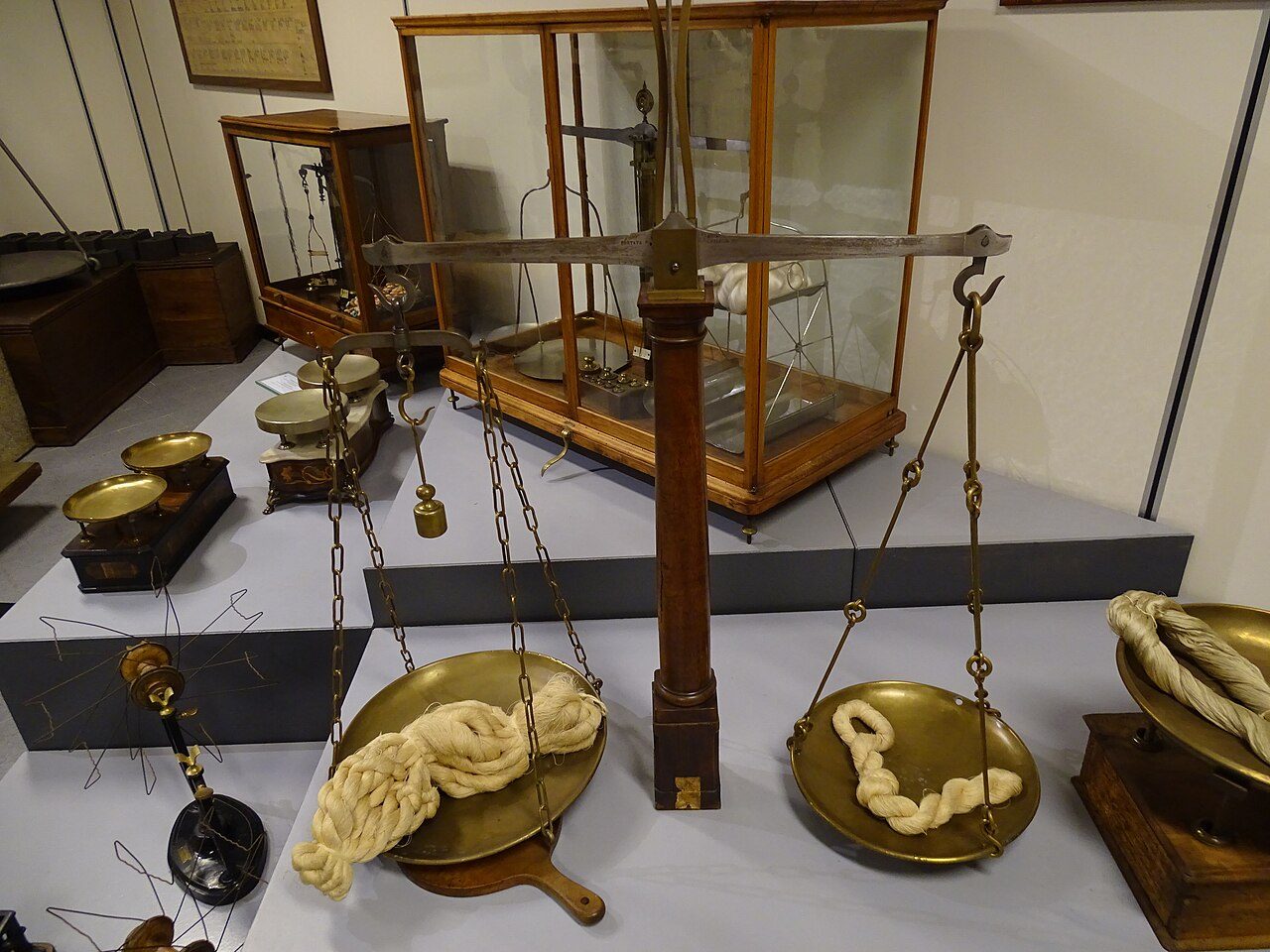
Skeins had to be weighed, and a damp skein weighs more. In the ovens the silk was brought to a standard moisture level, the same for everyone, and only then went on the scale. It was the way to prevent fraud.
Around them are the other judges: the seriplane, the dynamometer, the twist testers, the precision scales. They tested the thread's sturdiness, tensile strength and resistance, because good silk is above all consistent silk. Many of these instruments were a gift from Como's Chamber of Commerce.
One deserves a stop. It is the burst tester, which measures how much strain a fabric can take. During the Second World War, silk in Como was made into parachutes for airborne troops, and it was this very instrument, the museum says, that certified its quality. Few measurements have had such direct consequences.
The color laboratory
Then change benches. The chemistry lab has been reconstructed with period furniture and instruments, and it tells the story of the silk trade's other obsession: color. Silk is rarely used in its natural color.
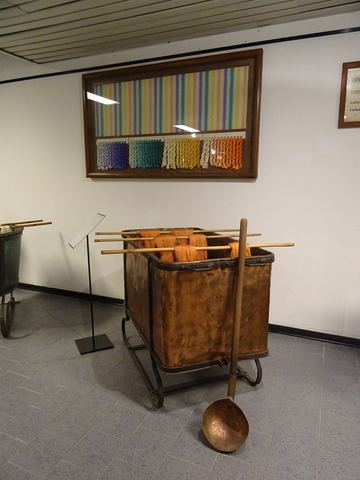
For centuries it was dyed with natural dyes, which had a serious flaw for an industry: it was impossible to get the same shade every time. Between the late 1800s and the early 1900s, the years of Como's great industrial boom, the switch to chemical substances was almost complete. They were more durable and easier to use.
The key word is aniline. It is the source of one of the first synthetic dyes, a purple discovered by accident in 1856 by William Henry Perkin, an eighteen-year-old Englishman who was trying to make quinine. In laboratories like this one, color recipes were written and dyes were tried out on a small scale, before risking a whole batch.
Measurement and recipe: this is where silk stops being just a trade and becomes a science.
About this stop
Anecdote
The silk that came down from the sky
Among the measuring instruments of the Museo della Seta, Como's silk museum, in the laboratory section, is a burst tester, the device that checks how much strain a fabric can take. It has a military past. During the Second World War, silk in Como was used to make parachutes for airborne troops, and the quality of that silk was certified with this very instrument. The museum itself tells the story. Look at it with that in mind: for a few years, a lab test carried out here decided whether a cloth was good enough to hold a man in the air.
Next stop
Continue toward the vats of the dye works, where the recipes turned into color