Stop 1 of 8Must-see
The silkworm
Where to stand
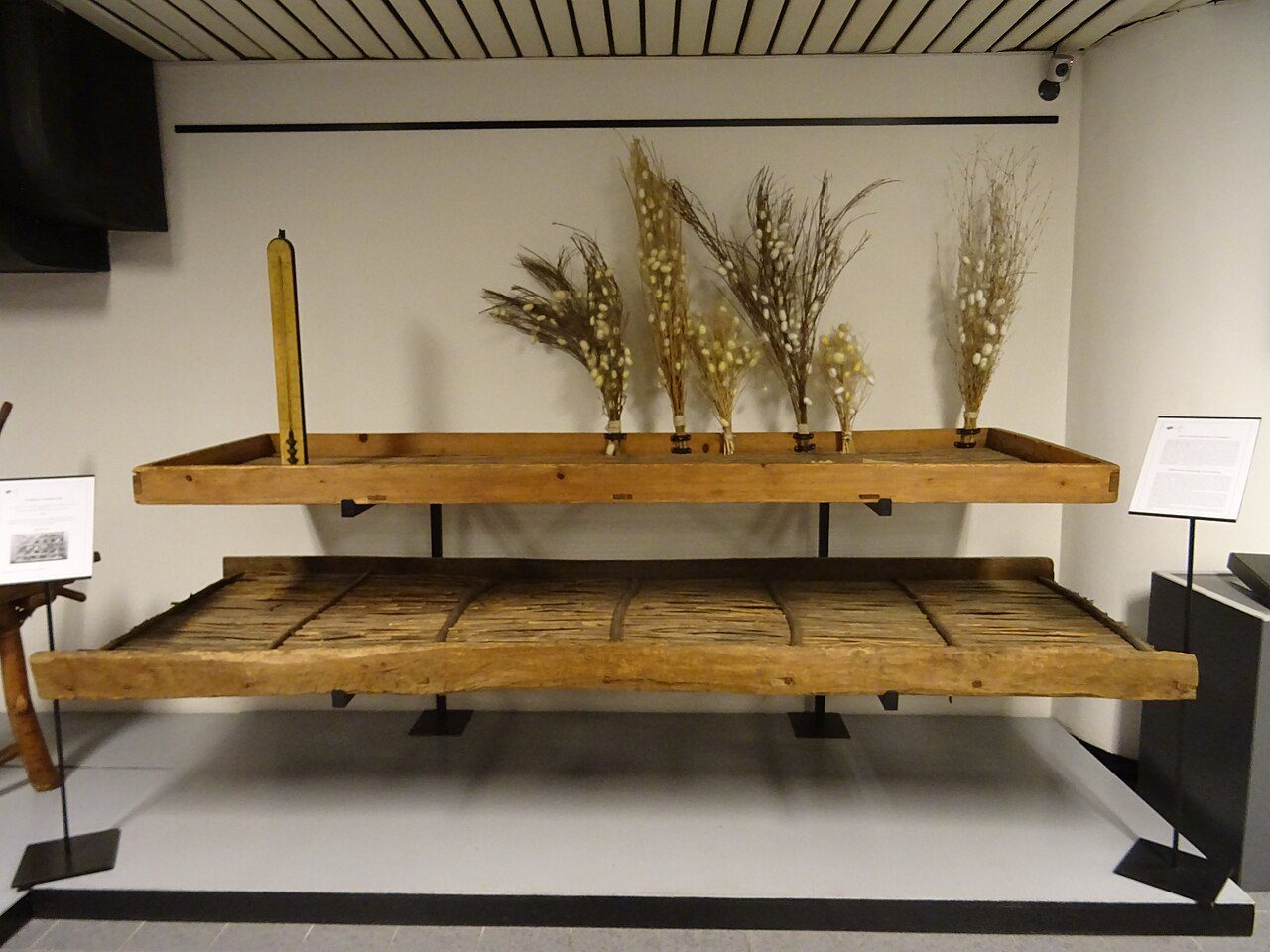
At the start of the route, facing the reed racks and the dry branches loaded with cocoons
It all starts with a caterpillar that eats nothing but mulberry leaves. In two or three days it seals itself inside a made of a single thread: the raw material of everything you will see in the museum.
Spot the detail
The dry branches covered in pale tufts: what are they?
The full story
Before the machines, an animal. Its name is Bombyx mori, the silkworm to everyone else, and it is a fussy eater: it feeds only on mulberry leaves. That is why anyone who raised silkworms also grew mulberry trees. The Italian technical term, gelsibachicoltura, packs both jobs into one word.
Where silkworms were raised
Look at the racks in front of you. These are the rearing beds, made of humble materials, marsh reeds or strips of wood. The newly hatched silkworms were laid on top.
They were not raised in a factory but in farmhouses across the plains and hills of northern Italy, in a room kept at a steady temperature and well aired. It was extra work to bring in a little more money, and it fell mostly to women and children.
One cocoon, a single thread
Then comes the moment that gives it all a point. Once fully grown, the silkworm goes to the woods, as the trade puts it: it climbs a branch and starts to release a fine filament that hardens the instant it meets the air.
The thread is made of two substances. Fibroin is the silk itself. is the glue that holds it together.
In two or three days the caterpillar wraps itself in a made of one unbroken thread. The museum says two kilometers, well over a mile; other sources give anything from a few hundred meters to a kilometer and a half. Either way it is a single thread, and a very long one.
Here the story turns cruel. If the moth comes out, it opens a hole in the and breaks the thread into thousands of useless pieces. So the cocoons were gathered beforehand and put through drying ovens. Only some were left to hatch, to guarantee the next generation.
The legend and the hot water
How anyone thought of unwinding a is explained by a Chinese legend. The empress Leizu was drinking tea when a cocoon fell into her steaming cup and began to come apart into a gleaming thread.
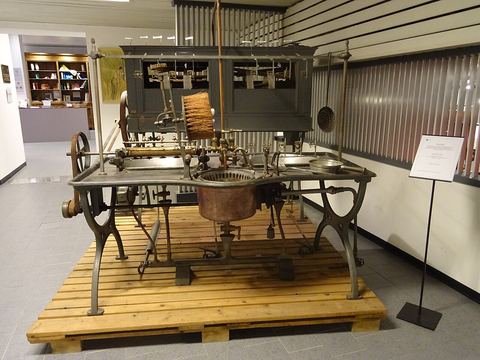
It is a legend, nothing more. But one detail is accurate, and you will meet it again at the next machine: you need hot water.
This is also the only stage of the process no longer carried out in Italy. Today the come from countries such as Vietnam, India and Cambodia. Everything else, from this point on, is still done in Como.
About this stop
Legend
The empress's cup of tea
The Museo della Seta, Como's silk museum, begins with the silkworms, and according to Chinese legend silk itself began by accident, almost five thousand years ago. Leizu, wife of the mythical Yellow Emperor, was drinking tea when a fell into her cup and began to come apart into a fine thread. Curious, she unwound it. Tradition also credits her with inventing the silk loom. How much of it is true, nobody knows. But the detail about the hot water is accurate: that is exactly how cocoons were softened in the mill to find the end of the thread.
In culture
Pliny and the silk that grew on trees
At the Museo della Seta, Como's silk museum, everything starts with the silkworm. But Pliny the Elder, the Roman writer born in Como in 23 AD, was convinced that Eastern silk grew on trees. In his Naturalis historia he says the Seres, the distant people it came from, combed it off wet leaves like white down. On the rest he had clear ideas. So much labor, he writes, so Roman ladies can appear in public in see-through clothes. And he reckons that India, the Seres and Arabia drain the empire of one hundred million sesterces a year. Almost fifteen centuries later, his city would make a trade of it.
No. Raising silkworms is the only stage of the process no longer carried out in Italy: according to the museum, the now come from countries such as Vietnam, India and Cambodia. In the 1970s the Chamber of Commerce tried to revive it with an experimental center at Cassina Rizzardi, near Como, but the experiment ended in 1980. What has stayed in the city is what comes afterward: dyeing, printing and . And that is a lot: again according to the museum, more than 70 percent of the silk that reaches Europe passes through here.
Next stop
Walk on to the filandina, the machine with the basins where cocoons become thread