Stop 4 of 6
Beyond the glass: the assembly hall
Where to stand
Still in front of the entrance, as close to the glass as you can get, looking inside
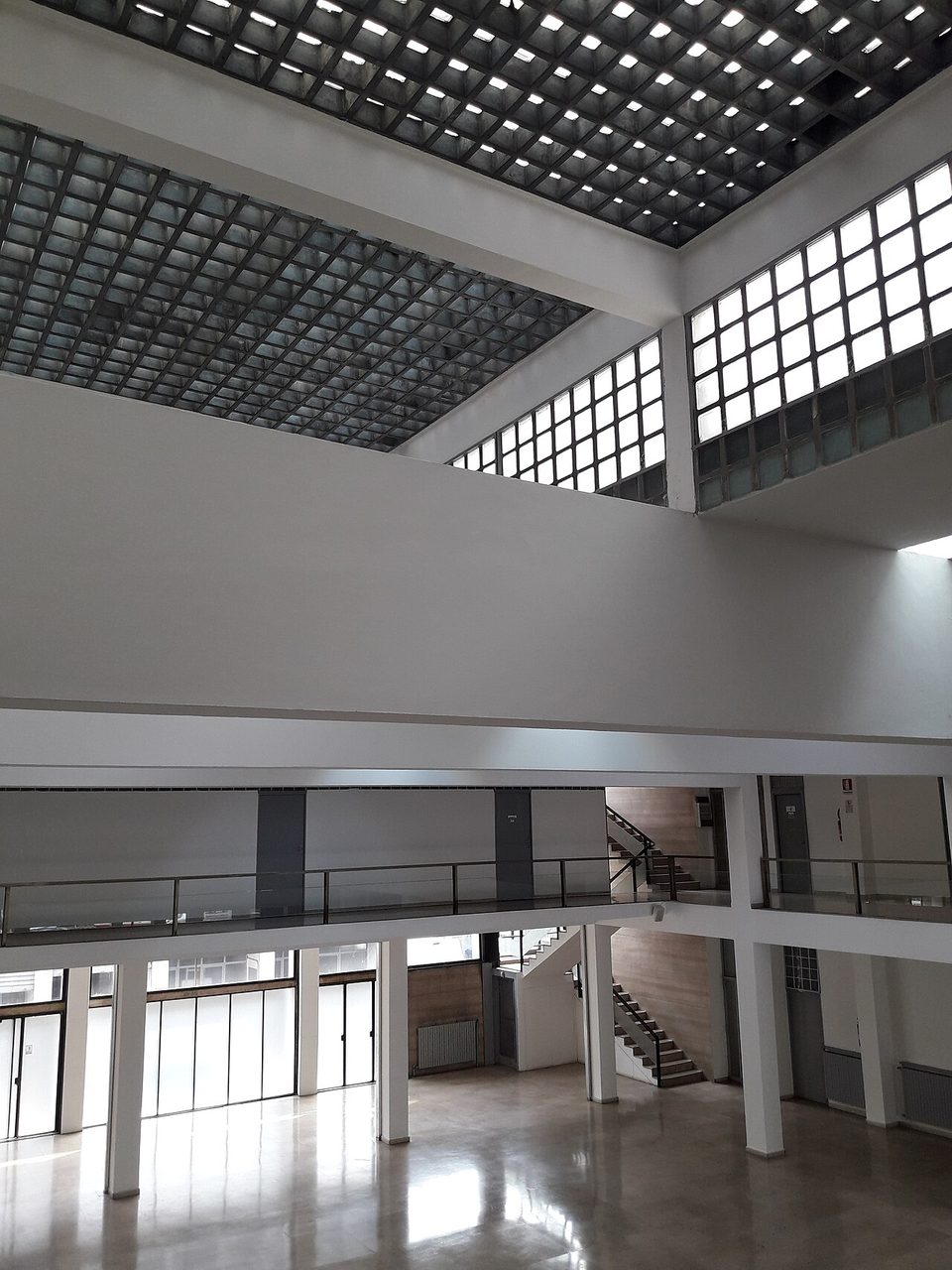
The heart of the building is a void: a hall two stories high, lit by a glass ceiling. Today it is white and bare. Originally it was colored and filled with abstract works, later destroyed.
Spot the detail
Beyond the atrium, find where the light in the large central hall comes from
The full story
The whole building revolves around a void. Beyond the atrium opens the assembly hall, two stories high. It is the courtyard of the old Italian palazzo, closed at the top by a glass roof.
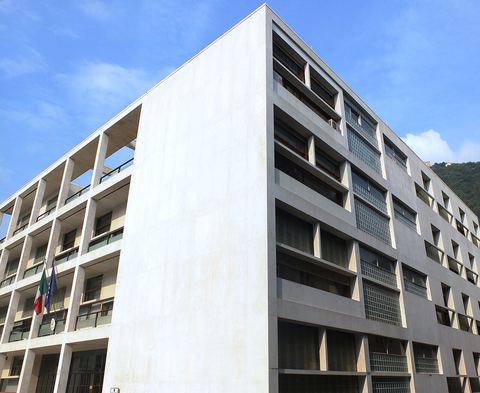
The building is a working command post, so you will probably only see it from here, through the doors. That is fine: it was made to be looked at from outside too.
One floor up, a overlooks the hall and leads to the rooms that mattered: the political secretariat, the boardroom of the party directorate, the office of the , the party chief for the province. Those in command worked in plain view: two of the boardroom's four walls were plate glass. From above, the ceiling lets light fall into the center of the building.
The lost colors and artworks
Today the walls and ceilings are white. It was not always so: originally the hall was tinted a very pale blue-green. And it was anything but bare. Between 1936 and 1938 the Como painter Mario Radice filled it with abstract works conceived for this very space.
The main piece was a block of marble more than four meters tall, with three words cut clean through it: order, authority, justice. The light from the entrance doors, passing through the openings, seemed to write them. Beside it, sealed between two sheets of plate glass, was the silhouette of Mussolini in gilded metal.
The whole thing was semitransparent, so that from outside the eye could pass through the building from one front to the other. Hanging from the pillars, on metal bars, were large panels with geometric shapes and slogans of the regime.
A unique case in Italy
For the scholar Cristina Casero it was a unique case: the only cycle of abstract paintings made in Italy in the years when public walls were being covered with grand celebratory murals. Avant-garde art in the service of a dictatorship, without embarrassment.
Nothing is left of it, apart from a few photographs. After the Liberation, in 1945, the building was occupied by the anti-Fascist parties and Radice's works were destroyed.
The white you see, in short, is not the purity Terragni intended. It is what remains once the regime has been removed.
About this stop
Record
Abstract art for the regime, then destroyed
In the 1930s the walls of Italian public buildings were being covered with grand celebratory murals. In the main hall of the Casa del Fascio in Como, the Fascist party headquarters, something different happened: the Como painter Mario Radice made compositions of pure geometry, worked out from the proportions of the architecture, with room on them for slogans, symbols and photographic portraits of Mussolini. According to the scholar Cristina Casero, it was the only cycle of abstract paintings made in Italy in that period. It lasted less than ten years: after the Liberation it was destroyed, and today we know it from a few photographs.
In culture
The chair that bounces
The architect Giuseppe Terragni did not stop at the walls: for the Casa del Fascio in Como he designed everything, from the window frames to the furniture. That includes a small armchair and a chair, the Lariana, both made of steel tube. The idea is simple and strange: the backrest is separate from the seat, and each springs on its own. The Columbus company made them in 1936. The American architect Steven Holl wrote that in that wobble you feel Terragni's joy of invention, like a stifled laugh. Decades later the Lariana went back into production, and a 1936 example is in the Vitra Design Museum, in Germany.
Offices. Since 1957 the building has been assigned to the Guardia di Finanza, Italy's financial police, which has a command here and a small historical collection. The walls are all white, the regime's symbols are long gone, and the in the atrium now honors the fallen of the Fiamme Gialle, the Yellow Flames, as the financial police are known. The architecture has remained, though: the atrium with its black marble ceiling, the double-height hall with its roof, the , the main staircase. A chapel was added in 1969.
Next stop
Turn the corner on the side of the facade's solid wall: you are on Via dei Partigiani