Stop 8 of 8
The sacello of the martyrs
Where to stand
To the left of the apse, through the door under the left choir loft; if it is closed, stop in front of it
A miniature church beside the , built between the late 4th and the 5th century. Tradition ties it to the three martyrs of Anaunia: the missionaries behind the legend of the doves of Legnano.
Spot the detail
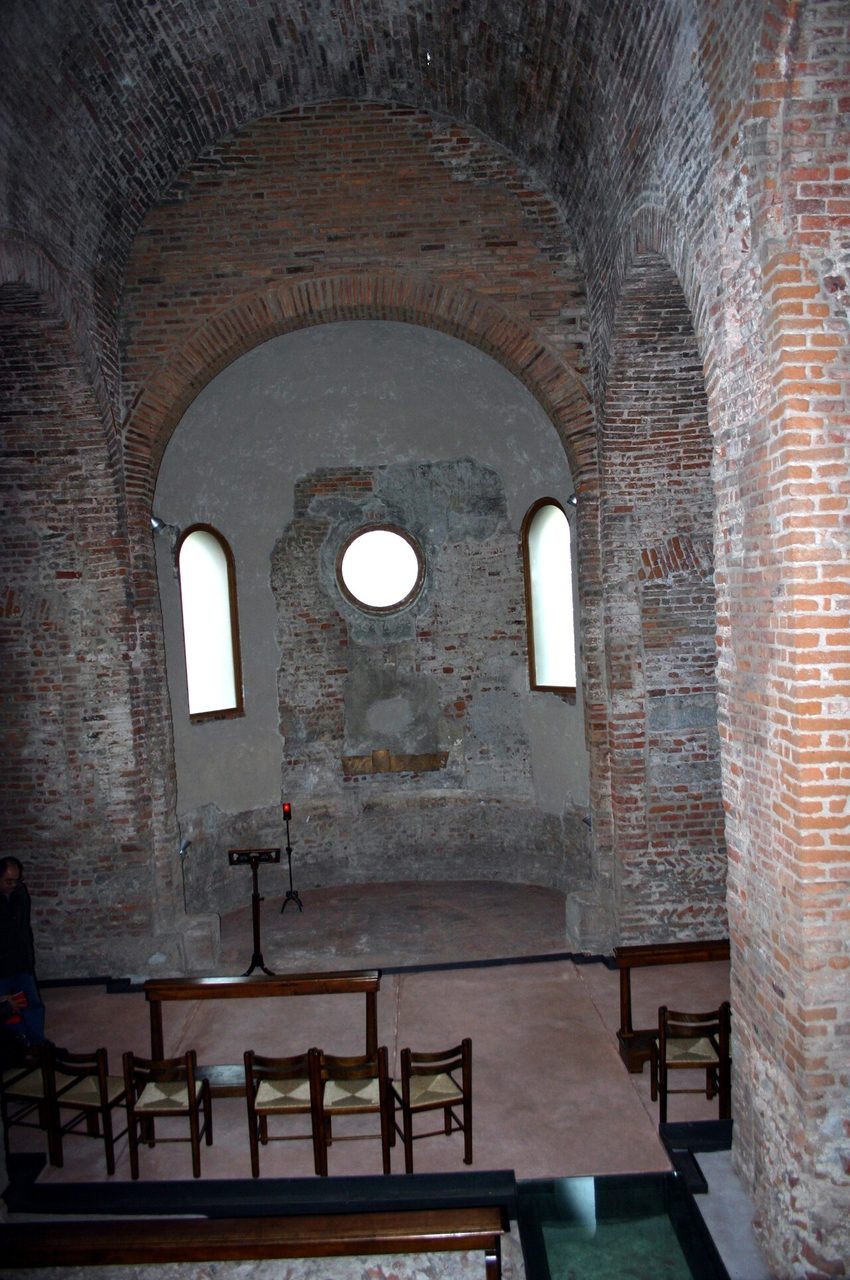
The sacello repeats the shape of a church in miniature. Which parts can you recognize?
The full story
This is the most intimate part of the basilica, and one of the oldest. The is a small chapel north of the , with an apse and a vault of its own. Archaeologists, studying the walls, date it between the late 4th and the 5th century: shortly after the main church.
It was probably built as a place of burial or remembrance for venerated people. Tradition ties it to the three saints you have met all through the visit.
Three missionaries in Val di Non
Their names were Sisinnio, Martirio and Alessandro. They came from Cappadocia, in what is now Turkey, and had arrived in Milan in the time of Ambrose. The bishop sent them to Anaunia, that is Val di Non, in the mountains of Trentino. Vigilius, bishop of Trento, had asked for them, for a land that was still pagan.
Up there they built a church and made converts. On May 29, 397, during a pagan festival of the fields, they were attacked and killed. According to the ancient account, their bodies ended up on a pyre.
Vigilius gathered what remained and sent part of it to Milan, to Simpliciano, who had just become bishop. The letter that accompanied the relics still exists. Simpliciano laid them in this basilica, and a few years later he was buried here too.
From the Alps to Legnano
The rest you know. The day of their death, May 29, is the same as the battle of Legnano, almost eight centuries later. To the Milanese it did not seem a coincidence. Three martyrs, three doves: the legend was ready.
The amphorae in the vault
One last thing, which you cannot see but is worth knowing. In the vault of the , whole amphorae were found, embedded in the mortar. The builders put them there to support the structure of the roof. The same technique turns up in Milan in the ancient chapels of the Basilica di San Lorenzo Maggiore.
It is a good way to say goodbye to San Simpliciano. Here the oldest things are the ones you notice least: the walls beneath the medieval look, the amphorae inside the vault, three missionaries behind a legend of doves. You just have to know where to look.
About this stop
Anecdote
The amphorae in the vault
In the vault of the of the martyrs, a small chapel beside the of San Simpliciano, archaeologists found a surprise: whole amphorae, embedded in the mortar. The builders had put them there to support the structure of the roof. It is not an isolated case. The same technique has been identified in Milan in two other ancient chapels, Sant'Ippolito and Sant'Aquilino, both in the Basilica di San Lorenzo Maggiore. The sacello, dated to the 5th century on the basis of its masonry, is only slightly younger than the basilica.
Three clerics who came from Cappadocia: Sisinnio, a deacon, Martirio, a lector, and Alessandro, a doorkeeper, the keeper of the church. Ambrose sent them to Anaunia, today's Val di Non in Trentino, at the request of Vigilius, bishop of Trento. On May 29, 397, they were killed during a pagan festival. Vigilius sent part of the relics to Simpliciano, who laid them in this basilica. At the site of the martyrdom, in Sanzeno, a basilica dedicated to them stands today.