Stop 4 of 8
The nave
Where to stand
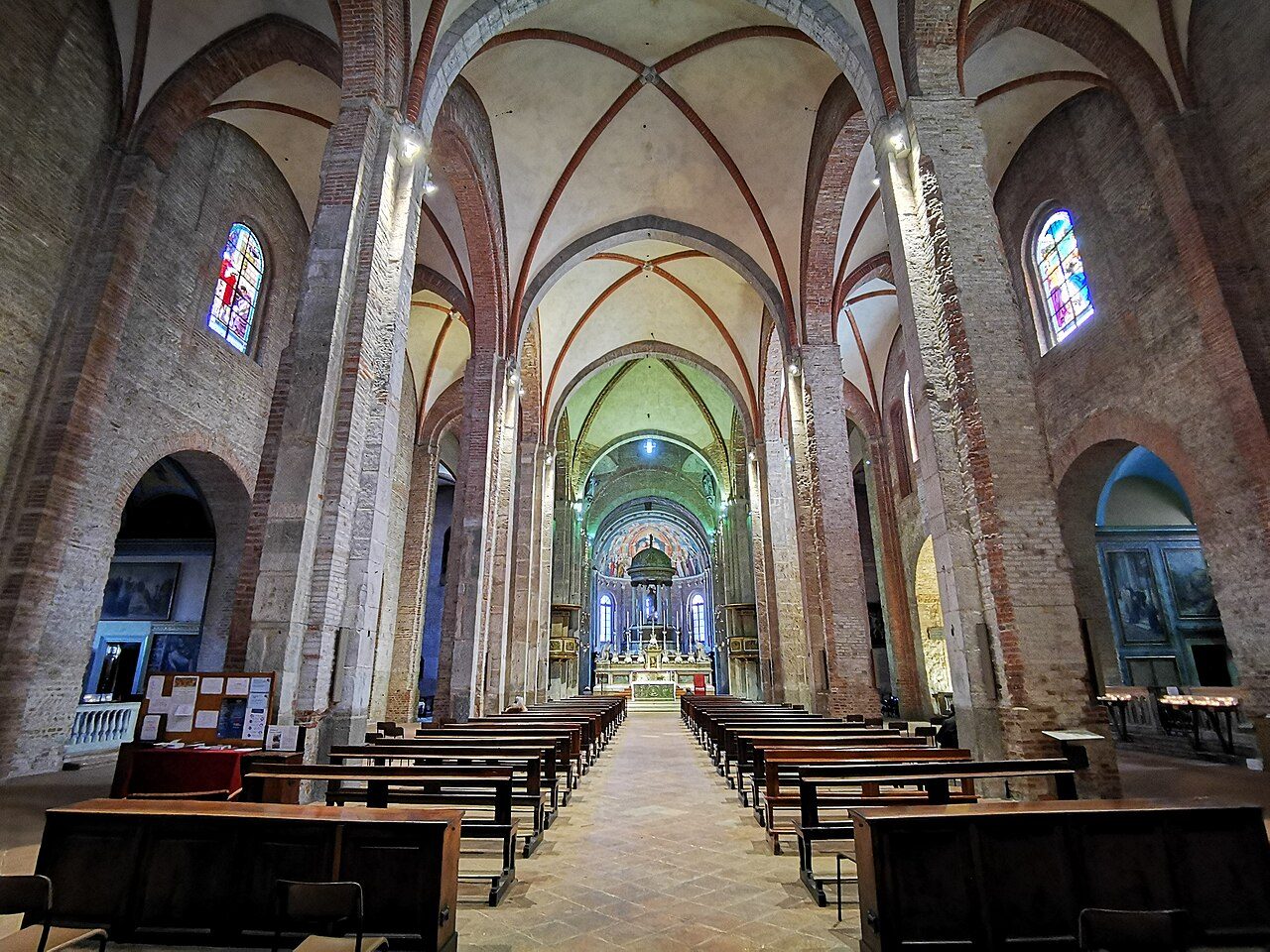
Just inside, at the start of the nave, with your back to the portal
A nave and two aisles of equal height, round brick pillars, little decoration. The space is still that of the 4th-century hall: the supports and the vaults were added in the Middle Ages.
Spot the detail
Compare the nave with the two side aisles. Which is the tallest?
The full story
The first impression is of space and silence. Little gold, little stucco, a lot of brick. In a city of heavily decorated churches, San Simpliciano seems almost empty. It is an emptiness with a history.
The perimeter, the walls, the height: everything around you is the 4th-century hall you saw from outside. At first it was a single room, with no supports and a roof of wooden beams. The floor lay almost two meters below the one you are walking on.
Who put in the pillars
The first to divide it were the Lombards, between the 6th and 7th centuries. They raised the floor, planted large pillars and rebuilt the roof. One tile from that roof survives, stamped with the mark of Agilulf, their king.
The round pillars of brick and the vaults you see are medieval instead, from between the 11th and 12th centuries. The nave and both aisles all reach the same height. Along the sides, from the 1400s on, chapels were added.
The restoration that went wrong
Between 1838 and 1841 the architect Giulio Aluisetti set out to modernize the church. He stripped away old plaster and capitals, demolished some Romanesque pillars and covered walls and vaults with decoration. The result has been heavily criticized: for today's scholars it falsified the look of the basilica.
The restorations of the 1900s did the reverse. Out with the additions, back to the brick. The bare church you see is the result of that cleanup.
An organ for Bach
Above the entrance, behind you, is a large organ. It was built in the early 1990s by the German Jürgen Ahrend, modeled on the Baroque organs of Germany.
A committee of Milanese enthusiasts wanted it, with the backing of the city government. Since then it has been the city's benchmark instrument for the music of Johann Sebastian Bach. If you happen to hear it played, stop: it was made for this space.
About this stop
In culture
A German organ for Bach
Above the entrance of the basilica of San Simpliciano is an instrument that has become a benchmark in Milan. It is the organ built in the early 1990s by the German Jürgen Ahrend, modeled on the Baroque organs of his country, on the initiative of a committee of enthusiasts backed by the city government. It is designed for the music of Johann Sebastian Bach. The concert series Bach in Basilica, directed by the organist Lorenzo Ghielmi and by Gianluca Capuano, reached its third edition in 2025. The basilica has also hosted concerts of the MITO SettembreMusica festival.
Because the restorations of the 1900s chose to take away rather than add. In the 1800s the architect Giulio Aluisetti had covered walls and vaults with decoration and removed old capitals and plaster: work that, according to scholars, falsified the church. After World War II those additions were eliminated, to bring the brick and the oldest forms back into view. The result is an austere interior, where space and light are what count. And where the fresco in the stands out even more.
Next stop
Stay in the nave and turn toward the entrance: look at the stained-glass windows high on the wall