Stop 5 of 7Must-see
The Cappella di Sant'Aquilino
Where to stand
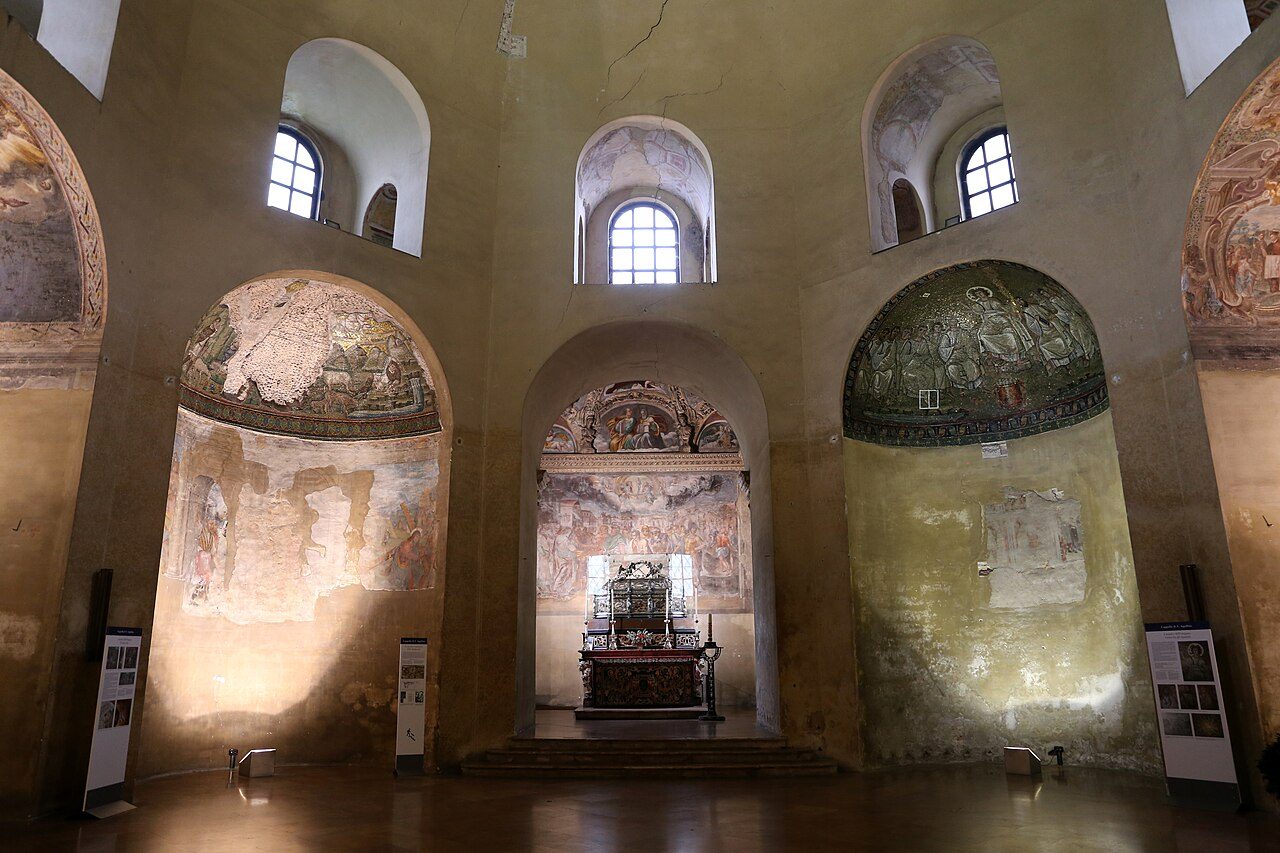
In the eight-sided chapel on the right side of the basilica, beyond the atrium, facing the niches with the mosaics
An octagon that in all likelihood began as an imperial mausoleum, with mosaics sixteen centuries old: a boyish Christ among the apostles, on a background of solid gold. If you only have time for one thing, make it this.
Spot the detail
In the mosaic in the right-hand niche, look closely at the face of Christ. What is missing?
The full story
You reach it by stages. First an atrium, a room with two curved walls where fragments of mosaic survive: apostles and patriarchs, the heads of the tribes of Israel.
Then a marble doorway covered in reliefs, with plants and animals. Look at it before you go through: it is Roman, from the first century, taken from another building and adapted to this opening. When they set it up here it was already three hundred years old.
Beyond the doorway is the octagon, the Cappella di Sant'Aquilino, the chapel of Saint Aquilinus. It is tall, with niches all around and an umbrella dome that is still the original. To make it lighter, the builders used terracotta tubes slotted one into the next.
What it was for
What was a room like this for? For a long time people thought it was a baptistery. Today the most convincing theory is a different one: an imperial mausoleum, built along with the basilica or shortly after.
The Milanese of the Middle Ages, after all, called it the chapel of the Queen. The queen was Galla Placidia, daughter of the emperor Theodosius. Whether she was the one who wanted it, nobody can say. But a room this lavish was not built for just anyone.
The two mosaics
Now the mosaics, which are the reason to come this far. Two remain, each in the of a niche. On the right, Christ sits among the apostles, all in white tunics, on a gold background. Step closer and look at the faces: these are not stock figures, each one has his own features.
On the left, the mosaic is more damaged. You can make out a pastoral landscape and what is left of a chariot drawn by white horses. Some read it as the prophet Elijah carried up to heaven. According to the most recent studies, which the basilica has adopted, it is the chariot of Christ, shown as the true sun.
Everything else is lost. The walls were faced with colored marble, and the dome was covered by a great mosaic that was demolished in the 1600s, because it was in poor shape and far from the taste of the time. The two stayed hidden under later decoration, and came to light again only between 1936 and 1943.
The saint on the altar
The chapel takes its name from the altar. There, in an urn of crystal and silver, lies Saint Aquilinus, a German priest who according to tradition was killed in Milan around 1015. In the 1500s Carlo Borromeo, archbishop of Milan, proclaimed him co-patron of the city, and the ancient mausoleum changed its dedication.
Stay a few minutes. These are among the oldest Christian images in Milan, and you can look at them from a step away.
About this stop
Anecdote
The Christmas ray in Sant'Aquilino
The Sant'Aquilino chapel, in the basilica of San Lorenzo, is an octagon that was most likely built as an imperial mausoleum. According to the most recent studies, which the basilica has adopted, it was oriented on purpose. On Christmas Day the light comes in through the southeast window and falls on the mosaic of the chariot of Christ, shown as the sun. Then it moves down toward the floor, perhaps toward the spot where the sarcophagus stood. The same play of light is found in an ancient mausoleum in Rome. Christmas falls around the winter solstice, and the worship of Christ had absorbed the older cult of the Unconquered Sun.
Legend
Sant'Aquilino, the porters' saint
In the Sant'Aquilino chapel, on the right side of the basilica of San Lorenzo, an urn of crystal and silver holds the saint the chapel is named after. According to tradition, Aquilinus was a German priest, born in Würzburg, who came to Milan. Around 1015 a group of heretics killed him with a knife to the throat. The body is said to have been found by porters, who carried it to San Lorenzo. He has been their patron saint ever since. For centuries, every January 29, the porters of Milan came to the basilica in procession, bringing oil for the lamp that burned in front of the urn.
Galla Placidia, one of the most powerful women of the late empire. She was the daughter of the emperor Theodosius, the sister of the emperor Honorius, and the mother of a third emperor, Valentinian III. In the Middle Ages the Milanese credited her with the chapel, which they called the chapel of the Queen, and an ancient sarcophagus kept there is also known by her name. There is no proof she was really involved. But the dates fit, and today scholars take seriously the idea of a mausoleum commissioned by the imperial family.
Next stop
Go behind the chapel's altar and head down toward the foundations