Stop 1 of 8
Via Mercanti and the Palazzo dei Giureconsulti
Where to stand
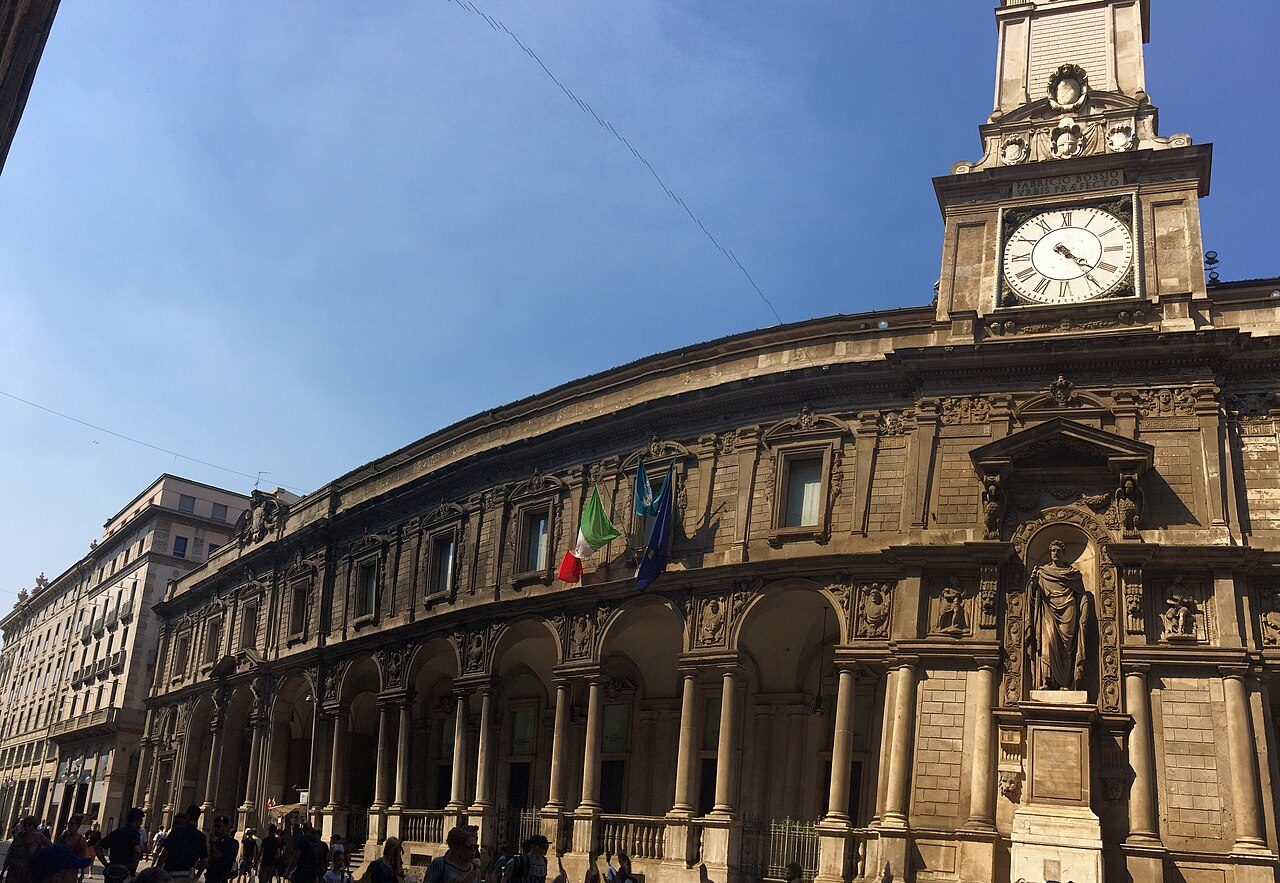
On Via Mercanti, with Palazzo della Ragione behind you, facing the long colonnaded facade with the clock tower
You are standing in the middle of what used to be the square: this street cut it in two in the 1800s. Ahead is the palace paid for by a Milanese pope and built around the 13th-century civic tower.
Spot the detail
On the facade there is a niche with a statue giving a blessing. Who is it?
The full story
You are on a street full of passersby, and it does not look like a square. It was one. Until the 1800s this spot lay inside a large enclosed space, the square of the Comune, Milan's medieval city government, and the arched palace behind you stood at its center. Then the city opened Via Mercanti, and the square was left split in two.
In front of you is the side that used to close it: the Palazzo dei . Look at the rhythm of the facade, paired columns and arches, repeated along its whole length. This is the taste of the late 1500s, elegant and a little theatrical.
A gift from a pope
The man who wanted it and paid for it was Giovanni Angelo Medici, a Milanese nobleman who became pope under the name Pius IV. Work began in 1562 to a design by Vincenzo Seregni, architect of the Duomo, the cathedral.
The name tells you who used it: the were the experts in law. The palace housed the College of Noble Doctors, which turned out senators, judges and captains of justice. In short, the city's ruling class.
The tower that gave the orders
The palace did not start from scratch. Seregni built it around the civic tower, known as the tower of Napo Torriani and raised in 1272, almost three centuries earlier. Up there hung a bell called the Zavataria, after the , the city's chief magistrate, who had donated it. It rang for the curfew, for fires and for the executions of the condemned.
Later the bell gave way to a clock. The clock had its own ritual too: according to reconstructions, exact noon was given by the Brera Observatory with a visual signal, and a ball slid down the pole of the tower's lightning rod.
In the early 1800s Milan's first stock exchange opened in a room of this palace. From law to money: the square was changing trades, but it was still the place where things got decided.
About this stop
Anecdote
A king, a tyrant slayer, a saint
The niche on the facade of the Palazzo dei has changed tenants with each regime. In 1611 it received a statue of Philip II, king of Spain, by the sculptor Gian Andrea Biffi: Milan was under Spanish rule at the time. In 1797, for the celebration of the constitution of the Cisalpine Republic, the king was turned into Marcus Junius Brutus, the killer of Caesar: a tyrant slayer in place of a sovereign. Then Brutus vanished too. Since 1833 his place has been taken by Saint Ambrose giving a blessing, by Luigi Scorzini.
Anecdote
The noon that came down from the tower
The Palazzo dei , on Via Mercanti, is built around a 13th-century civic tower, the one with the clock. Before the clock, a bell hung up there: the Zavataria, named after the Zavatario della Strada, who had given it to the city. It announced the curfew, fires and the executions of the condemned. Then came the clock, and with it a new ritual. According to reconstructions, the exact time came from the Brera Observatory by visual signal, and at noon a ball slid down the pole of the lightning rod. So the tower that had spoken in sound for centuries began to give the time by sight.
Because you are only seeing part of it. Originally it was a large closed rectangle, with six entrances and Palazzo della Ragione standing alone in the middle. In the second half of the 1800s Milan redrew its center and opened Via Mercanti, which ran through the square and split it. The Palazzo dei , which closed one side, was left across the street. What is called Piazza Mercanti today is the space that remains between the palace, the loggia and the Casa dei Panigarola.
This stop on the map
Next stop
Turn toward Palazzo della Ragione and walk up to its arches on the street side