Stop 8 of 8
The Casa dei Panigarola
Where to stand
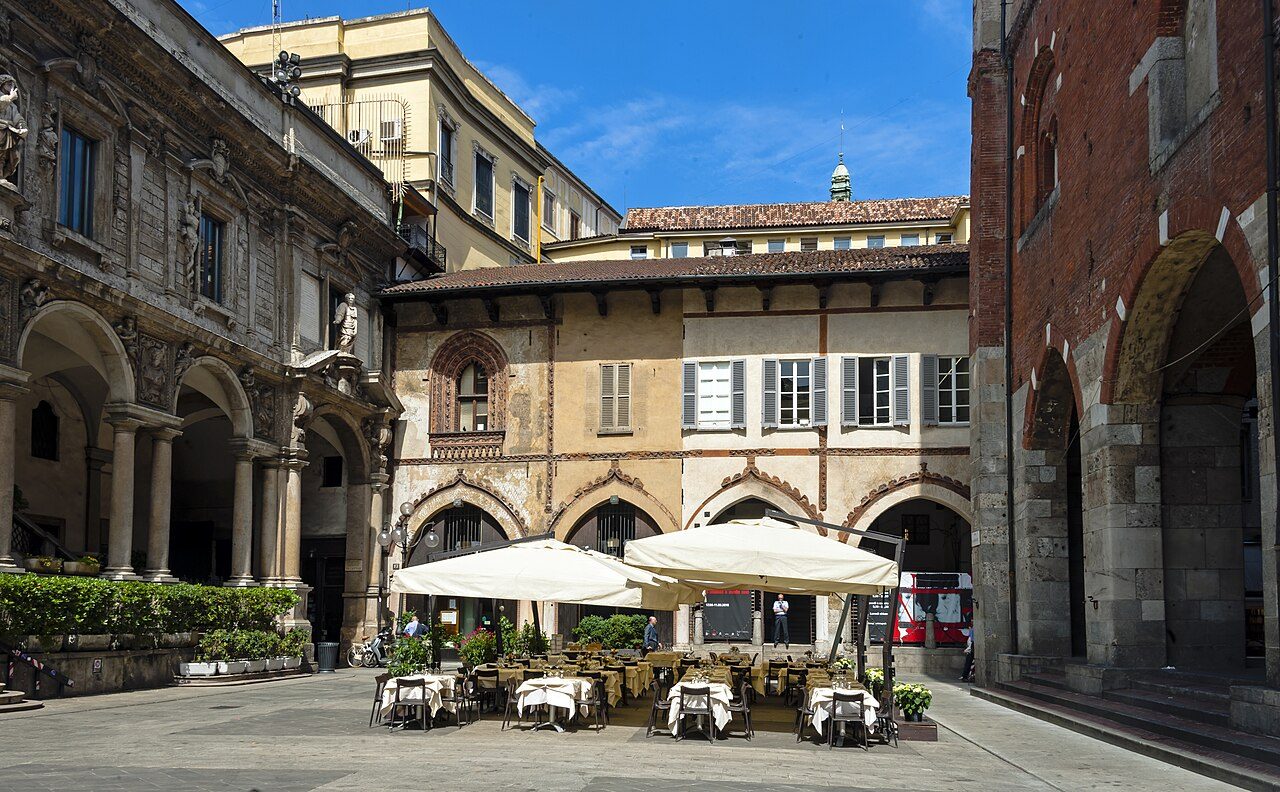
In the square, in front of the brick house with the low pointed arches and Gothic windows
The house of the notaries who for centuries recorded the dukes' decrees. Brick, terracotta and Gothic arches from the 1400s, plus a plaque that advises everyone against going to court.
Spot the detail
In the loggia under the arches, find a terracotta plaque on the wall, written in Latin. What is it about?
The full story
The last side of the square is the homiest. No marble: brick, terracotta moldings with leaves, pointed arches that are low and wide, almost squashed. This is the Lombard Gothic of the 1400s. The facade dates from 1466 and is attributed to the architect Giovanni Solari.
A family of notaries
The name comes from the Panigarola, notaries originally from Gallarate. They held a post that passed from father to son: the Office of the Statutes. Here the dukes' decrees and public acts were recorded and copied out. It was, in effect, the written memory of the state.
They did it for centuries, until the family died out in 1741. That is why the house is also known as Palazzo dei Notai, the Notaries' Palace.
Advice from a jurist
In the loggia, on the wall, is a terracotta plaque in Latin. It was signed in the mid-1400s by Tommaso da Caponago, a man of the law. It honors no one: it gives a warning.
Disputes over property, it says, bring enmity and expense, and wear down body and mind. Those who expect to win often lose. And even those who win, once the toil and the money are added up, gain nothing. Coming from a jurist, a few steps from the courthouse, that carries some weight.
What you see, it has to be said, is also a restoration. At the end of the 1800s the architect Luca Beltrami reworked the facade, reassembling it with old pieces, and added the single window on the upper floor himself. Under the arches, in the cobblestones, is one last detail: a biscione, the serpent of the Visconti.
You've come full circle. A on horseback, a sow, a balcony for sentences, a warning against lawsuits. In this square Milan spent centuries talking about just two things: power and justice.
About this stop
Anecdote
The plaque that says don't sue
In Piazza Mercanti, a few steps from the palace where justice was administered, a jurist left a piece of contrarian advice. The terracotta plaque on the Casa dei Panigarola, signed by Tommaso da Caponago in the mid-1400s, warns that disputes over property breed enmity, cost money and wear down body and mind. Those who expect to win often lose, and even those who win, once toil and expense are added up, gain nothing. The sources disagree on the year: 1445 or 1448. In the late 1800s the architect Luca Beltrami built it into the facade he was reassembling.