Stop 5 of 8Must-see
Pollaiolo's Lady
Where to stand
In the Salone Dorato, in front of the small portrait of a young woman in profile against a blue sky
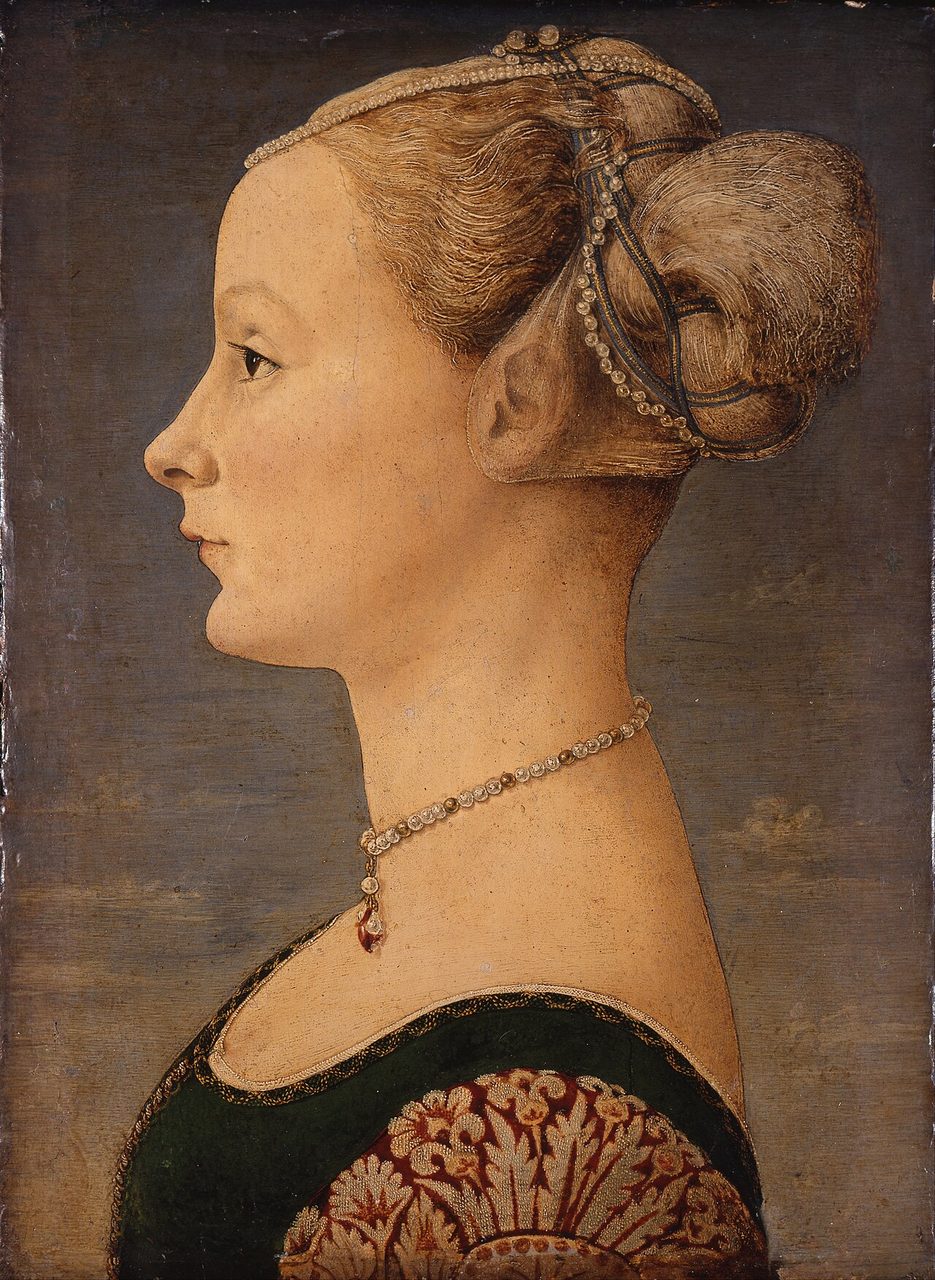
The symbol of the museum: a Florentine girl painted by Piero del Pollaiolo around 1470. Her dress and jewels say she was rich and perhaps newly married. Her name, though, nobody knows.
Spot the detail
The sleeve: see how much room it takes up in such a small painting
The full story
She is smaller than you expected. It happens to a lot of people: she is the face of the museum, she even appears in its logo, and you picture a big painting. In fact she is less than half a meter tall, about a foot and a half.
The painter, around 1470, is Piero del Pollaiolo, a Florentine. For a long time she was attributed to Antonio, his brother; today scholars prefer Piero.
The girl is in profile, as on a medal: in the Florence of those years, that is how ladies had themselves portrayed. Follow the line that runs from forehead to nose, to chin, to neck. It is a crisp, confident outline, almost engraved. Florentines put drawing above everything else, and here it shows.
Pearls, veil and velvet
Then move closer, because inside that outline something else is going on. The light settles on the pearls one at a time. Her hair is gathered under a veil so fine that you notice it only over the ear.
At her neck hangs a pendant with a ruby. The sleeve is velvet. This attention to surfaces, to skin, to reflections is a lesson learned from Flemish painters.
The jewels speak. Pearls and rubies were read as symbols of married love, which is why this is thought to be a wedding portrait: the image of a bride, perhaps wearing the jewels of her dowry.
A bride without a name
But which bride? Here the mystery begins. On the back of the panel, a Latin inscription calls her the wife of Giovanni de' Bardi, a banker. Too bad it is probably a fake.
In the early nineteenth century the painting was in Milan, in the Belgioioso household, and passed for the portrait of a family ancestor. Others have suggested Marietta Strozzi. No theory quite holds up.
Count Gian Giacomo Poldi Pezzoli, the collector who created this house, bought her shortly before 1871 from another great Milanese collection, that of the Borromeo family. He could not have known she would become the work everyone comes to see.
Perhaps she works precisely because we do not know who she is. A name would shut her inside a biography. As it is, she remains what the painter intended: a girl from Florence on her best day.
About this stop
In culture
Pollaiolo's lady turned trademark
In the Salone Dorato, the Golden Room of the Museo Poldi Pezzoli, hangs the portrait of a young Florentine woman in profile, painted by Piero del Pollaiolo around 1470. She is not only the museum's most famous work: she is its signature. The graphic designer Italo Lupi simplified her profile down to a few strokes and used it to form the two Ps of Poldi Pezzoli in the logo. Try it: look at the museum's logo, then at the painting. Few portraits from five centuries ago can survive that kind of reduction and stay recognizable.
No. Her dress and jewels tell us only that she belonged to the high society of fifteenth-century Florence, and that the portrait may have been made for her wedding. An inscription on the back names her as the wife of the banker Giovanni de' Bardi, but it is considered probably fake. In nineteenth-century Milan she passed for an ancestor of the Belgioioso family. Someone has put forward the name of Marietta Strozzi. No proposal has been proven, and by now the mystery is part of the painting.
Next stop
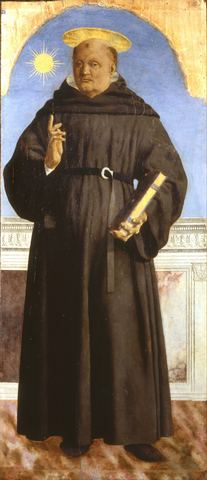
Still in the Salone Dorato, look for the friar in a black habit, tall and narrow, by Piero della Francesca