Stop 2 of 8Must-see
The Modellone
Where to stand
In the room of wooden models, which you cross at the start and again at the end of the route: walk around the big model
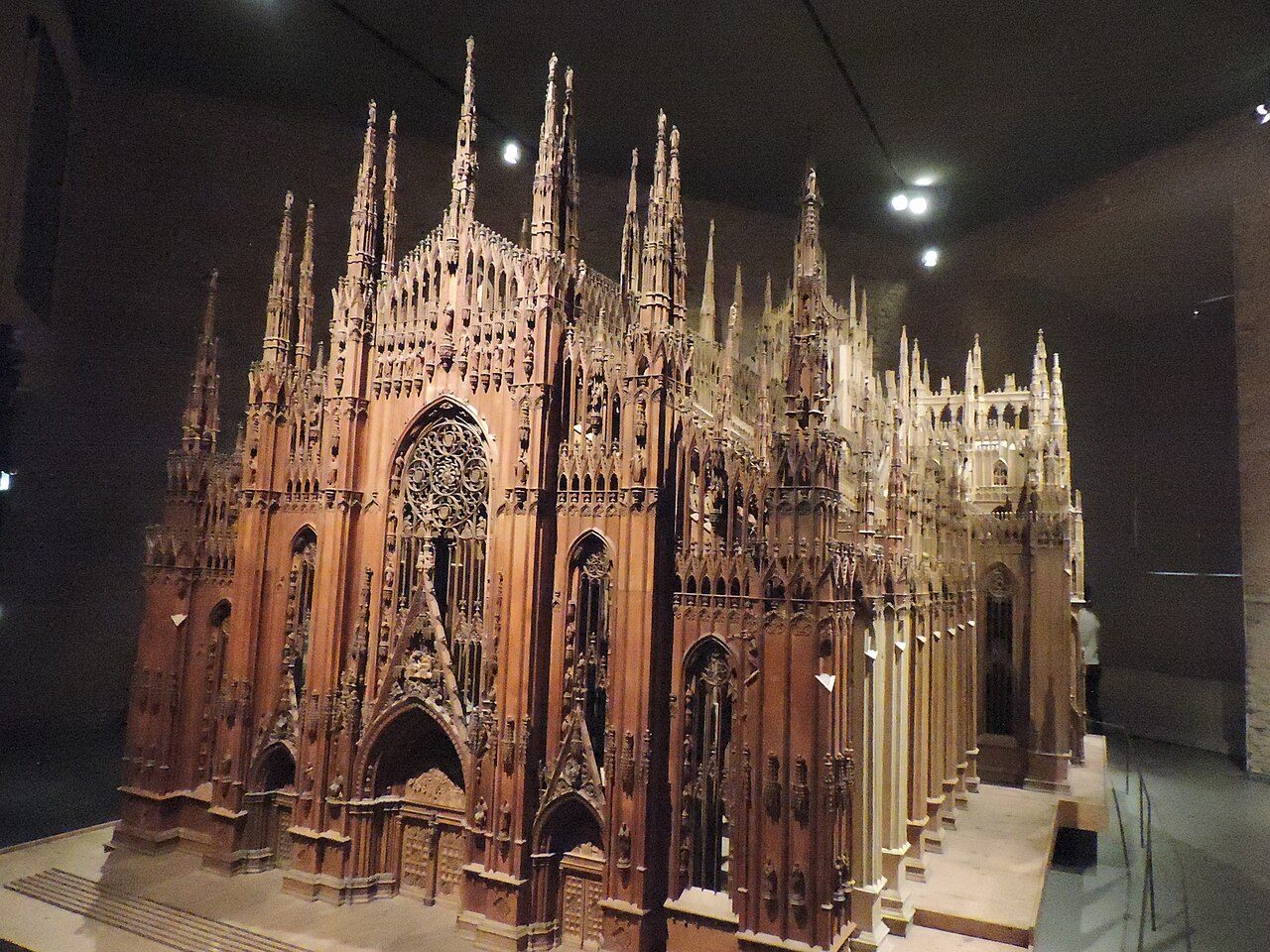
A wooden Duomo more than five meters tall, at a scale of 1 to 22. It was begun in 1519 to help the architects decide, and updated for almost four centuries. It is the cathedral's design in three dimensions.
Spot the detail
Look at the facade of the model and compare it with the real one, which you saw from the piazza
The full story
Here the whole Duomo fits in one room. It is made of wood, more than five meters tall, about 17 feet, and almost eight meters long. They call it the Modellone, the big model, and the name does not exaggerate.
It is not a giant ornament. It is a working tool. On cathedral building sites, models were used to experiment and to design: a drawing was not enough to convey the proportions between the parts. You needed something to walk around, measure and argue over.
Almost four centuries of work
The Modellone was born in 1519, when the Fabbrica, the body that built the Duomo, entrusted its construction to Bernardo Zenale, a painter and architect who a few years later would become the architect of the Duomo. The design is attributed to him, to Cristoforo Solari and to Gerolamo della Porta.
At that point the real Duomo was still far from finished, and the model reflects the church as it was then. After that it grew along with it. In the mid-nineteenth century Giuseppe Bellora took it apart, restored it and added the first bays toward the facade and the , including the main one. The last date is 1891.
The wood is linden, walnut and Swiss pine. The scale is 1 to 22: every centimeter you see stands for twenty-two on the cathedral.
What to look for
Walk around it without hurrying. Look at the flying buttresses, the stone bridges that leap from the high walls over the lower aisles. In the model they are continuous stairways, which pass through the by way of small Gothic doorways.
Then look at the roof, with the and the tiburio, the tower over the crossing of the arms. From the piazza you can barely guess at all this: here you look at it from above, like a bird.
There is nothing like it in Milan. In Lombardy the only things that resemble it are the models of the cathedrals of Pavia and Vigevano, which are smaller.
Before it entered the museum, in 1953, the Modellone spent a long time at the Camposanto, in the Fabbrica's own building. It was at home there: among the people who were still building the Duomo.
You will meet it again at the end of the route, from the opposite side. So much the better. After seeing statues, stained glass and up close, you will be able to point on the model to the spot each one came down from.
About this stop
Anecdote
The facade that exists only in wood
In the museum stands the Modellone, a wooden Duomo over five meters tall, and its facade is not the real one. In 1886 the Fabbrica, the body that builds and maintains the cathedral, held a competition to redo the facade, the one Napoleon had wanted, which many disliked. The winner was a very young architect, Giuseppe Brentano, with a neo-Gothic design: three pointed-arch entrances and lacy gables. Brentano died in 1889, not yet thirty, and the facade was never redone. His design was built once, though, at a scale of 1 to 22, on the Modellone. There the Duomo has the face it might have had.
For deciding. A drawing shows a facade or a floor plan, but it does not make clear how the parts of a building fit together. A model does. On cathedral building sites, models were used to try out solutions and check proportions. The Modellone, begun in 1519, was updated for centuries, until 1891, following the growth of the cathedral. That is why it is so big: it had to show the details too.
Next stop
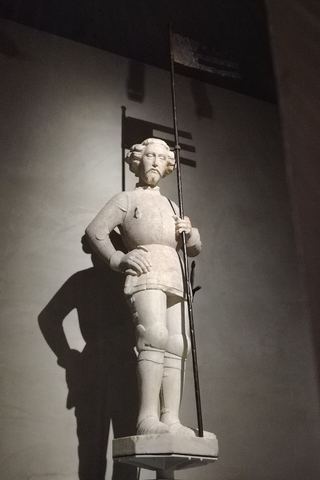
Pick up the route again as far as the room on the origins of the Duomo, where a marble warrior is waiting for you