Stop 7 of 7
The Exit Toward La Scala
Where to stand
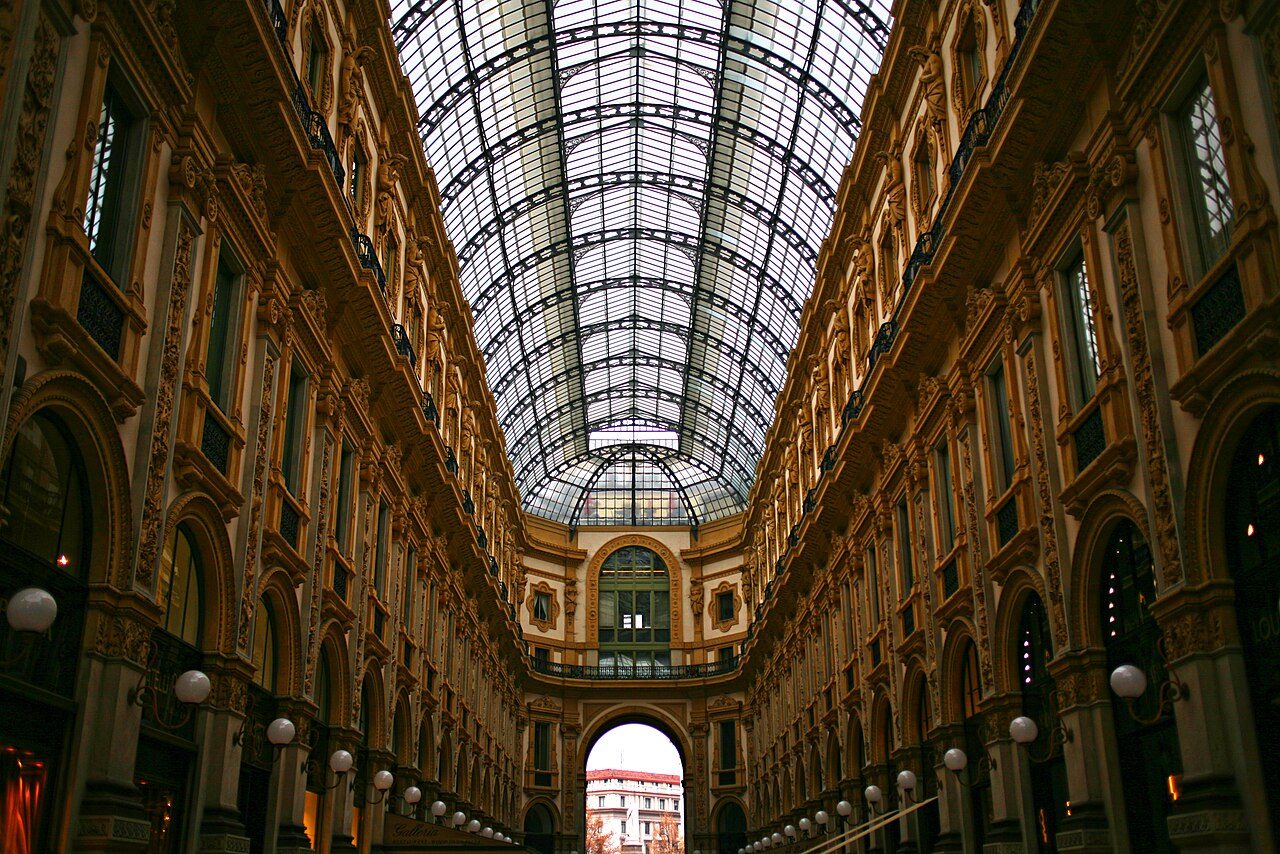
Under the arch that opens onto Piazza della Scala, turning back to look down the full length of the Galleria
From the far end you see the whole Galleria, and you understand what it left the world: a model copied everywhere and a word, galleria, that ended up on the signs of American shopping malls.
Spot the detail
Compare this arch with the one facing the Duomo: what is missing?
The full story
Before you step out, turn around. From here you have almost two hundred meters of Galleria in front of you in one go, about six hundred and fifty feet: the vault running away, the dome halfway down, and at the far end the light of Piazza del Duomo. This is the view that explains why the place set the standard.
On this side the entrance is plainer. Mengoni also had a problem to solve: the axis of the Galleria does not fall straight onto Piazza della Scala. He dealt with it using an , meaning a space with a curved plan, which softens the way out. The newspapers of the day did not fail to notice that crooked axis.
A model copied everywhere
When it opened, the Galleria was not the first covered street in Europe. But it was bigger than all those that came before, and architectural historians consider it the direct ancestor of today's enclosed shopping malls.
Naples wanted its own, the Galleria Umberto I. And on the other side of the ocean the Italian word has stuck to the idea: in the United States a good many shopping malls are called Galleria, starting with the one in Houston, which borrowed the glass vault from the original. None of them has a Duomo at the other end.
Admirers and critics
Travelers were among the first to fall in love with it. The American writer Mark Twain, in a travel book published in 1880, says he spent nearly all his time in Milan here. He describes the tables scattered over the marble, the people eating, drinking, and smoking, the crowd strolling by. Then he concludes: I should like to live in it all the time.
Not everyone agreed. The Società degli artisti, Milan's artists' society, led by the architect Camillo Boito, judged the Galleria useless. Later another architect, Giuseppe De Finetti, called the great arch facing the Duomo the tackiest disguise imaginable. They had their arguments: to make room for all this, a piece of old Milan had disappeared.
Between the Duomo and La Scala
But look where you are. Just outside is the Teatro alla Scala, the home of opera. At the far end is the Duomo, the cathedral.
In between, holding the church and the theater together, Milan put a street of cafés and shop windows, and covered it with a dome. It is hard to imagine a more honest portrait of this city.
Now step out. The Galleria will go on doing what it has done for a century and a half: letting people walk through it.
About this stop
In culture
Mark Twain wanted to live in the Galleria
The American writer Mark Twain describes Milan in A Tramp Abroad, a travel book published in 1880. Of the Galleria Vittorio Emanuele II, Milan's glass-roofed arcade, he writes that he spent most of his time there. This is how he describes it: new and sumptuous buildings, streets roofed over with glass at a great height, marble pavements, tables everywhere, people eating, drinking, and smoking, other people strolling by. His conclusion is a declaration of love: I should like to live in it all the time.
Record
Galleria, a word Milan exported
The Galleria Vittorio Emanuele II, Milan's glass-roofed arcade, was not the first covered street in Europe: London and Brussels already had theirs. But it was bigger than all those that came before, and architectural historians consider it the direct ancestor of today's enclosed shopping malls. The effect shows in the vocabulary too. Naples built its own Galleria Umberto I, and in the United States many shopping malls carry the Italian name Galleria, starting with the one in Houston, which borrowed the glass vault from the original. It all starts from a cross of iron and glass almost two hundred meters long.
In culture
The singers waiting for a contract
The Galleria Vittorio Emanuele II, Milan's glass-roofed arcade, ends in front of the Teatro alla Scala, the opera house, and in the nineteenth century that made it, in a few years, a kind of job market for musicians. Singers and players gathered here hoping to be hired by one of Lombardy's theaters. Not everyone was lucky. The writer Giovanni Verga told it in the story Primavera: a young musician arrives in Milan, his music under his arm, and finds that artists' dreams, from every corner of Italy, grow pale under the gleaming glass of the Galleria. Finally he takes a job playing piano in cafés in faraway countries, and leaves.