Stop 2 of 7Must-see
The Famedio, temple of Milan's great and good
Where to stand
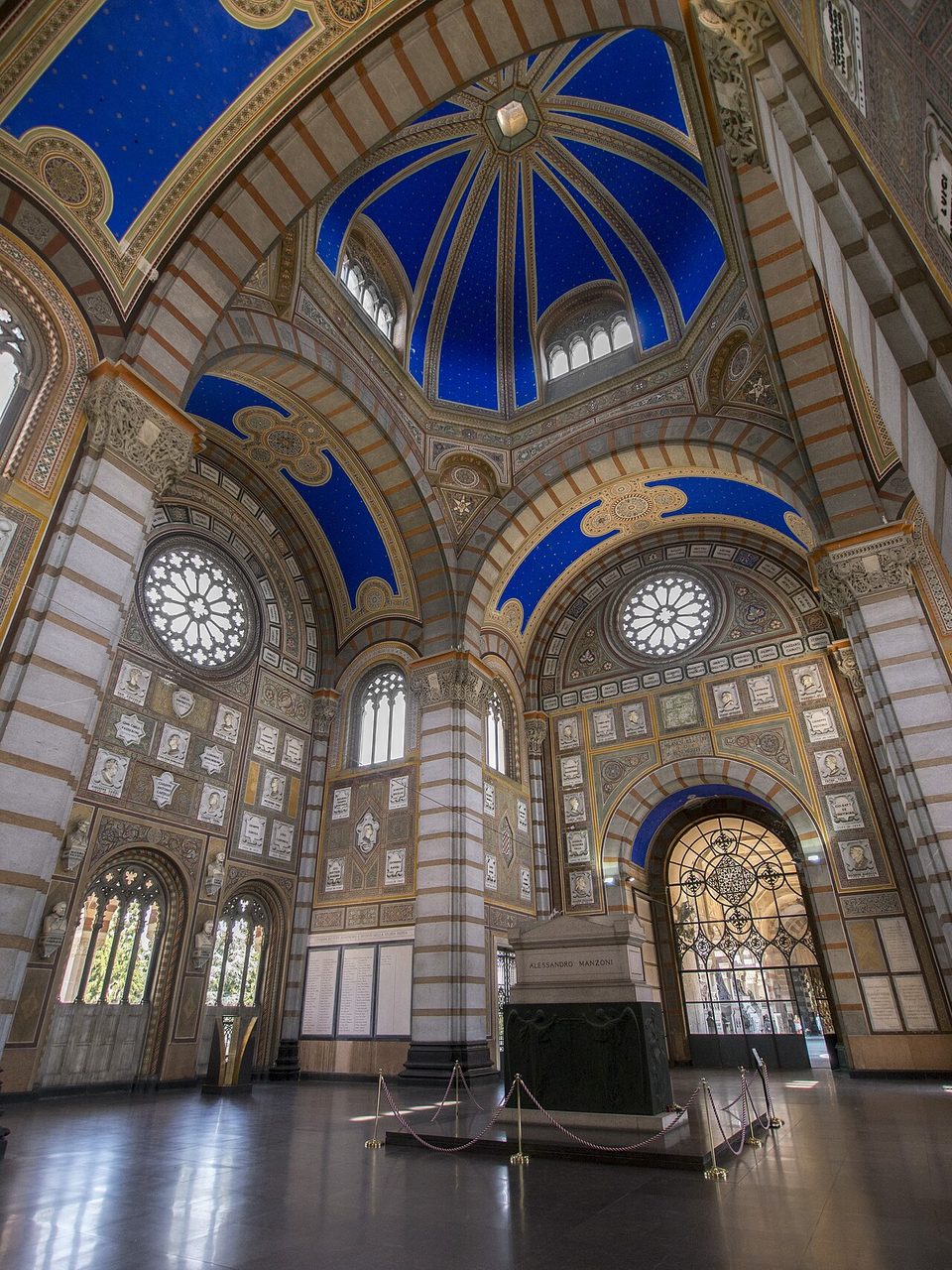
Inside the central building of the facade, in front of the sarcophagus in the middle of the hall
It was meant to be a church and became Milan's pantheon. Manzoni lies at the center, the names of the city's great and good run along the walls, and Gaber, Jannacci and Alda Merini rest in the crypt.
Spot the detail
Manzoni has a twin sarcophagus, with the same city coat of arms. Find it: whose is it?
The full story
The name was made up for the purpose. joins two Latin words and means temple of fame. Maciachini, the architect, had designed it as the cemetery church. With the building work under way, Milan changed its mind: more than a church, it needed somewhere to line up its great names.
Look at the center. The belongs to Alessandro Manzoni, the author of I promessi sposi, the novel every Italian reads at school, known in English as The Betrothed. He was brought here in 1883, ten years after his death. The base with the bronze reliefs is much more recent: Giannino Castiglioni sculpted it in the 1950s, when the tomb was moved to the middle of the hall.
The names on the walls
Then raise your eyes to the walls. Those lists of names cut into the stone are the real heart of the . Not everyone you read about is buried here. In fact, almost no one is.
Inside the hall there are only eight tombs. There is the poet Salvatore Quasimodo, a Nobel laureate. There is the designer Bruno Munari. There is Carla Fracci, the ballerina, the first woman to be buried here.
The others are a name on the wall. Take Giuseppe Verdi: he stayed at the Monumentale for just a month, then was moved to the rest home for musicians that he had founded.
Herbert Kilpin, the founder of the AC Milan soccer club, first had his name on the wall and then, since 2024, a place in the crypt. Giorgio Muggiani, one of the founders of Inter, the city's other club, is here too. In here, at least, the derby ends in a draw.
The crypt beneath the hall
Beneath your feet is the crypt, and down there the company changes tone.
- Giorgio Gaber and Enzo Jannacci, the singer-songwriters.
- Franca Rame, the actress.
- Alda Merini, the poet.
- Umberto Veronesi, the doctor.
A nineteenth-century novelist upstairs, two singer-songwriters downstairs: that is Milan for you.
Who decides who gets in
A committee decides who gets in, and the test is to have brought honor to the city, as a Milanese by birth or by adoption. Every November 2 the mayor presides over a ceremony and new names are carved into the walls. In 2016, in one go, the arrivals included the writer Umberto Eco and the fashion designer Krizia. The is not locked in the past: it is updated every year.
And fame, now and then, changes address. The writer Cesare Cantù was buried here at the end of the nineteenth century, and ten years later he was moved to Brivio. Not even in the temple of fame is your place guaranteed forever.
About this stop
In culture
Verdi, a guest for one month
Giuseppe Verdi died in Milan on January 27, 1901, and was buried at the Cimitero Monumentale, the city's monumental cemetery. He stayed about a month. Then he and his wife, Giuseppina Strepponi, were moved to the crypt of the rest home for musicians that the composer had founded. For the occasion a young Arturo Toscanini conducted a choir of more than eight hundred voices in Va' pensiero, the chorus from Nabucco. What the Monumentale has kept of Verdi is his name, carved in the , the hall of illustrious Milanese. Toscanini, on the other hand, came back to stay.
A committee, which chooses people who have brought honor to Milan, Milanese by birth or by adoption. Be careful, though: getting into the almost always means having your name carved on the walls, not having your tomb there. Only eight people are buried in the hall, among them Manzoni, Cattaneo, Quasimodo and Carla Fracci. Others rest in the crypt. Everyone else is buried somewhere else, in the cemetery or far from Milan. New names are added every year on November 2, at a ceremony presided over by the mayor.
Next stop
Go into the cemetery and look, to the left of the entrance, for the raised garden with a large group of bronze figures