Stop 5 of 7
The Edicola Toscanini and the language of symbols
Where to stand
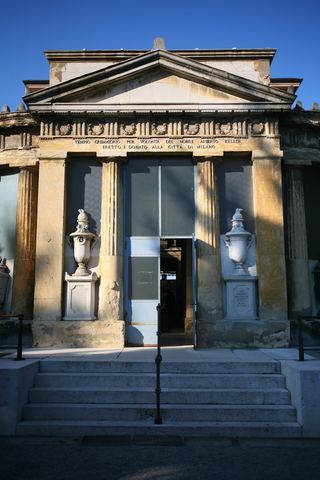
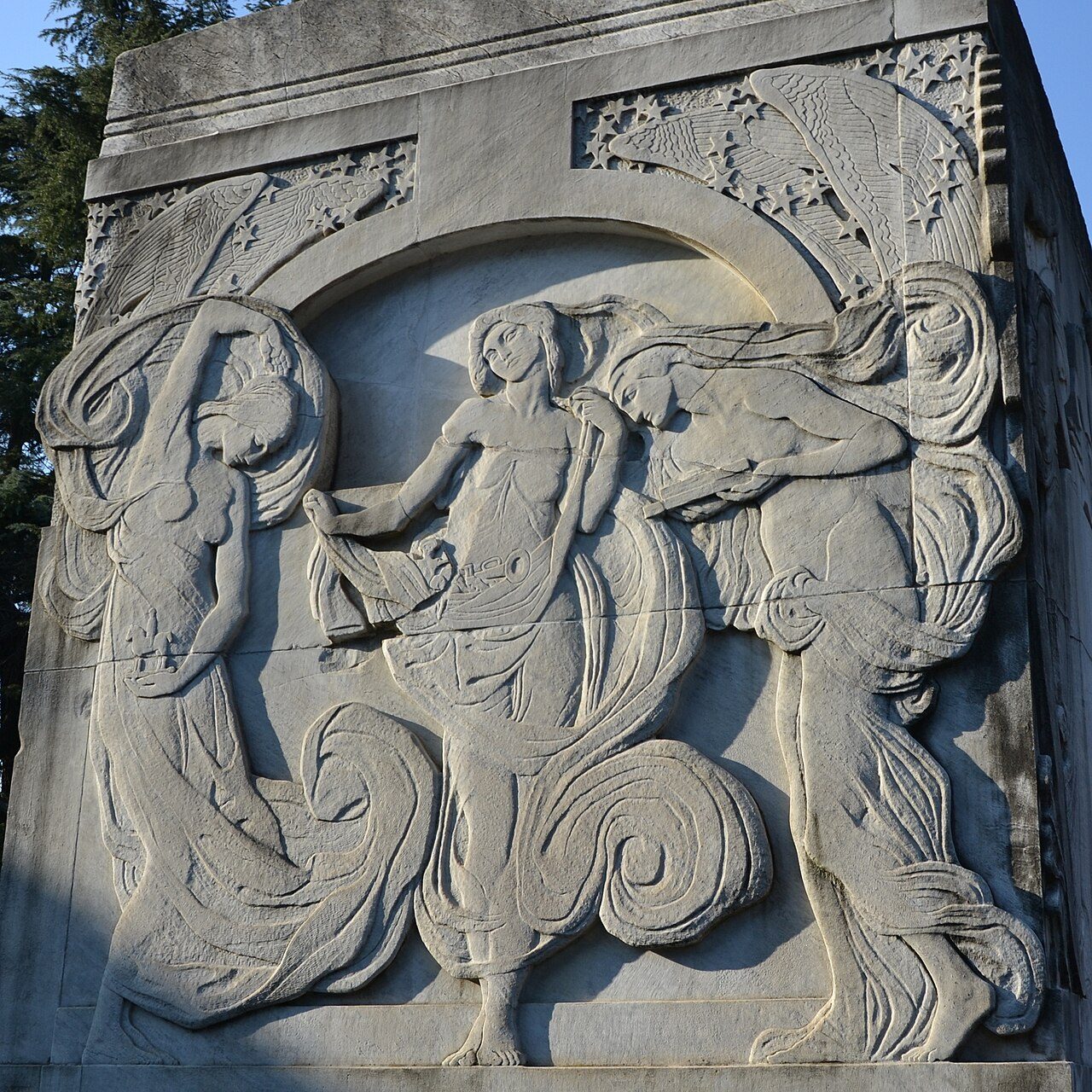
Among the family chapels, in front of the Toscanini one: go right up to the carved reliefs
The conductor Arturo Toscanini had this tomb built for his son Giorgio, who died as a child in Buenos Aires in 1906. The reliefs by Leonardo Bistolfi speak of childhood and of a voyage by sea.
Spot the detail
Search Bistolfi's reliefs for signs of the sea. Why the sea, on a child's tomb?
The full story
Don't let the surname lead you. This tomb was not built for a famous man. It was built for a child.
Arturo Toscanini, the conductor, lost his son Giorgio in Buenos Aires: the boy fell ill with diphtheria and died. The year was 1906. The small body came back to Milan by sea, and his father had this , or family chapel, built for it.
The design is by the architect Mario Labò, the reliefs by the sculptor Leonardo Bistolfi. Look at them up close. Bistolfi does not carve a portrait or write a dedication: he uses symbols. There are those of childhood and those of the voyage by sea, because Giorgio's whole story lies right there, between an age and an ocean.
Over time the became the family tomb. Arturo is buried here too. And here rests Vladimir Horowitz, the great pianist, who had married Wanda, the maestro's daughter. Horowitz died in New York, but this is his tomb, beside his father-in-law.
How to read the symbols
The Toscanini is the right place to learn something you will need all over the cemetery: how to read symbols. Along the avenues you find them at every step.
- The hourglass is time running out.
- The poppy is sleep, and dreaming.
- The butterfly is rebirth.
Then there are the angels, the weeping women, the cherubs, even sphinxes. The sculptors of those days did not explain grief: they gave it a figure, and counted on you knowing how to read it.
The sculptors along the avenues
Once you get the habit, the Monumentale turns into an art gallery. Within a few avenues the languages change.
In 1890 Enrico Butti carves for the tomb of Isabella Casati a young woman on her deathbed, lost in a dream, with all the realism of the late nineteenth century. A year earlier, Medardo Rosso had made a bronze for the Filippi tomb.
In 1929 Adolfo Wildt brings a taut expressionism to the Korner. Giacomo Manzù lines up six sacred statues in bronze in the Edicola Motta.
All of this grows out of one simple task: remembering someone. Before you leave, ask yourself the question they asked themselves. What would you carve for someone who is no longer here?
About this stop
Many, and that is why the Monumentale is called an open-air museum. Medardo Rosso, Leonardo Bistolfi, Enrico Butti and Adolfo Wildt all worked on the tombs, and after them Lucio Fontana, Giacomo Manzù, Francesco Messina, Fausto Melotti and Giò Pomodoro. There are architects too, such as Gio Ponti and the BBPR studio. Within a few avenues you go from the realism of the late nineteenth century to the sculpture of the later twentieth. No museum in Milan lets you make the same journey while walking outdoors.
Next stop
Look for the Tempio Crematorio, a building shaped like a temple inside the cemetery walls