Stop 5 of 5
The Cloisters and the Lost Friary
Where to stand
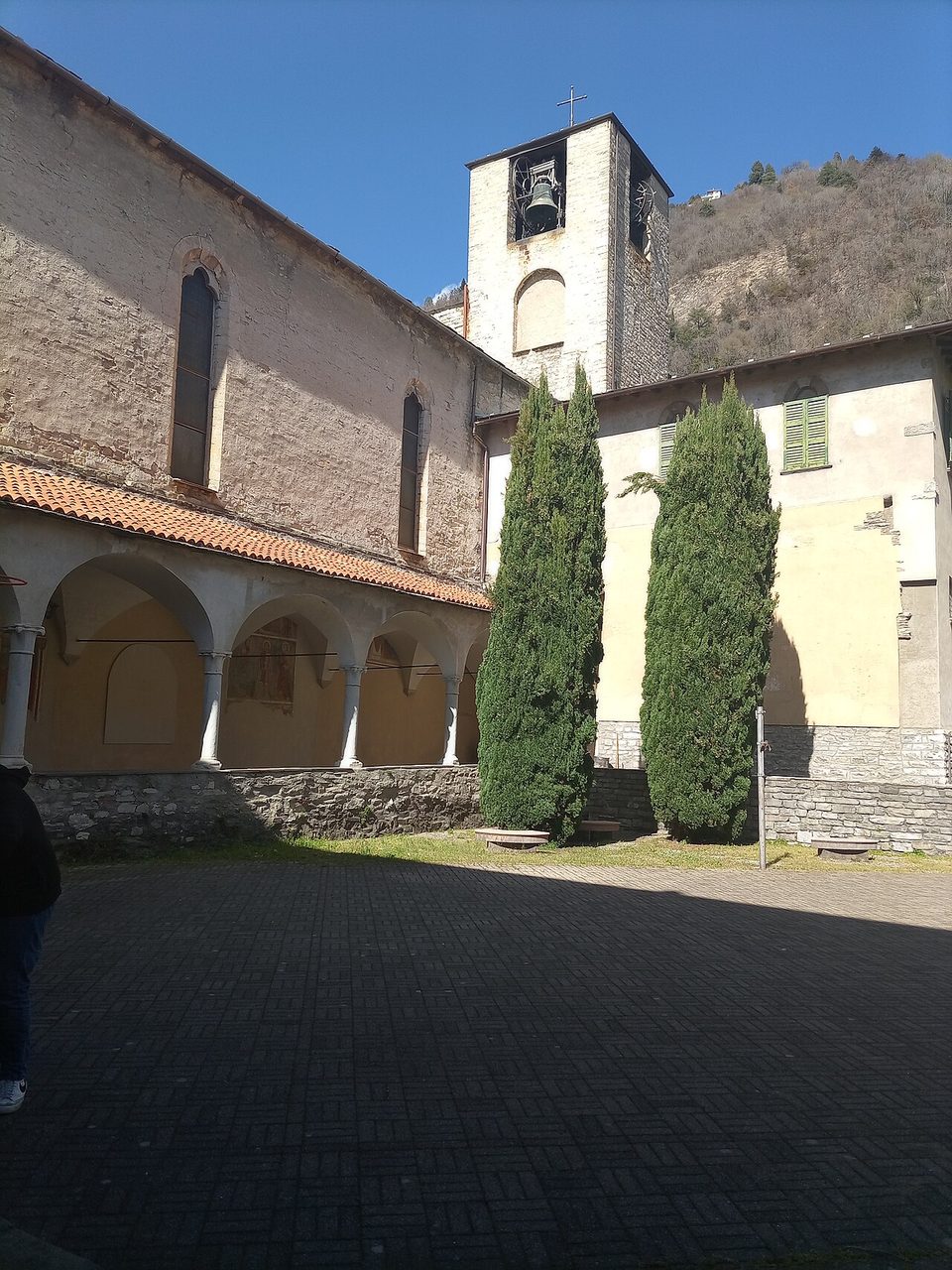
On the south side of the church, where the arcades of the friary's two cloisters remain
Two mutilated cloisters are what is left of the Augustinian friary: seven of one, three sides of the other. On the walls, traces of late 15th-century frescoes. The refectory was given an unusual supper: Saint Augustine at table with the saints of his order.
Spot the detail
Look at the spot where the frescoes meet the vaults of the portico: what happened here?
The full story
A friars' church is always half of something. The other half was the friary: the cells, the refectory, the cloisters where the friars walked and prayed. The one at Sant'Agostino spread out along the south side of the church and was enlarged in the 17th century. Then, in 1772, it was suppressed, and it has been losing pieces ever since.
Today parts of two cloisters remain, both reworked in the 16th century. Of the outer one, the more recent, seven survive, meaning seven sections of portico. Of the inner one, three sides are left.
The frescoes on the walls
Look at the walls, especially the wall of the church. There are fragments of votive paintings, partly covered by the vaults of the portico. The catalog records date them to the end of the 15th century, and some attribute them to Andrea De Passeri, the same painter as the fresco above the church portal. They are scraps, not a cycle to be read scene by scene: what is left of a painted cloister.
The painted supper in the refectory
The most curious piece of the friary, though, belongs to the refectory, the hall where the friars ate. In 1620 a large fresco was painted there: a Last Supper of Saint Augustine. In place of Jesus and the apostles, Augustine and the saints of his order sit at the table.
The idea was not new: a similar painting, more than a century older, is in Gravedona, up the lake, where the Augustinians had another friary. Tradition gives the Como one to Giovanni Paolo Recchi, a local painter and pupil of Morazzone, the Lombard master, but scholars are far from sure.
On its fate, the sources do not agree. Local guides describe it as still in the refectory. A record in the Catalogo generale dei beni culturali, Italy's national heritage catalog, lists it instead as a lost work. If you find the hall open, you can check for yourself.
Either way, we know what it looked like, thanks to a 19th-century engraver, Giovanni Pedraglio, who copied it in a print. Under the image, a key numbers the diners one by one: Nicholas of Tolentino, Thomas, archbishop of Valencia, William, duke of Aquitaine. And whoever cataloged the print also noted a cat in the scene.
Of a small city of friars, a few arches remain, a painted supper and a sheet of paper. Sometimes that is enough.
About this stop
Record
The last of the three friaries
In the Middle Ages three orders of mendicant friars settled around Como, almost at the corners of a triangle: the Franciscans at San Francesco, the Dominicans at San Giovanni in Pedemonte, the Augustinians at Sant'Agostino. Two of those friaries are gone. Where the Dominicans lived there is now the train station, which is why it is called Como San Giovanni. The Franciscan friary became a barracks and was later torn down to build the courthouse: its church survives, used for exhibitions. Sant'Agostino is the only one of the three where church and cloisters still stand together.
In culture
A friars' supper that ended up in a print
In 1620 a large fresco was painted for the refectory of the friary of Sant'Agostino, in Como: Saint Augustine at table with the saints of his order, like a Last Supper of friars. In the 19th century the engraver Giovanni Pedraglio copied it in an etching that numbers the figures one by one: Nicholas of Tolentino, Thomas, archbishop of Valencia, William, duke of Aquitaine. The record in Italy's national heritage catalog even points out a cat in the scene. The same record gives the fresco as lost, while local guides describe it as still in place. A copy of the print is kept in the Musei Civici in Lecco.
It was suppressed in 1772, in the age of the Habsburg reforms, and the following year the church became a parish church. Of the friars' buildings, the refectory and parts of two cloisters remain on the south side: seven of the more recent one and three sides of the older one, with traces of frescoes. In 1620 a Last Supper of Saint Augustine was painted for the refectory, and a 19th-century print reproduces it figure by figure.