Stop 6 of 7Must-see
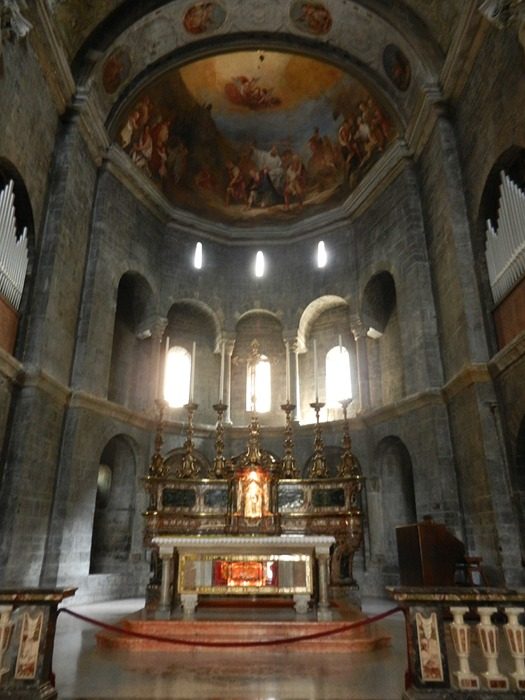
The altar and the tomb of San Fedele
Where to stand
In the center of the church, in front of the chancel, facing the high altar and the apse
Under the altar is the reason the church has this name: a marble tomb chest holding the bones of Fedele, soldier and martyr. They have been there since 1365, and the chest says so itself, in Latin. Even though other cities have claimed to have them.
Spot the detail
On the tomb chest under the altar: a glittering band full of tiny faces
The full story
The altar in front of you looks like a single piece. It is an assembly. The top where Mass is celebrated is a fourteenth-century slab, a single block more than two and a half meters long, over eight feet, and weighing more than a ton.
Under it is the tomb chest, also cut from a single block of Musso marble. The little columns holding up the slab are from the nineteenth century. Behind, the Baroque altar of colored marbles is from the eighteenth. And in the 1970s, with the new rules for the liturgy, the old slab was detached from the rest and moved forward, to the center.
Who Fedele was
The chest is the heart of it all. Inside are the bones of Fedele. According to tradition he was a Roman soldier at the imperial court in Milan.
Found out as a Christian and imprisoned, he fled with some companions toward Como. The others, Carpoforo among them, were caught and killed at the gates of the city. He kept going along the lake, all the way to its head, where the soldiers caught up with him and beheaded him.
There are many versions of the story and they don't agree: for some he was not a soldier but a missionary sent from Milan. What is certain is that his tomb was already venerated in the early sixth century.
The bones reach Como
In 964 Bishop Gualdone went to fetch the bones and brought them to the city, to this church, which was then called Sant'Eufemia. The chroniclers speak of a celebration by the whole population.
For four centuries they stayed buried in the middle of the choir. Then, on June 4, 1365, Bishop Stefano Gatti had them moved into the chest. You don't have to take anyone's word for it: the record is carved in the marble, in Latin and in Gothic letters, and it calls Fedele athlete and martyr.
A contested saint
There is a complication, though. Arona, on Lake Maggiore, has also claimed to hold the relics of Fedele and Carpoforo: they were supposedly carried off from Como during a war with Milan. And in the sixteenth century Carlo Borromeo, archbishop of Milan, wanted them for his own city, where a church bears the name of San Fedele.
Como has never changed its story: the martyr is here. In 1964, for the thousandth anniversary of their arrival, the bones were reassembled in an urn of gilded bronze, inside the chest.
Look up at the . The painted is from the nineteenth century and tells the story of Fedele's martyrdom. But the best part is below: the gallery of little Romanesque columns, each capital different from the next. It is the reverse side of the apse you see from outside, at the back of the church.
A thousand years of devotion, and a tug-of-war between cities over the same bones. The Middle Ages cared about their saints.
About this stop
Legend
The flight of Fedele the soldier
The basilica of San Fedele, in Como, is named after a martyr whose bones lie under its high altar. According to tradition Fedele was a Roman soldier at the imperial court in Milan. Found out as a Christian, he was imprisoned, escaped with some companions and took the road to Como. The others, Carpoforo among them, were caught and killed at the city gates. He went on to the head of the lake, where he was captured and beheaded. A small chapel rose on the spot; it still exists and is called San Fedelino. Other versions make him a missionary, not a soldier: the sources are few and disagree.
Legend
The dream that found the martyr
Under the high altar of San Fedele, in Como, lie the bones of the martyr Fedele, originally buried at the head of the lake. How did Gualdone, bishop of Como, know where to dig in 964? According to tradition a local woman told him: Fedele had appeared to her in a dream and shown her his burial place, by then forgotten. The bishop, the story goes, had the spot dug up, and the bones were there. For one scholar there is also a less miraculous reason: the church was probably about to hand the title of cathedral to another, and a martyr's bones gave it a new role.
Anecdote
One saint, claimed by three cities
In the basilica of San Fedele, in Como, the bones of the martyr Fedele lie under the high altar: the city has held them since 964. But Arona, on Lake Maggiore, has also claimed to have them: they were supposedly carried off from Como during a war with Milan. In the sixteenth century Carlo Borromeo, archbishop of Milan, had those relics moved to his own city, where a church is dedicated to San Fedele. Arona protested and got part of them back. Three cities for a single martyr.
A martyr of the early centuries, about whom little is known. The best-known tradition makes him a Roman soldier in Milan, secretly Christian, who fled toward Como and was killed at the head of the lake during the persecutions. Another describes him as a missionary sent to convert the lands around the lake. His tomb was already venerated in the early sixth century. In 964 the bones were brought to Como, to this church. The diocese remembers him on October 29.
Next stop
Move to the side, into the corridors that run around the two large chapels