Stop 2 of 5Must-see
The courtyard and the church with no facade
Where to stand
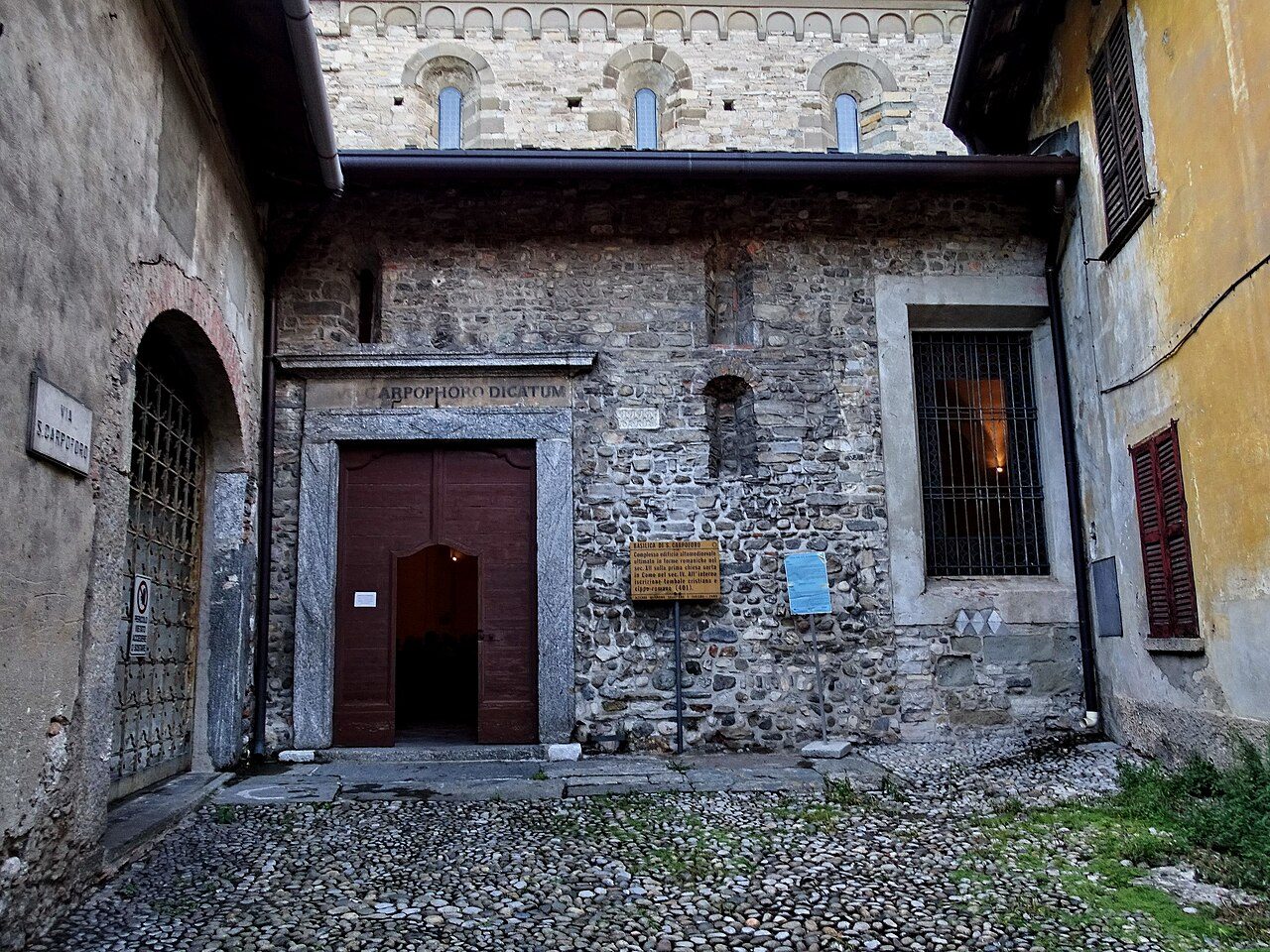
In the cobbled courtyard, facing the doorway with the gray stone frame that opens in the side of the church
You enter San Carpoforo from the side. There is a facade, but it is pressed against the hill and has no doors. All around, houses and monastery have leaned on the church until they have almost hidden it.
Spot the detail
Look up above the low roof of the entrance: what runs along the top of the taller wall, under the eaves?
The full story
Every church has a main entrance, a facade that tells you: this is the way in. Not San Carpoforo. The doorway in front of you opens in the side, onto a cobbled courtyard that could belong to a farmhouse. Above the door you can still read two Latin words, CARPOPHORO DICATUM: dedicated to Carpoforo.
The real facade exists, but you will not see it easily. It faces west, toward Castel Baradello, the castle on the hill, and it is pressed against the slope, partly buried. It has no doors. All it had were three , narrow openings with one arch each, and over time they were walled up.
Why against the mountain
Why put a facade against a mountain? There is no final answer. The most repeated explanation blames landslides: the ground here is unstable and is said to have wiped out the old entrance. A document from 1204 does mention a portico of the church, which is no longer there.
What is certain is that the church is oriented, meaning its altar points east, and to the west there is the hill. The result is a church with its face to the mountain, one you have to approach from the side.
The monastery beside the church
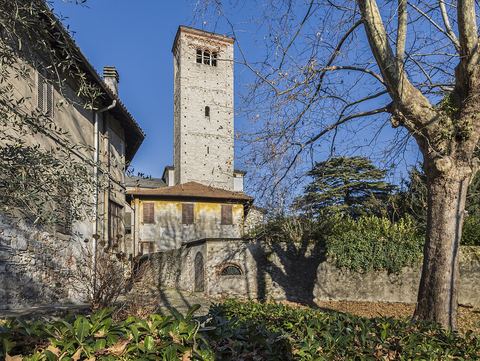
Now look at what surrounds it. The church is squeezed between buildings that have leaned against it over the centuries, so much so that from outside it is hard to make out its shape. The large complex next door was the monastery: Benedictine in the eleventh century, then from the sixteenth century home to the Hieronymites, the monks of the order of Saint Jerome, who rebuilt it from scratch. Today it houses a school.
The doorway you enter through is Renaissance in style, and that tells you something too. The Hieronymites did not stop at redoing the monastery. They went to work on the church, covered it with vaults, and closed off part of it to make service rooms. To them, the Middle Ages were old stuff in need of an update.
Above the low roof of the entrance, though, a taller wall rises in pale stone, with a row of small arched windows. That is the nave. It is the first piece of Romanesque church you come across, and from here on there will be a lot more of it.
About this stop
Anecdote
Three men shot in front of the church
On April 11, 1849, shots ring out in front of the basilica of San Carpoforo, in Como. The Austrians execute Andrea Brenta, an innkeeper in Val d'Intelvi, the valley between Lake Como and Lake Lugano, and leader of the uprising that had broken out there the year before, along with two companions, Andrea Andreetti and Giovanbattista Vittori. They had been captured a few days earlier, betrayed and surrounded at night in a tavern. Brenta is buried in a mass grave. Eleven years later, with Lombardy now liberated, his body is moved with full honors to Como's main cemetery.
Anecdote
The forged charter of the Lombard king
Among the papers of the monastery of San Carpoforo, in Como, one was cited for centuries: a donation from Liutprand, king of the Lombards, dated 724. Too bad it is a forgery. Scholars have shown it is modeled on a charter of the emperor Conrad II, three centuries later, and that its list of properties comes from a genuine document of the emperor Frederick Barbarossa, from 1159. It was made, it seems, shortly afterward. Some copies, perhaps the oldest, even got the era wrong, with the year 800. In Como someone noticed and made a new one with a more believable date. Even forgers sometimes brush up on their history.
Because the facade is pressed against the hill and has no doors. It faces west, toward the Baradello, and is partly buried. The most repeated explanation blames landslides, said to have wiped out an older entrance: a document from 1204 mentions a portico that no longer exists. There is no sure answer, though. What is certain is that the altar is to the east, as in ancient churches, and to the west there is the mountain. So you go in from the side.
Next stop
Stay outside and look for a spot where you can see the whole bell tower above the rooftops