Stop 8 of 8Must-see
The priestess Isiuret
Where to stand
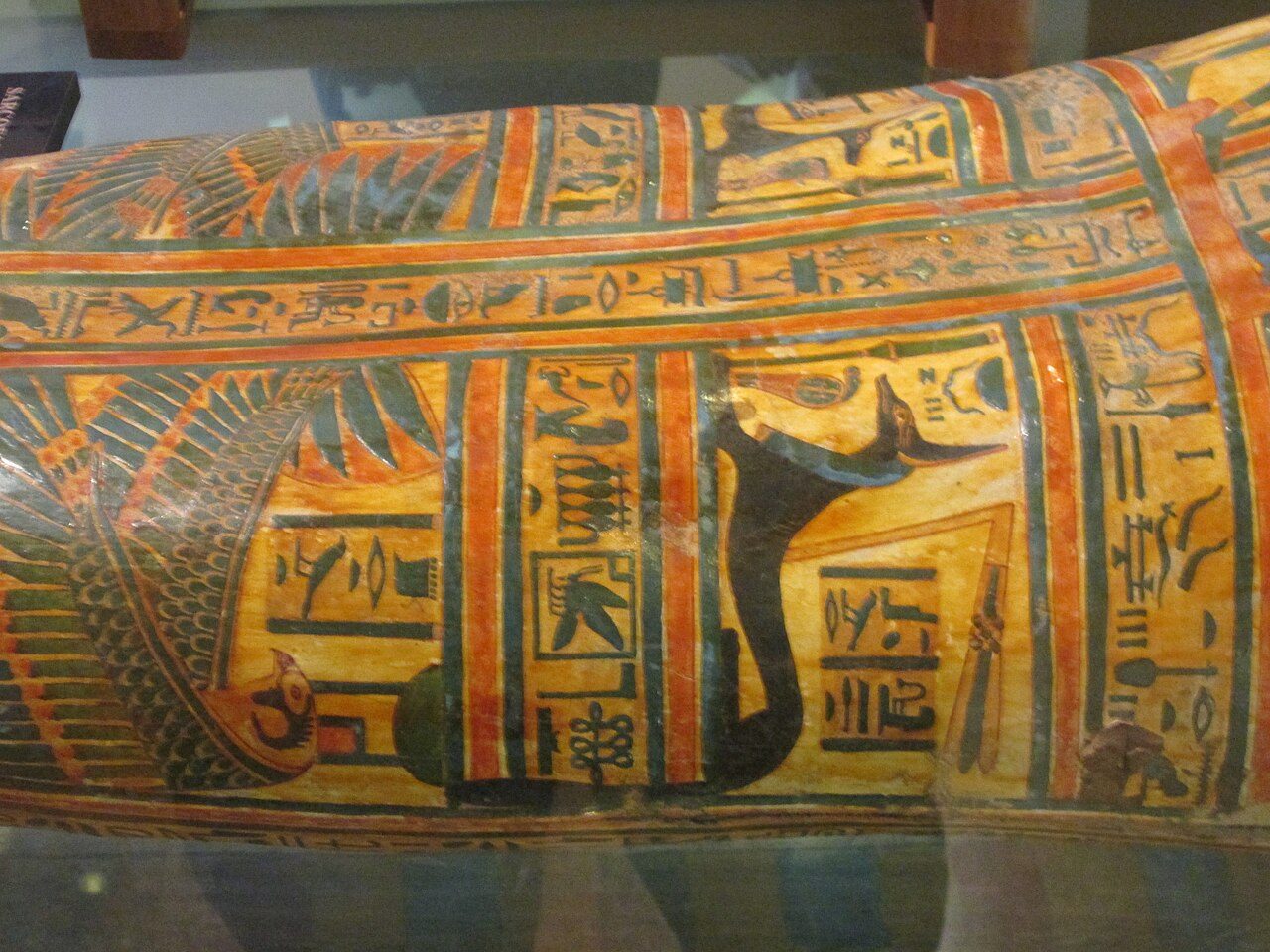
In the Egyptian room, in front of the painted coffin
An Egyptian mummy almost three thousand years old, preserved in its painted casing. Her name was Isiuret, she sang and played music for the gods of Thebes, and she died young. We know all this without ever unwrapping her.
Spot the detail
On the coffin, find the longest hieroglyphic inscriptions
The full story
Isiuret has had a test that nobody in her day could have imagined. In 1990 her mummy was given a CT scan, presented as the first ever performed on a mummy in Italy. The result: a woman who died between the ages of 18 and 30.
What you have in front of you is not a wooden coffin. It is a : layers of linen coated in plaster and carefully painted. The surface is a crowd of gods, each one accompanied by inscriptions calling for protection. The mummy is still inside, wrapped in its bandages.
Who Isiuret was
The longest inscriptions say who she was. The name means Isis the Great. She lived in the ninth century BC in Thebes, in the south of Egypt, and she was in the service of the gods: she played the for Amun, sang in the choir of the goddess Mut and was nurse to Khonsu the Child. Three roles, one for each of the city's gods.
From Thebes to Como
The journey to Como begins with a mix-up. In 1819 Muhammad Ali, the ruler of Egypt, gave the coffin to a certain Baldassarre Valerio, saying it came from the pyramids of Memphis. The titles written on it and the type of coffin tell of a different origin: Thebes.
Later it entered the collection of Alfonso Garovaglio, a nineteenth-century collector from Como. Most of the museum's thousand or so Egyptian objects come from his bequest.
The rest of the Egyptian room
The rest of the room is her world in miniature. The shabtis are the figurines that were meant to serve the dead in the afterlife. The scarabs were amulets of rebirth: the scarab hieroglyph means to become, to be renewed.
There are small bronzes of Osiris, Isis and their son Horus, and embalmed animals collected, back then, out of scientific curiosity. In the room you will also find medallions frescoed in the 1700s: a reminder that this was a room in the Giovio house long before it became Egypt.
More recently, working from the CT data, a laboratory at the University of Milan reconstructed the full figure of Isiuret, with clothes and ornaments remade together with costume designers and Egyptologists. In a museum full of objects without owners, she has a name, a job and an age.
About this stop
Anecdote
A mummy in the CT scanner
In the museum's Egyptian room lies the mummy of Isiuret, a priestess from Thebes who lived almost three thousand years ago, still sealed in her painted case. In 1990 she was given a CT scan: at the time it was presented as the first ever performed on a mummy in Italy. There was no need to unwrap her, and yet from that scan we know she died between the ages of 18 and 30. Almost twenty years later she left the museum for a year of restoration and analysis in a laboratory in Piedmont. The linen band wrapped around her is seven meters long. She came home in February 2010.
Because of one collector's passion. In the 1800s anyone who could afford it bought antiquities from every country: it was a way of studying the world, and also of getting noticed. Alfonso Garovaglio, a collector from Como, gathered Egyptian and Near Eastern antiquities: most of the museum's thousand or so Egyptian objects come from his bequest. Isiuret's coffin had been given in 1819 by the governor of Egypt to a certain Baldassarre Valerio, and later ended up in his collection. Then the collection was bequeathed to the city museum, where it remains.