Stop 3 of 8
Como's first people
Where to stand
In the prehistory and protohistory section, among the cases holding urns and grave goods from the tombs
Before the Romans, the hills around Como were home to a Celtic-speaking people who traded with Etruscans and Greeks. We know them mostly from their tombs: dozens of them, one display case after another.
Spot the detail
Among the vessels, find the ones with two or more arms, like small candelabra
The full story
The section starts a very long way back: the traces of the first humans who passed through here tens of thousands of years ago, including a cave above the town of Erba. Have a look, but do not linger. The heart of it is farther on, in the Iron Age, when something big happens around Como.
Archaeologists call it the Golasecca culture, after the village on the Ticino river where the first tombs surfaced in the 1800s. It covered a territory between Piedmont and Lombardy, from the Alps to the Po, and it had two centers: one on the Ticino, the other here.
On the hills of Como people lived without a break for seven centuries, from the eleventh to the fourth BC. They spoke a Celtic language. They are, in practice, the Celts of Italy before the Gauls.
A people known from tombs
What you will see of them is mostly tombs, and not out of a taste for the macabre. As so often with the earliest peoples, almost everything we know comes from the ; far less has come out of the settlement.
The rite was cremation: the ashes went into an urn, and vessels and ornaments were placed beside it. This set is known as the . Every display case is one set of grave goods, which is to say one person.
Look for three things. The tomb of the little cart, among the oldest. The Grandate lid, in embossed bronze: it is not local work, and it arrived from the Veneto area back in antiquity. And the with the doppieri, vessels with several arms and stamped decoration, the sign of a phase when someone here had started to do very well.
Between the Alps and Etruscans
The reason is location. Anyone living between the Alpine passes and the plain becomes a go-between for two worlds: to the north the peoples beyond the Alps, to the south the Etruscans and, behind them, the Greeks. In the fifth century BC the settlement at Como was at its height. Excavations of the houses have turned up Greek pottery and even a silver coin minted at Populonia, an Etruscan city on the coast of Tuscany.
Then, in the fourth century, the Gauls come down and another story begins. The last cases are warriors' tombs, from Valsassina and the Valle Intelvi, two valleys near the lake.
Keep one thing in mind: Como does not begin with Rome. By the time the Romans arrive, people here have been trading with half the Mediterranean for centuries.
About this stop
Yes, and for quite a while. On the hills southwest of the present city there was a settlement of the Golasecca culture, which lasted from the eleventh to the fourth century BC. In the fifth century it was at its height: it served as a go-between for the Etruscans and the peoples north of the Alps, and Greek pottery reached its houses. The Roman city came later, and since then Como has grown without a break on the same layout. The museum tells the story of the two cities one after the other.
Next stop
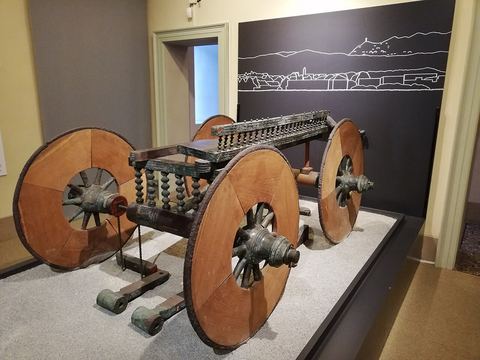
Carry on through the same section until you reach the large four-wheeled wagon