Stop 3 of 7Must-see
San Fermo, May 27, 1859
Where to stand
On the piano nobile, the main upper floor, in the small room devoted to 1859, in front of the large canvas at the center
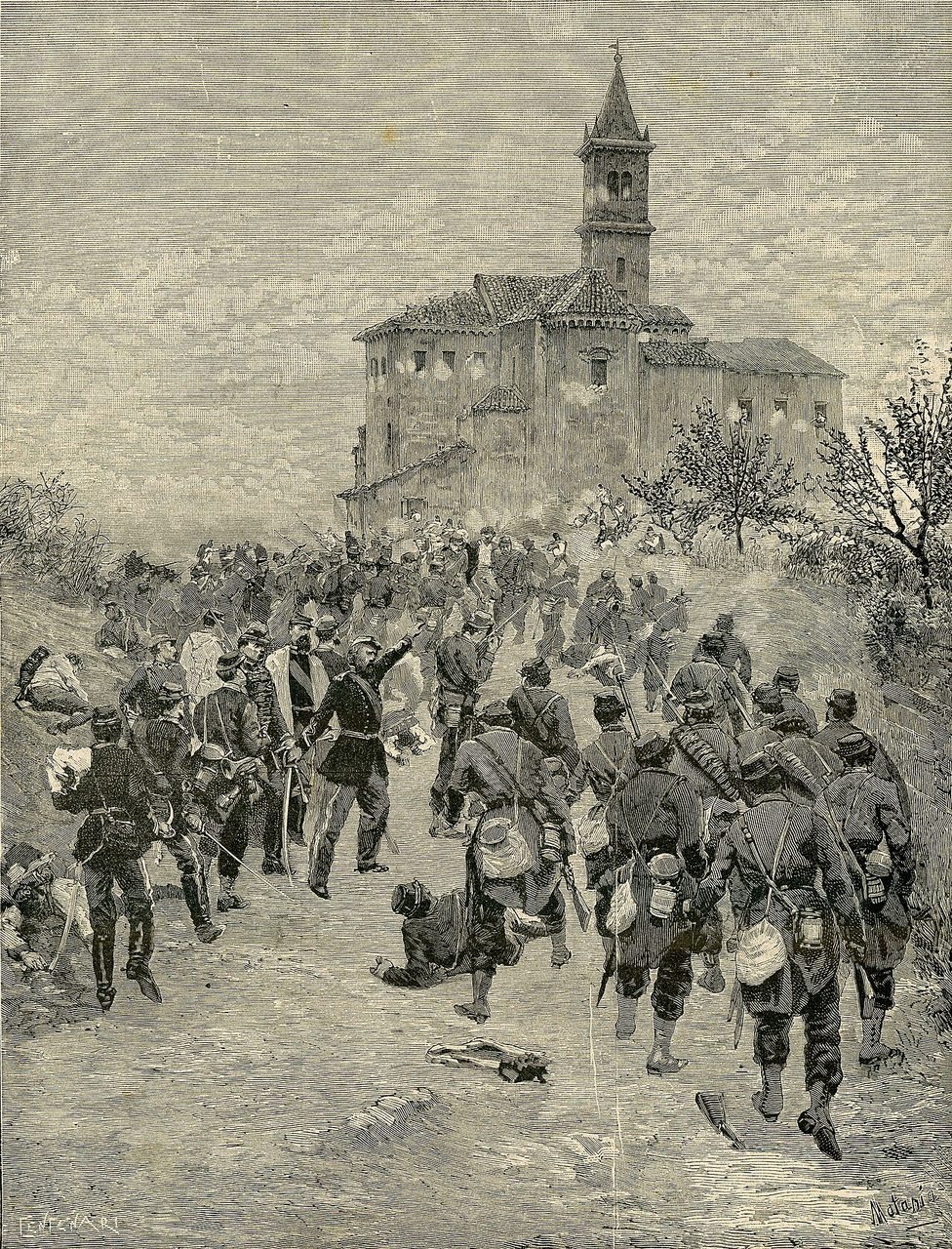
The battle that opened the gates of Como to Garibaldi, fought in the hills just outside town. At the center is the large canvas of the death of Captain De Cristoforis, who fell leading the attack. Around it, weapons and uniforms of the two armies.
Spot the detail
Among the paintings, find a painter who portrayed himself in uniform. What rank does he hold?
The full story
Stand in front of the large canvas at the center of the room. It is by Sebastiano De Albertis, a Milanese painter of battles, and it tells a true story: the death of Captain Carlo De Cristoforis at San Fermo, a village in the hills just outside Como.
The day of the battle
It is May 27, 1859, the Second War of Independence. Garibaldi commands the , the Hunters of the Alps, about three thousand volunteers with no cannon and no cavalry. Facing him are the Austrians of General Urban, about twice as many.
He arrives from Varese, sends one regiment south to fool the enemy, and takes the rest toward San Fermo. The attack was meant to start by surprise, at a signal shot. But someone fires too soon.
De Cristoforis, it seems, takes it for the signal, comes out onto the road with his company, and ends up under fire from the bell tower. He is hit in the abdomen and dies soon after, in the arms of his brother Malachia, an officer in the same corps. He was thirty-four. The Cacciatori charge with bayonets all the same, from three sides, and take the position.
De Cristoforis was no ordinary soldier. Milanese, a law graduate, convicted by the Austrians, he had studied the art of war in Paris and taught it in London. He left a book, published after his death, titled Che cosa sia la guerra, or What War Is.
Garibaldi enters Como
That same evening, at half past nine, Garibaldi enters Como through Porta Sala, the gate where the street that bears his name runs today. The Austrians leave through another gate, Porta Torre, and fall back toward Monza, leaving baggage and prisoners behind. The Cacciatori have lost thirteen men.
What the cases hold
Now move on to the display cases. Here are the of the two armies, Austrian and Piedmontese, mannequins in uniform, weapons, and objects gathered on the battlefields. Here are the volunteers' personal papers. And there is a series of color prints after drawings by the painter Bossoli, made for the Times of London: the 1859 campaign told to English readers, one episode after another.
The village of the battle was then called Vergosa. Since 1911 it has been called San Fermo della Battaglia, San Fermo of the Battle. Not many clashes get to change the name of a place.
About this stop
In culture
War Painted by Those Who Were There
In the Garibaldi Museum in Como, the rooms are also a small gallery of war painting. Sebastiano De Albertis, who painted the large canvas of the battle of San Fermo, won by Garibaldi in 1859 outside the city, studied at the Brera Academy in Milan, volunteered in the wars of independence, and from 1855 painted battle scenes. The painter Trezzini painted himself in the sergeant's uniform of the , Garibaldi's volunteers. The veteran Francesco Capiaghi painted the Austrian surrender of 1848, with carts bringing food to the starving troops. The prints after drawings by the painter Bossoli were made instead for readers of the Times of London.
A short, decisive battle, on May 27, 1859. Garibaldi, with about three thousand volunteers of the and not a single cannon, attacked the Austrians dug in on the hills outside Como. The bayonet charge succeeded, but it cost the lives of Captain Carlo De Cristoforis and twelve other men. Toward sunset the Austrians tried to come back up and were driven off. At half past nine that evening Garibaldi entered the city. The village, then called Vergosa, has been called San Fermo della Battaglia since 1911.
Next stop
Continue into the next room, the one with the red shirts