Stop 1 of 7Must-see
The Facade and Garibaldi's Plaque
Where to stand
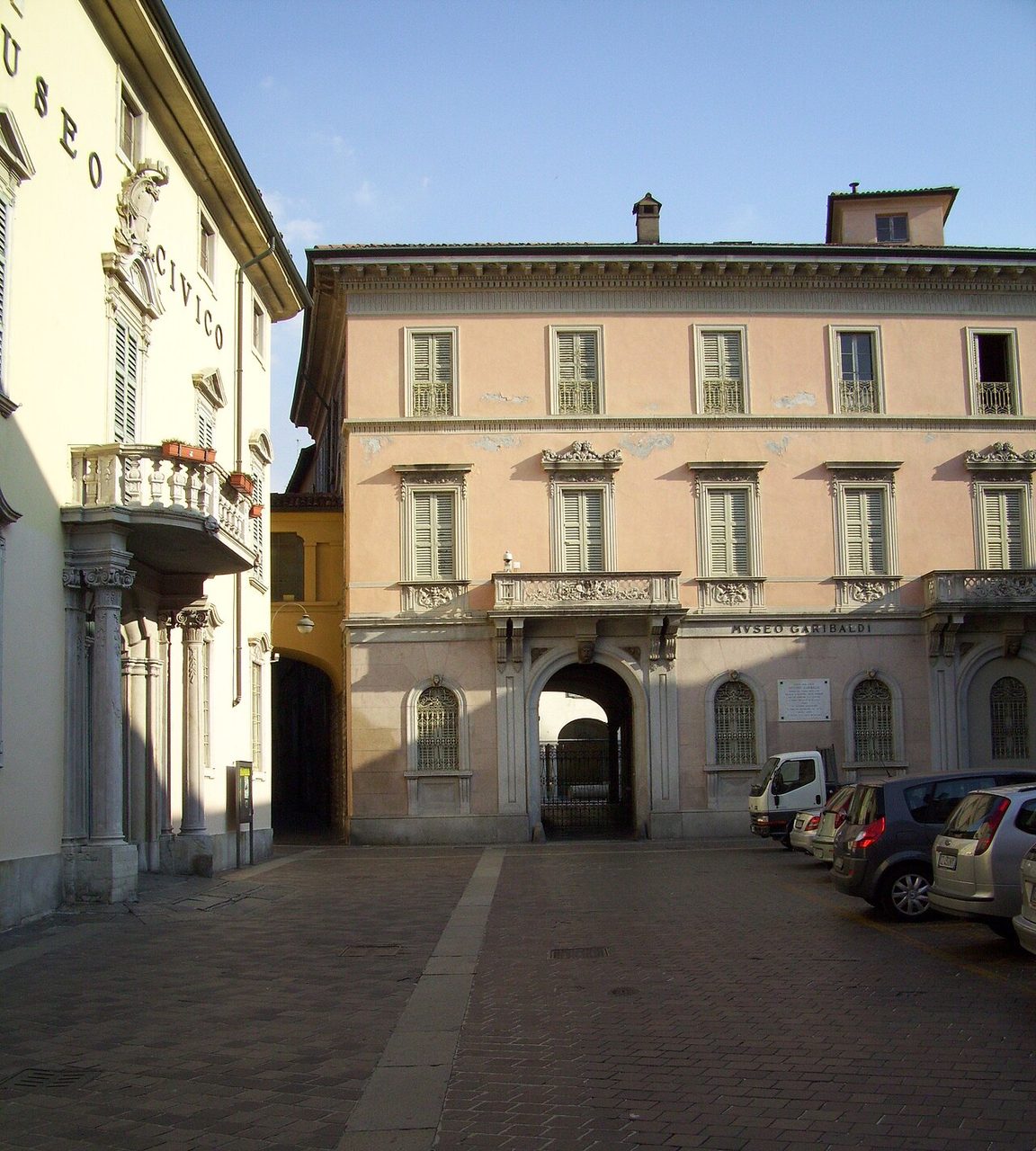
In Piazza Medaglie d'Oro, facing the pinkish facade of Palazzo Olginati, next to Palazzo Giovio
A 15th-century palazzo remodeled in the mid-1800s by Luigi Olginati. In 1866 it hosted Garibaldi, and that is why the last heir left it to the city: it was to become a museum bearing the General's name.
Spot the detail
Find the plaque on the facade: which year does it speak of?
The full story
Look at the facade before you go in. At the bottom there is , a facing of raised stone blocks that gives the ground floor a sturdy look. Above it, pinkish plaster, cut by horizontal bands.
Nothing showy. This is the sober elegance of a family that had no need to be noticed.
Now find the two small carved balconies, in sandstone from Viggiù and pink granite from Baveno, with stylized plant motifs. They sit above the two entrances. One of the entrances, though, is now walled up, and you go in through the other, along a vaulted passageway.
From the 1400s to the Olginati
The palazzo is older than it looks. It began in the 1400s as the home of the De Curte family, passed to the Della Torre di Rezzonico counts, and in the early 1800s came to the Olginati.
The look you see dates from 1853. It was the wish of Luigi Olginati, who sat on the city committee for the civic museum and had a taste for the antique: he ordered work that would give the house back the look of an earlier age. Restraint outside, richness inside: frescoes, stuccowork, wall hangings.
The guest of 1866
Thirteen years later came the guest who would change the fate of the house. 1866 is the year of the Third War of Independence, fought against Austria, and Como was one of the seven centers where the volunteers of Giuseppe Garibaldi were trained. The General came to town and stayed here.
The mayor wrote to Luigi Olginati to thank him for his hospitality. Garibaldi did the same, years later, from his island of Caprera. Those letters are still in the museum's archive.
The family did not forget. The last descendant, Carlotta, left the city the palazzo and everything in it, on condition that it become a museum named after Garibaldi, in memory of that stay. In her will she asked that the family's bookcases and historical documents be part of it too.
And so a private home became the place where Como keeps its memory. A tip before you go up: remember that you are entering a house.
The display cases with the uniforms came later. The owners, in their portraits, are still on the walls.
About this stop
Yes, in 1866: the plaque on the facade records it and the papers confirm it. The museum's archive has the letter in which the mayor of Como thanks Luigi Olginati for the hospitality offered to the General. There is also a letter from Garibaldi himself, written years later from Caprera, thanking Olginati for the hospitality he received. Which rooms he stayed in, the sources we consulted do not say. Be wary of anyone who points one out too confidently.
This stop on the map
Next stop
Go up to the piano nobile, the main upper floor, to the rooms facing the square, and look for the one devoted to 1848